
Causes of Screw Vibration in Screw Jacks During Operation
2026-04-27 14:35:54
Click:
“
Screw jacks are widely used in industrial applications for precise lifting, lowe
”
Screw jacks are widely used in industrial applications for precise lifting, lowering, and positioning of heavy loads. However, vibration of the screw rod during operation is a common issue that can compromise performance, accelerate wear, and even pose safety risks. This article explores the primary causes of screw vibration in screw jacks and provides practical solutions to mitigate these problems.
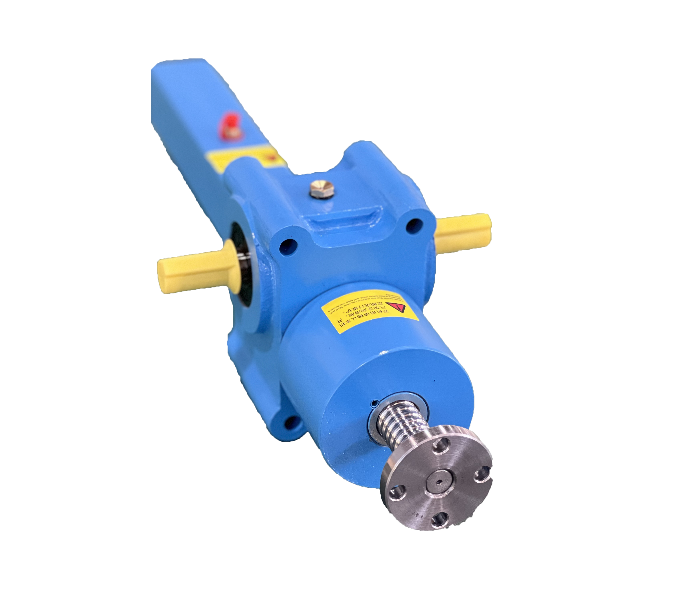
1. Installation and Alignment Issues
Improper Assembly Tolerance
If the worm gear and worm shaft are not manufactured or assembled with sufficient precision, irregular meshing can occur, leading to uneven force transmission and vibration. Similarly, misalignment between the screw rod and the nut—such as eccentricity or angular deviation—creates excessive friction and periodic impact forces, triggering vibrations.
Solution: Ensure high-precision machining of gear components and strict adherence to assembly tolerances. Regularly inspect and adjust the alignment of the screw rod and nut to maintain concentricity.
Loose Mounting or Foundation Instability
A dermail screw jack that is not securely fastened to its base or operates on an uneven surface may shift during lifting, causing dynamic imbalance. Additionally, loose anchor bolts or a weak supporting structure can amplify vibrations under load.
Solution: Verify that the equipment is mounted on a stable, level foundation. Tighten all bolts and use vibration-damping pads if necessary.
2. Load-Related Factors
Overloading or Eccentric Loading
Exceeding the rated load capacity forces the screw rod to bend slightly, disrupting smooth rotation and generating vibrations. Similarly, placing the load off-center creates uneven stress distribution, leading to lateral forces that induce oscillation.
Solution: Always operate within the specified load limits and ensure the load is centered. Use guiding mechanisms to prevent lateral movement of heavy or irregularly shaped loads.
Sudden Load Changes
Impact loads or rapid acceleration/deceleration can cause transient vibrations due to inertial forces.
Solution: Implement gradual speed adjustments and avoid abrupt starts/stops. Use soft-start motors or inverters to control acceleration profiles.
3. Component Wear and Defects
Worn Screw Rod or Nut
Prolonged use leads to wear on the screw thread or nut, increasing backlash (play between components). This backlash allows the screw to 'rattle' during rotation, especially under varying loads.
Solution: Replace worn components promptly. Consider using preloaded nuts or anti-backlash designs to minimize play.
Damaged Bearings
Bearings that support the screw rod or worm shaft may develop pitting, misalignment, or insufficient lubrication, causing irregular rotation and vibration.
Solution: Inspect bearings regularly for signs of wear or damage. Replace them with high-quality, properly lubricated bearings and ensure correct installation.
Bent Screw Rod
A bent screw rod—often caused by overloading, impact, or improper handling—creates unbalanced forces during rotation, leading to severe vibration.
Solution: Check the screw rod for straightness using a dial indicator. Replace bent components immediately.
4. Lubrication and Thermal Effects
Insufficient or Degraded Lubrication
Poor lubrication increases friction between the screw and nut, generating heat and causing uneven wear. This can lead to 'stick-slip' behavior, where the screw alternately sticks and slips, producing vibrations.
Solution: Use high-quality lubricants recommended by the manufacturer and adhere to a regular relubrication schedule. Monitor lubricant condition and replace it if contaminated or degraded.
Thermal Expansion
In high-temperature environments, thermal expansion of the screw rod or housing can alter clearances, leading to misalignment and vibration.
Solution: Select materials with low thermal expansion coefficients for critical components. Provide adequate cooling or ventilation to control operating temperatures.
5. External Vibrations and Resonance
Environmental Vibrations
Vibrations from nearby machinery, conveyors, or forklifts can transfer to the screw jack, exciting resonant frequencies in the system.
Solution: Isolate the screw jack from external vibration sources using vibration-damping mounts or flexible couplings.
Mechanical Resonance
If the operating speed of the screw jack matches its natural frequency, resonance occurs, amplifying vibrations.
Solution: Adjust the operating speed to avoid critical frequencies. In severe cases, modify the system’s stiffness or mass distribution to shift the natural frequency.
Conclusion
Screw vibration in screw jacks arises from a combination of installation errors, load conditions, component wear, lubrication issues, and external influences. By addressing these factors through precise assembly, proper load management, regular maintenance, and environmental controls, operators can significantly reduce vibration, enhance reliability, and extend the service life of screw jacks. For persistent vibration problems, consulting the manufacturer or a mechanical engineer is advisable to identify and resolve underlying issues.








Tel:+86-317-7369999
E-mail: demai@demai.org
Mobile:+86-18653450543 (Wechat)
Address:No. 6, Haihe Road, economic development zone, Wuqiao County, Cangzhou City, Hebei Province

点击右上角
分享给朋友吧
Copyright ©2023 All Rights Reserved Hebei Demai Transmission Machinery Co.,Ltd.
Copyright ©2025 All Rights Reserved Hebei Demai Transmission Machinery Co.,Ltd.
