
How to Improve the Efficiency of Hand-Operated Screw Jacks
2026-04-07 09:27:21
Click:
“
This article explores practical strategies to enhance the efficiency of hand-operated screw jacks, ensuring smoother operation, reduced labor, and extended service life.
”
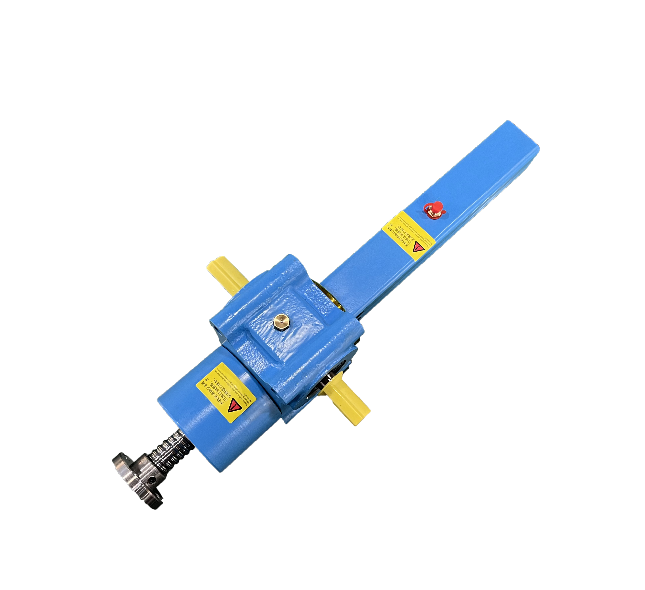
Hand-operated screw jacks are essential mechanical devices for lifting, lowering, or positioning loads in industrial, construction, and logistics applications. However, their efficiency—defined as the ratio of useful work output to input energy—is often limited by factors such as friction, mechanical design, and operational conditions. This article explores practical strategies to enhance the efficiency of hand-operated screw jacks, ensuring smoother operation, reduced labor, and extended service life.
1. Optimize Screw Thread Design
The screw thread is the core component influencing efficiency. Key considerations include:
- Thread Type Selection:
- Trapezoidal threads (e.g., Tr20×4) are common but generate high sliding friction, reducing efficiency to 30–50%.
- Ball screws, which replace sliding friction with rolling friction via recirculating balls, achieve 90%+ efficiency but are costlier.
- Acme threads offer a balance between cost and efficiency, suitable for moderate-load applications.
- Pitch and Lead Angle:
- Increasing the pitch (distance between threads) reduces the number of rotations needed to lift a load but may lower self-locking ability.
- Optimal lead angles (typically 5–15°) minimize friction while maintaining stability. For example, a 10° lead angle with a low-friction coating can reduce input torque by 20–30%.
- Material and Surface Finish:
- Use hardened steel (e.g., 45# steel) for threads to resist wear.
- Apply surface treatments like nitriding or diamond-like carbon (DLC) coatings to reduce friction coefficients (μ) from 0.15 (untreated steel) to 0.05–0.08.
2. Reduce Friction Through Lubrication
Friction accounts for 50–70% of energy loss in screw jacks. Effective lubrication strategies include:
- Lubricant Selection:
- Lithium-based greases (e.g., NLGI Grade 2) provide long-lasting protection in moderate temperatures.
- Synthetic oils (e.g., PAO) excel in extreme cold or high-speed applications.
- Solid lubricants (e.g., molybdenum disulfide, MoS₂) reduce friction to μ < 0.04 under heavy loads.
- Lubrication Method:
- Automatic grease systems ensure consistent coverage, extending maintenance intervals.
- For open-type jacks, manual reapplication every 50–100 operating hours is recommended.
- Sealing Design:
- Use O-rings or labyrinth seals to prevent contaminants (dust, moisture) from degrading lubricants.
- Use O-rings or labyrinth seals to prevent contaminants (dust, moisture) from degrading lubricants.
3. Enhance Gear Transmission Efficiency
Most screw jacks incorporate gear reducers (e.g., worm gears, bevel gears) to amplify torque. Improvements include:
- High-Efficiency Gear Materials:
- Replace bronze worm gears with self-lubricating polymer composites (e.g., POM + PTFE), reducing friction by 40%.
- Use case-hardened steel for pinions to minimize wear.
- Precision Machining:
- Maintain gear tooth accuracy (e.g., AGMA Grade 10) to reduce backlash and meshing losses.
- Optimal Gear Ratio:
- A 20:1 gear ratio may require fewer handle rotations but increases internal friction. Balance speed and efficiency based on load requirements.
- A 20:1 gear ratio may require fewer handle rotations but increases internal friction. Balance speed and efficiency based on load requirements.
4. Improve Structural Rigidity
Deflection or misalignment in the jack’s frame or screw can increase friction and energy loss:
- Material Upgrade:
- Use high-strength aluminum alloys (e.g., 7075-T6) or carbon steel (e.g., AISI 1045) for critical components.
- Finite Element Analysis (FEA):
- Simulate stress distribution to identify and reinforce weak points (e.g., bearing housings).
- Alignment Maintenance:
- Regularly check and adjust the parallelism between the screw and nut to prevent binding.
- Regularly check and adjust the parallelism between the screw and nut to prevent binding.
5. Optimize Operational Practices
Human factors and usage patterns also impact efficiency:
- Ergonomic Handle Design:
- Extend the handle length to increase leverage (e.g., from 300mm to 500mm reduces input force by 40%).
- Add non-slip grips to minimize hand fatigue during prolonged use.
- Smooth Operation:
- Avoid abrupt starts/stops to reduce inertial losses.
- Train operators to maintain a steady rotation speed (e.g., 10–15 RPM).
- Load Distribution:
- Center the load to prevent eccentric forces that increase friction.
- Use leveling feet or anti-vibration mounts to stabilize the jack on uneven surfaces.
6. Advanced Technologies (Optional)
For high-performance applications:
- Electric Assist Modules:
- Retrofit a small electric motor (e.g., 100W brushless DC) to the handle for semi-automated operation.
- Smart Sensors:
- Install torque sensors to monitor efficiency in real time and alert users to maintenance needs.
- Install torque sensors to monitor efficiency in real time and alert users to maintenance needs.
Case Study: Efficiency Gains in a Warehouse Lifting System
A logistics company replaced traditional trapezoidal-thread jacks with ball-screw models and synthetic lubricants. Results included:
- Input torque reduction: From 25 Nm to 8 Nm (68% decrease).
- Operation time per lift: From 45 seconds to 18 seconds.
- Maintenance interval extension: From 3 months to 12 months.
Conclusion
Improving the efficiency of dermail hand-operated screw jacks requires a holistic approach, combining thread optimization, friction reduction, structural upgrades, and smart operation. By implementing these strategies, users can achieve significant energy savings, lower operational costs, and enhanced reliability. For maximum impact, prioritize low-friction components (e.g., ball screws) and proactive maintenance (e.g., automated lubrication).
Keywords: Screw jack, Hand-Operated Screw Jacks, dermail








Tel:+86-317-7369999
E-mail: demai@demai.org
Mobile:+86-18653450543 (Wechat)
Address:No. 6, Haihe Road, economic development zone, Wuqiao County, Cangzhou City, Hebei Province

点击右上角
分享给朋友吧
Copyright ©2023 All Rights Reserved Hebei Demai Transmission Machinery Co.,Ltd.
Copyright ©2025 All Rights Reserved Hebei Demai Transmission Machinery Co.,Ltd.
