
How to Realize Anti-Rotation Function in Screw Jacks
2026-04-06 08:59:42
Click:
“
This anti-rotation function ensures stable operation, accurate positioning, and safe load bearing. Below is a detailed introduction to the common anti-rotation structures and implementation principles of screw jacks.
”
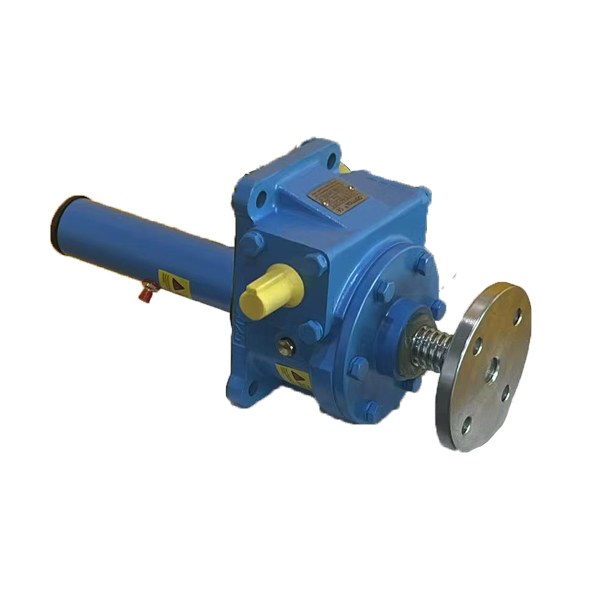
Screw jacks are widely applied in lifting, pushing, pulling, and positioning scenarios across machinery, construction, automation, and metallurgy industries. In many working conditions, pure linear lifting motion is required while any radial rotation of the lifting screw must be completely eliminated. This anti-rotation function ensures stable operation, accurate positioning, and safe load bearing. Below is a detailed introduction to the common anti-rotation structures and implementation principles of screw jacks.
Key Reasons for Needing Anti-Rotation
During operation, the lead screw of a standard screw jack tends to rotate synchronously with the internal worm gear or bevel gear, failing to achieve pure up-and-down linear movement. Rotation will cause load deflection, reduced positioning accuracy, equipment wear, and even safety hazards. Therefore, anti-rotation design is essential for applications requiring strict linear motion.
Common Anti-Rotation Structures and Principles
1. Square Guide Rod Anti-Rotation This is the most universal and cost-effective structure. The lifting screw is processed into a **square or hexagonal cross-section** at the extending end, matching a fixed square guide sleeve installed on the top of the jack body. When the transmission mechanism drives the screw to move vertically, the square profile is constrained by the sleeve, completely restricting radial rotation while allowing smooth linear displacement. It is suitable for medium and small load screw jacks with general precision requirements. ###
2. Keyway & Guide Key Anti-Rotation A rectangular keyway is milled along the axial direction of the lifting screw, and a fixed guide key is assembled inside the jack housing. The guide key slides along the keyway during screw lifting, blocking rotational torque. This structure features high concentricity and stable motion, suitable for precision lifting equipment with high positioning requirements, such as automated production lines and precision testing machines.
3. External Anti-Rotation Bracket & Guide Rail For heavy-duty and large-stroke screw jacks, an independent external guide rail system is configured. The lifting screw is connected to a moving platform fixed on linear guide rails or polished rods. The guide rail system bears all rotational force and ensures vertical linearity. It is widely used in high-load scenarios such as hydraulic lifting platforms, metallurgical machinery, and large-scale assembly equipment, with strong stability and durability.
4. Anti-Rotation Nut Structure Part of the screw jack adopts a specially designed anti-rotation nut assembly. The nut is connected with a limit pin or anti-rotation plate fixed on the jack body. When the screw moves, the nut is locked and cannot rotate, thus driving the screw for linear lifting without spinning. This integrated structure is compact and reliable, ideal for screw jacks with limited installation space.
5. Double Lead Screw Anti-Rotation For high-precision and heavy-load synchronous lifting systems, double parallel screws are adopted, with one screw responsible for lifting and the other serving as a guide rod to restrict rotation. This dual-screw structure greatly improves anti-torsion performance and overall rigidity, often used in multi-point synchronous lifting projects.
Selection Suggestions for Anti-Rotation Solutions
Light load & general purpose: Square guide rod anti-rotation is preferred for its low cost and easy maintenance. -
High precision & compact layout: Choose keyway and guide key structure.
Heavy load & large stroke: Adopt external guide rail anti-rotation system.
Multi-point synchronous lifting: Use double lead screw or integrated anti-rotation nut design.
Conclusion The anti-rotation function is a critical guarantee for the stable performance of screw jacks. Different anti-rotation mechanisms are designed to adapt to diverse loads, strokes, precision demands and installation environments. Selecting a suitable anti-rotation structure can effectively improve motion accuracy, extend service life, and ensure safe and reliable operation of the equipment in industrial applications.








Tel:+86-317-7369999
E-mail: demai@demai.org
Mobile:+86-18653450543 (Wechat)
Address:No. 6, Haihe Road, economic development zone, Wuqiao County, Cangzhou City, Hebei Province

点击右上角
分享给朋友吧
Copyright ©2023 All Rights Reserved Hebei Demai Transmission Machinery Co.,Ltd.
Copyright ©2025 All Rights Reserved Hebei Demai Transmission Machinery Co.,Ltd.
