
Key Considerations for Using Nut-Driven Screw Jacks
2026-03-23 08:23:14
Click:
“
Screw jacks are widely used in industrial automation, material handling, and precision positioning systems due to their high load capacity, compact design, and reliable linear motion control.
”
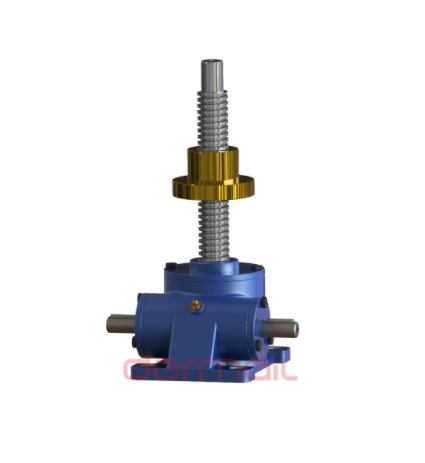
Screw jacks are widely used in industrial automation, material handling, and precision positioning systems due to their high load capacity, compact design, and reliable linear motion control. Among various configurations, the nut-driven screw jack—where the screw remains stationary while the nut translates along its axis—offers unique advantages in specific applications. However, this design also introduces distinct challenges that require careful attention during selection, installation, and operation. This article outlines critical considerations for ensuring optimal performance and safety when using nut-driven screw jacks.
1. Mechanical Design Optimization
1.1 Nut-Screw Interface Precision
The clearance between the nut and screw threads directly impacts system stability. Excessive clearance causes vibration, noise, and backlash, while insufficient clearance leads to binding or increased friction. For trapezoidal screws, typical clearance ranges from 0.01–0.03 mm, whereas ball screws require tighter tolerances (e.g., P-class precision) to minimize axial play. Preloading mechanisms, such as double-nut configurations with spring washers, can eliminate backlash and enhance repeatability in high-precision applications like semiconductor manufacturing or CNC machining.
1.2 Guidance System Integration
Nut-driven systems necessitate external guidance to restrict rotational movement and ensure pure linear translation. Linear guides (e.g., HGH-series profiled rail systems) or round shafts with bushings are commonly used. Key design parameters include:
- Guide spacing: Maintain a ratio of guide span to screw diameter ≥1.8 to minimize deflection under side loads.
- Alignment accuracy: Ensure coaxiality between the screw and drive shaft ≤φ0.05 mm and perpendicularity ≤0.05°/1000 mm to prevent premature wear.
- Rigidity: Select guides with sufficient load ratings to resist bending moments, especially in long-stroke applications.
1.3 Anti-Reverse and Self-Locking Mechanisms
Trapezoidal screws inherently provide self-locking due to their high friction angle, preventing nut backdriving under static loads. For non-self-locking ball screws, incorporate electromagnetic brakes or spring-loaded pawls to hold positions during power failures or emergency stops. This is critical in vertical-lift systems like elevator platforms or robotic arms to avoid catastrophic drops.
2. Material Selection and Heat Treatment
2.1 Screw Material
- High-load scenarios: Opt for alloy steels (e.g., 40Cr, 42CrMo) with quenching and tempering (HRC 28–32) followed by surface hardening (e.g., induction hardening to HRC 55–60) for wear resistance.
- Corrosive environments: Use stainless steel (304/316L) or apply coatings like nickel plating or ceramic layers to extend service life.
2.2 Nut Material
- Bronze nuts: Suitable for low-speed, heavy-duty applications (e.g., press machines) due to their self-lubricating properties.
- Plastic nuts: Polymer materials (e.g., POM, PA66) reduce noise and weight but are limited to temperatures ≤80°C and light loads.
- Ball screw nuts: Made from high-carbon chromium bearing steel (GCr15) with quenching to HRC 60–64 for durable ball circulation channels.
3. Installation and Commissioning
3.1 Alignment and Preload Adjustment
- Use laser alignment tools or dial indicators to achieve coaxiality and perpendicularity within specified tolerances.
- For double-nut systems, adjust preload to 10–15% of the axial load using shims or compression springs. Excessive preload increases friction and heat, while insufficient preload compromises accuracy.
3.2 Lubrication Strategy
- Grease: Lithium-based grease (NLGI 2) is ideal for moderate-speed applications, with relubrication intervals every 500 operating hours.
- Oil: For high-speed operation (>1000 RPM), implement forced lubrication (e.g., oil mist or circulating oil systems) to prevent localized overheating.
- Sealing: Install bellow boots or labyrinth seals to protect against contaminants, especially in dusty environments like foundries or cement plants.
4. Operational Monitoring and Maintenance
4.1 Load and Speed Management
- Avoid dynamic loads exceeding 80% of the rated capacity to prevent screw bending or nut failure.
- Monitor operating temperatures; if the screw surface exceeds 70°C, investigate lubrication or cooling issues.
4.2 Periodic Inspection
- Inspect threads for wear, pitting, or cracks every 2000 operating hours. Replace components if thread height reduction exceeds 10%.
- For ball screws, check for ball breakage or jamming in the return tube, which may indicate contamination or improper preload.
4.3 Environmental Adaptation
- In humid conditions, apply rust-preventive coatings (e.g., WD-40) and use corrosion-resistant materials.
- For cleanroom applications, select non-lubricated plastic nuts or sealed ball screws to minimize particle generation.
5. Safety Enhancements
5.1 Limit Switches and Overload Protection
- Install proximity sensors at travel endpoints to prevent nut overrun.
- Use torque limiters or current monitoring to halt operation if loads exceed 110% of the rated value.
5.2 Emergency Braking
- Vertical installations require fail-safe brakes with response times ≤200 ms and braking torque ≥1.5× the rated load torque.
- Regularly test brake functionality during maintenance cycles.
5.3 Operator Training
- Train personnel on proper startup/shutdown procedures and emergency protocols to avoid shock loads or collisions.
- Conduct simulated failure drills (e.g., nut jamming, screw fracture) to ensure rapid response.
6. Case Study: Automated Warehouse Shuttle System
A nut-driven ball screw jack was deployed in an automated storage/retrieval system (AS/RS) for high-speed pallet positioning. Key design features included:
- Preloaded double-nut assembly with 0.005 mm axial clearance for ±0.1 mm positioning accuracy.
- HGH35CA linear guides spaced at 1.5× the screw diameter to resist 2-ton lateral loads during acceleration.
- Forced oil lubrication with temperature sensors to maintain optimal operating conditions at 1.2 m/s.
The system achieved 99.98% uptime over 3 years, demonstrating the effectiveness of proper nut-driven screw jack implementation.
Conclusion
Nut-driven screw jacks offer a versatile solution for precision linear motion, but their performance hinges on meticulous design, material selection, and maintenance. By addressing clearance control, guidance rigidity, lubrication, and safety mechanisms, engineers can maximize system reliability and lifespan across diverse industrial applications. Regular monitoring and adherence to operational guidelines further ensure safe, efficient, and cost-effective performance.








Tel:+86-317-7369999
E-mail: demai@demai.org
Mobile:+86-18653450543 (Wechat)
Address:No. 6, Haihe Road, economic development zone, Wuqiao County, Cangzhou City, Hebei Province

点击右上角
分享给朋友吧
Copyright ©2023 All Rights Reserved Hebei Demai Transmission Machinery Co.,Ltd.
Copyright ©2025 All Rights Reserved Hebei Demai Transmission Machinery Co.,Ltd.
