
Differences of Screw Jacks and Electric Linear Actuators
2025-12-23 10:20:09
Click:
“
In the realm of mechanical transmission and linear motion systems, worm gear screw jacks and electric linear actuators are two widely used devices. While both serve the purpose of converting rotational motion into linear motion
”
In the realm of mechanical transmission and linear motion systems, worm gear screw jacks and electric linear actuators are two widely used devices. While both serve the purpose of converting rotational motion into linear motion, they differ significantly in design, performance, and application scenarios. This article explores their key differences and outlines their respective scopes of use.
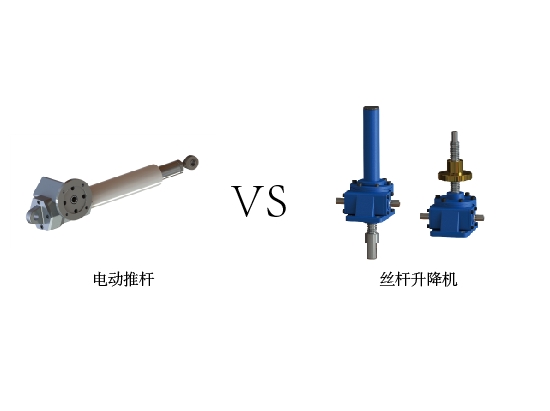
1. Structural Differences
1.1 Worm Gear Screw Jack
A worm gear screw jack consists of a worm gear reducer and a screw-nut mechanism. The worm gear drives the screw to rotate or the nut to move axially, achieving linear motion. It typically features an open structure, requiring additional protective covers or dust seals for environmental protection. The screw is often made of low-carbon alloy steel with anti-corrosion coatings for durability.
1.2 Electric Linear Actuator
An electric linear actuator integrates a worm gear or gear transmission system with a screw-nut mechanism inside a protective casing. It includes components such as an outer tube, guide bushing, and dust-proof seals, forming a closed-loop system. The outer casing is usually made of high-strength aluminum alloy with hard anodizing treatment for enhanced corrosion resistance and aesthetic appeal.
2. Performance Comparison
2.1 Transmission Efficiency
- Worm Gear Screw Jack: The sliding friction between the worm gear and screw results in lower efficiency (30%-60% for standard models, up to 90%+ for ball screw variants).
- Electric Linear Actuator: Gear or ball screw transmissions offer higher efficiency (80%-95%), reducing energy consumption.
2.2 Self-Locking Capability
- Worm Gear Screw Jack: Trapezoidal screw models inherently self-lock, preventing unintended movement under load. Ball screw variants require additional braking mechanisms.
- Electric Linear Actuator: Worm gear-driven models self-lock, while ball screw types need external brakes for safety.
2.3 Environmental Protection
- Worm Gear Screw Jack: Open design necessitates external protection (e.g., IP54 covers), limiting use in harsh environments.
- Electric Linear Actuator: Closed casing provides high IP ratings (IP66+), making it suitable for dusty, wet, or corrosive conditions.
2.4 Installation Flexibility
- Worm Gear Screw Jack: Typically mounted on flat surfaces with limited angular adjustment.
- Electric Linear Actuator: Supports multi-angle installation via tail-pin mounts, enhancing adaptability.
2.5 Load Capacity and Side Force Resistance
- Worm Gear Srew Jack: Lower side force resistance; requires additional guides for heavy loads.
- Electric Linear Actuator: Stronger side force tolerance due to rigid outer casing, ideal for lateral loads.
2.6 Noise Level
- Worm Gear Screw Jack: Higher noise due to sliding friction.
- Electric Linear Actuator: Quieter operation with gear or ball screw transmissions.
3. Application Scopes
3.1 Worm Gear Screw Jack
- Industrial Automation: Used in assembly lines, workpiece positioning, and clamping systems.
- Construction: Lifting platforms, construction elevators, and curtain wall installation equipment.
- Medical Equipment: Adjustable surgical tables and hospital beds.
- Stage Machinery: Lighting rigs and stage lifts.
- Advantages: Compact design, versatile power sources (electric/manual), and cost-effectiveness.
3.2 Electric Linear Actuator
- Food & Pharmaceutical Industries: High-hygiene requirements (e.g., sterile workshop lifting tables).
- Home Automation: Electric sofas, adjustable desks, and smart curtains.
- Industrial Fields: AGVs (Automated Guided Vehicles), new energy equipment, and automated production lines.
- Special Environments: Marine, chemical, and agricultural applications requiring dust/water resistance.
- Advantages: High protection ratings, flexible installation, and durability in harsh conditions.
4. Conclusion
Dermail transmission worm gear screw jacks excel in cost-sensitive, medium-load applications with moderate environmental requirements, while electric linear actuators dominate high-precision, high-protection scenarios demanding reliability and adaptability. Selecting the right device depends on factors such as load capacity, environmental conditions, installation constraints, and budget. By understanding their differences, engineers can optimize system design for efficiency and longevity.








Tel:+86-317-7369999
E-mail: demai@demai.org
Mobile:+86-18653450543 (Wechat)
Address:No. 6, Haihe Road, economic development zone, Wuqiao County, Cangzhou City, Hebei Province

点击右上角
分享给朋友吧
Copyright ©2023 All Rights Reserved Hebei Demai Transmission Machinery Co.,Ltd.
Copyright ©2025 All Rights Reserved Hebei Demai Transmission Machinery Co.,Ltd.
