
Achieving Synchronous Operation in Multi-Screw Jack Linkage Systems
2025-12-19 08:49:33
Click:
“
In industrial applications that demand precise vertical movement, such as heavy-duty lifting platforms, large-scale stage setups, and automated material handling systems, the use of multiple screw jacks working in tandem is commonplace.
”
In industrial applications that demand precise vertical movement, such as heavy-duty lifting platforms, large-scale stage setups, and automated material handling systems, the use of multiple screw jacks working in tandem is commonplace. However, ensuring that these individual screw jacks operate in perfect synchrony is crucial for the overall performance, safety, and longevity of the system. This article delves into the strategies and mechanisms employed to achieve synchronous operation when multiple screw jacks are linked together.
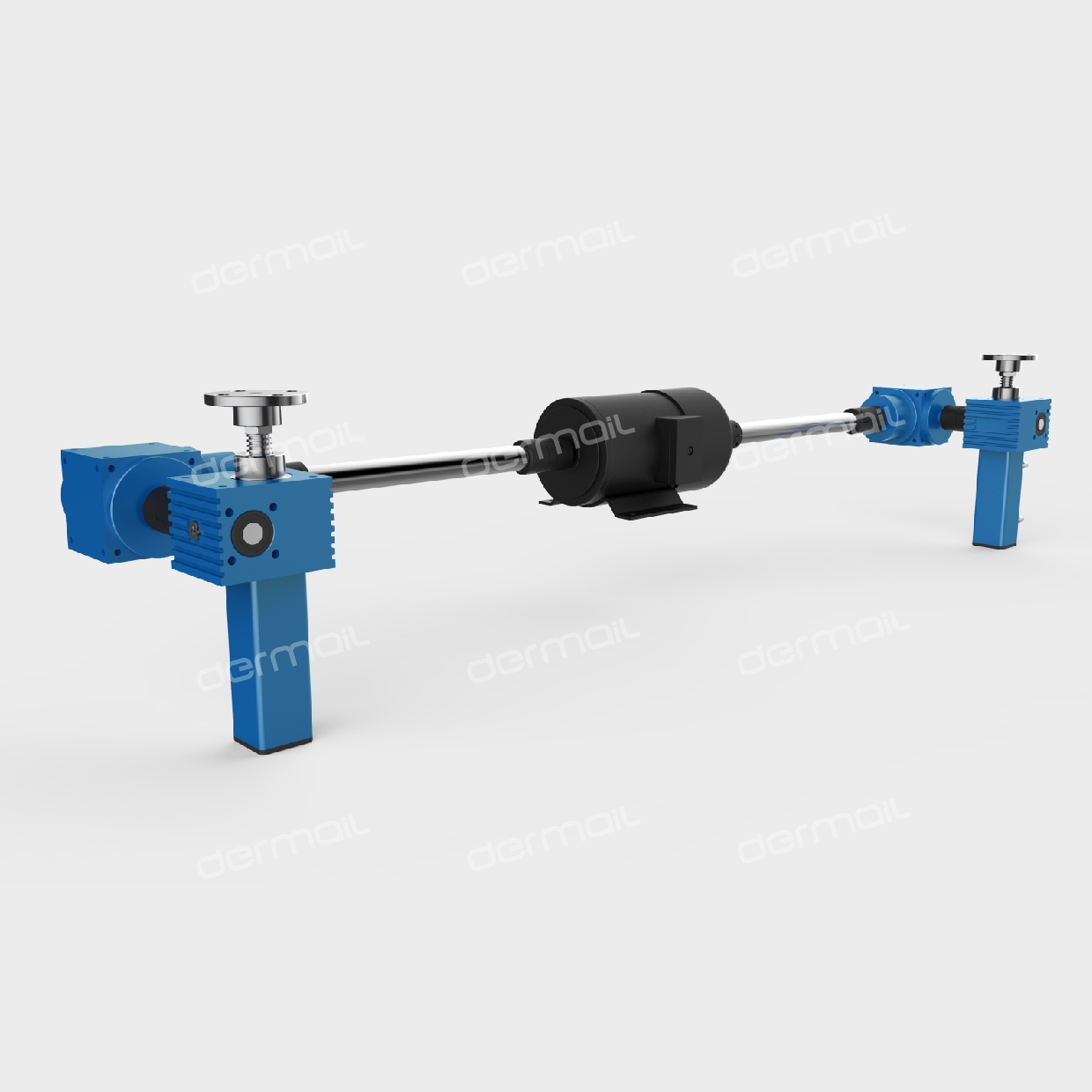
Understanding the Basics of Screw Jacks
Before exploring synchronization techniques, it's essential to grasp the fundamental operation of a screw jack. A screw jack is a mechanical device that converts rotational motion into linear motion through the use of a worm gear and a lifting screw. The worm gear, driven by an electric motor or manual input, rotates the screw, which in turn moves a load vertically. When multiple screw jacks are used in a system, they must move at the same rate to prevent uneven lifting, which can lead to structural stress, misalignment, and potential safety hazards.
Mechanical Synchronization Methods
1. Direct Mechanical Coupling
One of the simplest and most reliable methods for synchronizing multiple screw jacks is through direct mechanical coupling. This involves connecting the output shafts of the screw jacks using rigid couplings, such as flange couplings or universal joints. By physically linking the screw jacks together, any rotational movement applied to one jack is directly transferred to the others, ensuring they rotate at the same speed and, consequently, move the load uniformly. This method is highly effective for applications where the screw jacks are in close proximity and the loads are evenly distributed.
2. Chain or Belt Drives
For applications where direct coupling is impractical due to distance or layout constraints, chain or belt drives can be employed. These systems use chains or belts to connect the output shafts of the screw jacks, transmitting rotational motion from a single driving source to multiple driven jacks. Chain drives are more suitable for heavy-duty applications, offering high torque transmission and durability, while belt drives are quieter and require less maintenance but may not be as robust for very high loads. Both methods require precise tensioning and alignment to ensure smooth operation and synchronization.
Electrical Synchronization Techniques
1. Motor Synchronization with Variable Frequency Drives (VFDs)
In modern automated systems, electrical synchronization is often achieved using variable frequency drives (VFDs) to control the speed of the electric motors driving the screw jacks. Each screw jack is equipped with its own motor, and the VFDs are programmed to adjust the motor speeds based on feedback from sensors that monitor the position or speed of each jack. By continuously comparing the actual positions or speeds of the jacks and making real-time adjustments, the VFDs can maintain synchronization even under varying loads or during acceleration and deceleration phases. This method offers high precision and flexibility, allowing for fine-tuning of the synchronization parameters.
2. Servo Motor Control Systems
For applications demanding the highest level of precision and responsiveness, servo motor control systems are the preferred choice. Servo motors are equipped with built-in encoders that provide highly accurate position feedback to the motor controller. When multiple servo motors are used to drive screw jacks, the controllers can communicate with each other through a network, sharing position data and adjusting the motor outputs to ensure that all jacks move in perfect unison. This closed-loop control system can compensate for even the slightest discrepancies in motor performance or load distribution, making it ideal for applications such as precision machining, robotics, and high-end stage equipment.
Software-Based Synchronization Solutions
1. PLC-Based Control Systems
Programmable logic controllers (PLCs) are widely used in industrial automation to control and monitor complex processes. When it comes to synchronizing multiple screw jacks, a PLC can be programmed to receive input from various sensors, such as position encoders or load cells, and use this data to control the operation of the motors driving the jacks. The PLC can implement sophisticated algorithms to calculate the required motor speeds or positions and send control signals to the motor drivers, ensuring that all jacks move in a coordinated manner. This approach offers a high degree of flexibility and can be easily adapted to different system configurations and operating conditions.
2. Centralized Control Software
In large-scale systems with a large number of screw jacks, a centralized control software running on a dedicated computer or industrial PC can be used to manage the synchronization. This software can interface with multiple motor controllers or PLCs, collecting data from all the sensors in the system and performing complex calculations to determine the optimal motor outputs for synchronization. The software can also provide a user-friendly interface for operators to monitor the system status, adjust synchronization parameters, and troubleshoot any issues that may arise. This centralized approach simplifies system management and allows for easy integration with other industrial automation systems, such as enterprise resource planning (ERP) or manufacturing execution systems (MES).
Conclusion
Achieving synchronous operation in dermail transmission multi-screw jack linkage systems is essential for ensuring the performance, safety, and reliability of industrial applications that rely on precise vertical movement. Whether through mechanical coupling, electrical control techniques, or software-based solutions, there are a variety of methods available to suit different system requirements and operating conditions. By carefully selecting and implementing the appropriate synchronization strategy, engineers and system designers can create robust and efficient systems that meet the most demanding performance standards. As technology continues to advance, we can expect to see even more sophisticated and intelligent synchronization solutions emerge, further enhancing the capabilities of multi-screw jack systems in the future.








Tel:+86-317-7369999
E-mail: demai@demai.org
Mobile:+86-18653450543 (Wechat)
Address:No. 6, Haihe Road, economic development zone, Wuqiao County, Cangzhou City, Hebei Province

点击右上角
分享给朋友吧
Copyright ©2023 All Rights Reserved Hebei Demai Transmission Machinery Co.,Ltd.
Copyright ©2025 All Rights Reserved Hebei Demai Transmission Machinery Co.,Ltd.
