
Comparative Analysis: Bevel Gear vs. Worm Gear in Screw Jacks
2025-12-04 13:47:03
Click:
“
Screw jack systems are critical components in industrial machinery, automotive engineering, and military applications, enabling precise vertical motion control through mechanical power transmission.
”
Screw jack systems are critical components in industrial machinery, automotive engineering, and military applications, enabling precise vertical motion control through mechanical power transmission. Among the various gear configurations used in screw jacks, bevel gear and worm gear mechanisms stand out for their distinct performance characteristics. This article explores their structural differences, operational advantages, and typical applications to guide engineering decisions.
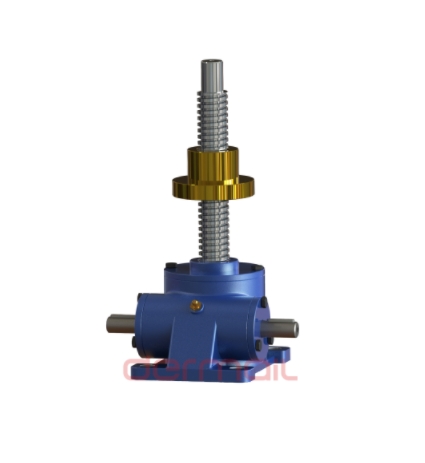
1. Structural Design and Transmission Principles
1.1 Bevel Gear Mechanism
Bevel gears feature conical-shaped teeth that mesh at a 90-degree angle, transmitting rotational motion between intersecting shafts. In screw jack systems, they convert horizontal motor input into vertical screw rotation, enabling compact designs. Key features include:
- High Precision: Helical or spiral bevel gears minimize backlash, ensuring accurate positioning (±0.01mm in high-end models).
- Efficiency: Transmission efficiency exceeds 90% due to rolling contact, reducing energy loss.
- Speed Adaptability: Gear ratios can be customized by adjusting tooth counts, supporting multi-speed configurations.
1.2 Worm Gear Mechanism
Worm gears consist of a threaded worm (screw) engaging a toothed worm wheel, converting rotational motion into linear screw movement. Their design priorities include:
- Self-Locking Capability: The worm’s lead angle (<5°) prevents reverse rotation under load without external brakes, enhancing safety.
- Compactness: The perpendicular shaft arrangement saves space, ideal for confined installations.
- Load Distribution: Line contact between worm and wheel distributes stress evenly, supporting heavy loads (up to 120 tons in industrial models).
2. Performance Comparison
2.1 Efficiency and Speed
- Bevel Gears: Excel in high-speed applications (e.g., automotive lift systems) with minimal heat generation. Their efficiency remains stable across varying loads.
- Worm Gears: Suffer from lower efficiency (50–70%) due to sliding friction, limiting their use to low-speed scenarios (e.g., conveyor adjustments). However, their self-locking property compensates for energy loss in static-load applications.
2.2 Load Capacity and Durability
- Bevel Gears: Handle high-torque demands (e.g., military vehicle lifts) with alloy steel gears and case-hardened treatments, achieving lifespans exceeding 1 million cycles.
- Worm Gears: Distribute loads across multiple teeth, reducing peak stress. Bronze worm wheels paired with hardened steel worms resist wear, lasting over 2 million cycles in optimized setups.
2.3 Noise and Vibration
- Bevel Gears: Generate moderate noise (60–75 dB) at high speeds, mitigated by precision grinding and helical tooth profiles.
- Worm Gears: Operate quietly (<60 dB) due to smooth line contact, making them suitable for noise-sensitive environments like medical equipment.
2.4 Maintenance and Cost
- Bevel Gears: Require periodic lubrication and alignment checks. Initial costs are higher due to precision machining, but long-term reliability reduces downtime expenses.
- Worm Gears: Need less frequent maintenance but are sensitive to lubricant quality. Their simpler design lowers upfront costs, though replacement parts may be pricier for heavy-duty models.
3. Typical Applications
3.1 Bevel Gear Screw Jacks
- Military: Adjustable missile launch platforms, aircraft landing gear retraction systems.
- Automotive: Vehicle lifts, transmission jacks.
- Industrial: High-speed assembly lines, CNC machine tool positioning.
3.2 Worm Gear Screw Jacks
- Construction: Building facade maintenance platforms, bridge jacking systems.
- Medical: Surgical table height adjustment, MRI scanner positioning.
- Energy: Solar panel tracking systems, wind turbine blade pitch control.
4. Selection Criteria
Choose dermail bevel gear screw jacks when:
- High efficiency and speed are critical.
- Precise, repeatable positioning is required.
- Budget allows for premium components.
Opt for worm gear screw jacks when:
- Self-locking safety is non-negotiable.
- Low-speed, high-load stability is prioritized.
- Noise reduction and compactness are essential.
Conclusion
Both bevel and worm gear mechanisms offer unique advantages in screw jacks. Bevel gears dominate high-performance, dynamic applications, while worm gears excel in safety-critical, low-maintenance scenarios. By aligning structural strengths with operational demands, engineers can optimize mechanical systems for efficiency, reliability, and cost-effectiveness.








Tel:+86-317-7369999
E-mail: demai@demai.org
Mobile:+86-18653450543 (Wechat)
Address:No. 6, Haihe Road, economic development zone, Wuqiao County, Cangzhou City, Hebei Province

点击右上角
分享给朋友吧
Copyright ©2023 All Rights Reserved Hebei Demai Transmission Machinery Co.,Ltd.
Copyright ©2025 All Rights Reserved Hebei Demai Transmission Machinery Co.,Ltd.
