
Why Ball Srew Jacks Are More Suitable for Specific Scenarios
2025-11-24 17:01:19
Click:
“
Ball screw jacks, renowned for their high precision, high efficiency, long lifespan, and low friction, are ideal for applications demanding strict requirements in motion accuracy, load capacity, operating speed, and stability.
”
Ball screw jacks, renowned for their high precision, high efficiency, long lifespan, and low friction, are ideal for applications demanding strict requirements in motion accuracy, load capacity, operating speed, and stability. Below are their typical use cases and competitive edges:
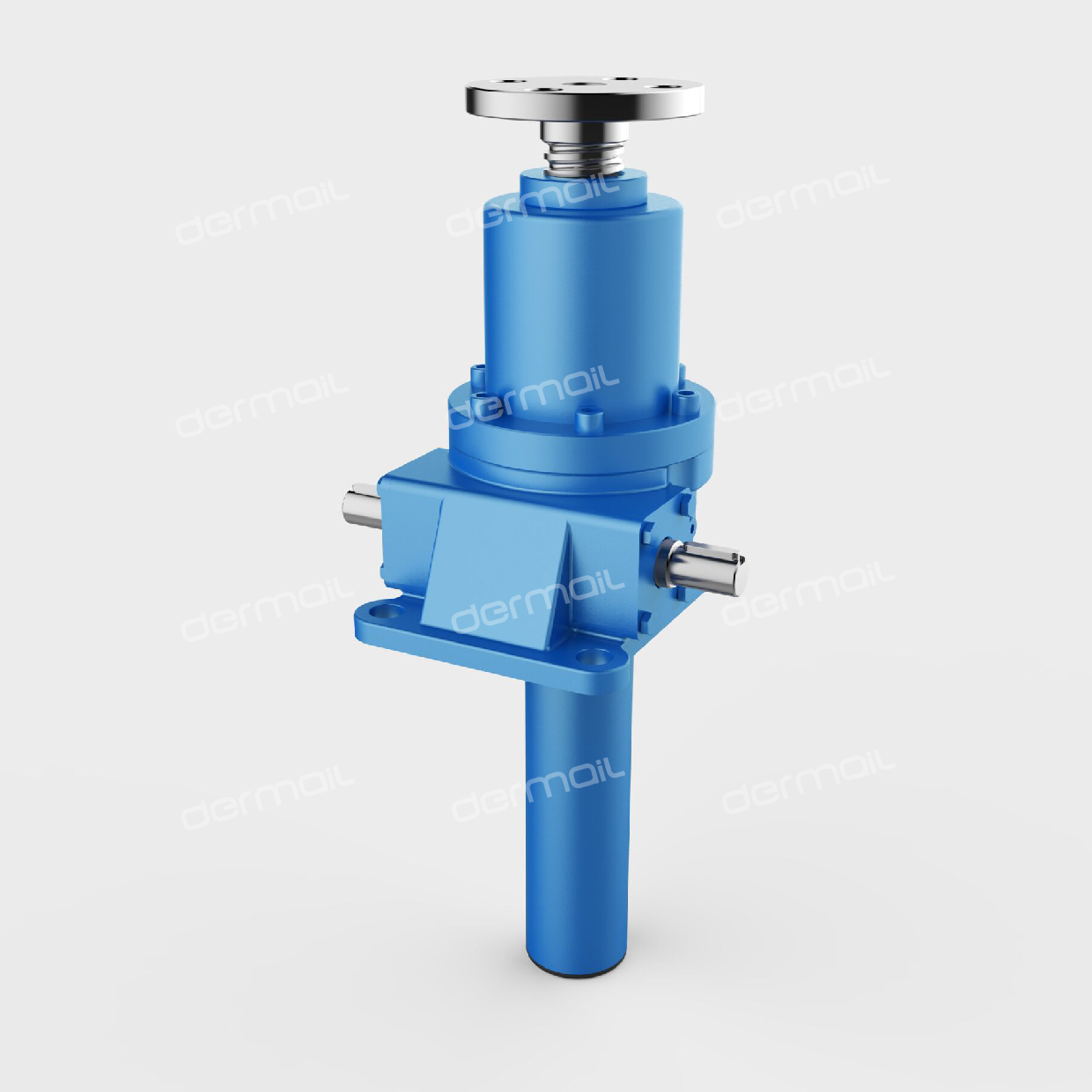
1. High-Precision Positioning Scenarios
Semiconductor Manufacturing Equipment
- Requirement: Sub-micron (±1 μm) positioning accuracy for wafer handling and photolithography alignment.
- Advantage: The rolling motion of ball screws eliminates sliding friction between the screw and nut, minimizing transmission errors. Paired with high-resolution encoders (e.g., 17-bit absolute encoders), they achieve nanometer-level motion control.
- Case Study: An 8-inch wafer fab uses ball screw jacks to drive vacuum chucks, achieving ±0.5 μm repeatability at 200 mm/s.
Medical Devices
- Requirement: Millimeter-level synchronization and vibration-free operation for CT scan tables and surgical robots.
- Advantage: Preloaded ball screws eliminate axial backlash, preventing positioning errors during reverse motion. Low friction reduces motor starting torque by 30%, minimizing mechanical shock.
- Case Study: A DSA angiography machine employs ball screw jacks for its C-arm, limiting vibration to ≤0.02 mm at 0.1 mm/s.
2. High-Speed and Heavy-Duty Applications
Automated Production Lines
- Requirement: Rapid lifting (≥1 m/s) while carrying loads ranging from hundreds of kilograms to several tons (e.g., automotive welding lines, 3C assembly lines).
- Advantage: Rolling friction coefficient (μ≈0.003) is 1/30th of that of trapezoidal screws (μ≈0.1–0.2), enabling high-speed operation. Larger screw diameters and nut sizes enhance load capacity.
- Case Study: A new energy vehicle factory uses ball screw jacks for body positioning fixtures, achieving 2-ton single-unit loads at 1.2 m/s with synchronization errors ≤0.1 mm.
Logistics and Warehousing Equipment
- Requirement: Frequent start-stop cycles (acceleration ≥0.5 m/s²) and rapid direction changes for stacker cranes and shuttles.
- Advantage: Rigid ball screw structures withstand inertial forces during high-speed motion, reducing deformation. Low friction cuts power consumption and extends service life.
- Case Study: An intelligent warehousing system uses ball screw jacks for forks, achieving ≤0.5-second positioning at 2 m/s while reducing energy use by 40% compared to trapezoidal screws.
3. Long-Lifespan and Low-Maintenance Applications
Aerospace Equipment
- Requirement: Decades of continuous operation (e.g., satellite antenna deployment, aircraft door actuators) with minimal maintenance.
- Advantage: Point-contact design (ball-to-raceway line contact) distributes stress, reducing wear to 1/10th of trapezoidal screws. Sealed lubrication systems ensure long-term performance in vacuum or high-temperature environments.
- Case Study: A communication satellite’s solar panel deployment mechanism uses ball screw jacks, maintaining ≤0.01 mm wear after 15 years in orbit.
Nuclear Power Plant Equipment
- Requirement: Radiation resistance, corrosion resistance, and stable operation for nuclear fuel rod handling robots.
- Advantage: Stainless steel (e.g., 316L) and special coatings (e.g., TiN) resist radiation and chemical corrosion. Preloaded structures eliminate backlash drift over time.
- Case Study: A nuclear plant’s waste-handling robot uses ball screw jacks, sustaining ±0.05 mm accuracy after 500,000 cycles.
4. Multi-Axis Synchronization and Control Scenarios
Robotic Joints
- Requirement: Multi-axis synchronous motion with trajectory accuracy ≤0.1 mm (e.g., 6-axis industrial robots).
- Advantage: Rigid ball screw structures reduce vibration transmission. Paired with servo motors and encoders, they enable closed-loop control with synchronization errors ≤0.02 mm.
- Case Study: An industrial robot manufacturer uses ball screw jacks for joints, achieving ±0.08 mm trajectory repeatability at 1 m/s.
Large-Scale Stage Equipment
- Requirement: Multi-unit synchronized lifting with height differences ≤1 mm (e.g., theater stages).
- Advantage: Low friction ensures uniform load distribution across multiple drives. PLCs and inverters achieve speed harmonization, limiting synchronization errors to ≤0.5 mm.
- Case Study: A national theater’s main stage uses 24 ball screw jacks, maintaining ≤0.3 mm synchronization at 10 m/min.
Comparison: Ball Screw Jacks vs. Trapezoidal Screw Jacks
| Feature | Ball Screw Jacks | Trapezoidal Screw Jacks |
|---|---|---|
| Efficiency | 90%–98% (rolling friction) | 26%–46% (sliding friction) |
| Precision | ±0.01 mm–±0.1 mm (high-precision models) | ±0.1 mm–±1 mm (standard models) |
| Lifespan | >1 million cycles (preloaded structures) | ~100,000 cycles (sliding wear) |
| Speed | Up to 2 m/s (low friction) | Typically ≤0.5 m/s (heat buildup) |
| Self-Locking | Requires brakes (no inherent locking) | Self-locking (no brakes needed for vertical loads) |
| Cost | Higher (precision, materials, craftsmanship) | Lower (simpler design) |
Selection Guidelines
- Prioritize Ball Screw Jacks When:
- High speed (>0.5 m/s), high precision (<±0.1 mm), and long lifespan (>500,000 cycles) are critical.
- Examples: Automation, robotics, medical devices, aerospace.
- Consider Trapezoidal Screw Jacks When:
- Light loads (<1 ton), low speeds (<0.5 m/s), cost sensitivity, and no self-locking requirement exist.
- Examples: Manual adjustment platforms, simple lifting mechanisms, infrequently used equipment.








Tel:+86-317-7369999
E-mail: demai@demai.org
Mobile:+86-18653450543 (Wechat)
Address:No. 6, Haihe Road, economic development zone, Wuqiao County, Cangzhou City, Hebei Province

点击右上角
分享给朋友吧
Copyright ©2023 All Rights Reserved Hebei Demai Transmission Machinery Co.,Ltd.
Copyright ©2025 All Rights Reserved Hebei Demai Transmission Machinery Co.,Ltd.
