
Precision Differences Between Ball Screw Jacks and Screw Jacks
2025-11-22 14:32:13
Click:
“
In industrial automation and precision engineering, screw jacks are essential devices for converting rotational motion into linear displacement, widely used in lifting, positioning, and load-handling systems.
”
In industrial automation and precision engineering, screw jacks are essential devices for converting rotational motion into linear displacement, widely used in lifting, positioning, and load-handling systems. Among them, ball screw jacks and trapezoidal screw jacks represent two dominant technologies, differing significantly in precision due to structural design, manufacturing processes, and operational mechanisms. This article compares their accuracy in terms of positioning, repeatability, processing grades, and application scenarios to guide optimal selection.
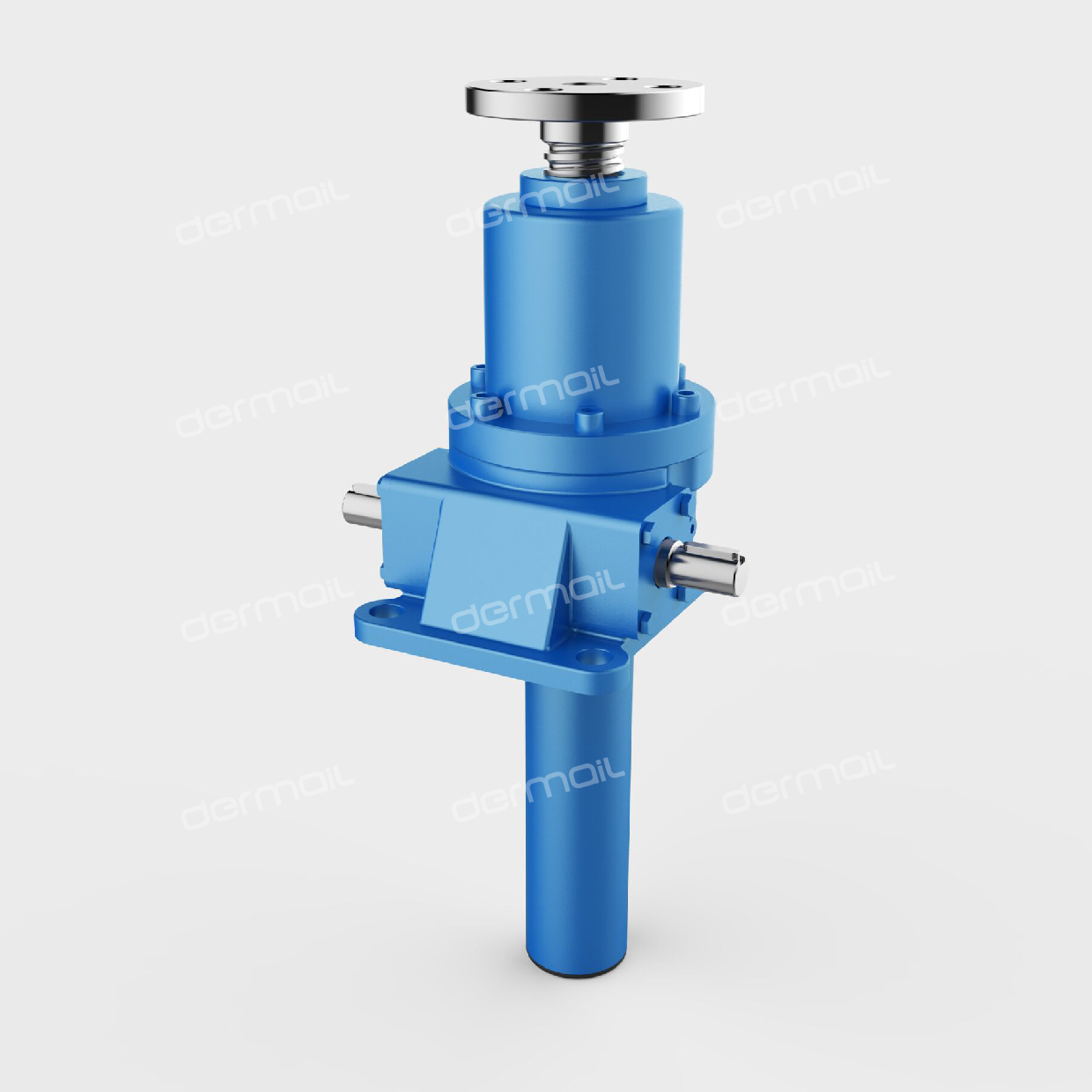
1. Positioning Accuracy: Micro-Level vs. Millimeter-Level Control
Ball Screw Jacks: Sub-Micron Precision
Ball screw jacks achieve ±0.01–0.05 mm/m positioning accuracy, with high-end models (e.g., C1–C5 grade) reaching ±0.005 mm/m or better. This ultra-high precision stems from:
- Precision-ground threads: Manufactured via grinding processes, ensuring minimal cumulative pitch error (<3 μm/m).
- Rolling friction mechanism: Steel balls roll between the screw and nut, reducing backlash to ≤0.003 mm through dual-nut preloading.
- Rigid support systems: Fixed-fixed bearing arrangements enhance critical speed by 40%, minimizing vibration-induced errors.
Example: In semiconductor manufacturing, ball screw jacks enable nanoscale wafer handling, ensuring sub-micron alignment during photolithography.
Trapezoidal Screw Jacks: Moderate Precision
Trapezoidal dermail screw jacks typically offer ±0.1–0.5 mm/m accuracy, classified as C7–C10 grade (cumulative error: 30–100 μm/m). Their lower precision results from:
- Rolling or cutting threads: Machining processes introduce greater surface roughness (Ra ≤ 0.8 μm) and pitch variations.
- Sliding friction: Direct contact between screw and nut generates backlash, requiring spring-loaded nuts or anti-backlash designs to mitigate gaps (though effectiveness is limited).
Example: In warehouse storage systems, trapezoidal screw jacks provide sufficient accuracy for pallet positioning without requiring micro-level control.
2. Repeatability: Consistency Under Cyclic Loads
Ball Screw Jacks: ±0.005 mm Repeatability
Ball screw jacks excel in repeatability due to:
- Zero backlash: Dual-nut preloading eliminates clearance, ensuring identical positioning in forward/reverse motions.
- Low friction coefficient: Rolling contact (μ ≈ 0.003) reduces wear, maintaining accuracy over millions of cycles.
- Thermal stability: Advanced materials (e.g., chromium steel) and compensation algorithms minimize thermal expansion errors.
Application: Robotic arms in automotive assembly lines rely on ball screw jacks for consistent part placement across thousands of cycles.
Trapezoidal Screw Jacks: ±0.05 mm Repeatability
Trapezoidal screw jacks face challenges in repeatability:
- Inherent backlash: Sliding friction creates clearance (typically 0.05–0.2 mm), causing positioning hysteresis.
- Wear-induced degradation: Prolonged use increases backlash, requiring frequent calibration or nut replacement.
Application: Manual adjustment mechanisms (e.g., theater stage lifts) tolerate moderate repeatability errors.
3. Manufacturing Grade: C1 vs. C10 Standards
Ball Screw Jacks: C1–C5 Grade Precision
Ball screw jacks adhere to ISO 3408 standards, with grades defined by cumulative pitch error:
- C1 grade: ≤3 μm/m (ultra-precision for aerospace, optics).
- C5 grade: ≤21 μm/m (general automation, CNC machinery).
High-grade ball screw jacks undergo precision grinding, superfinishing, and laser calibration to achieve sub-micron tolerances.
Trapezoidal Screw Jacks: C7–C10 Grade Standard
Trapezoidal screw jacks follow ISO 2904 standards, with grades based on tolerance classes:
- C7 grade: ≤50 μm/m (suitable for general industrial use).
- C10 grade: ≤100 μm/m (low-cost applications like manual jacks).
Manufacturing involves rolling or milling, resulting in coarser surfaces and larger pitch deviations.
4. Application Scenarios: High-Tech vs. Heavy-Duty
Ball Screw Jacks: High-Precision, High-Speed Applications
- Automation & Robotics: CNC machines, 3D printers, and pick-and-place systems demand micro-level control.
- Clean Environments: Medical devices and food processing benefit from oil-free operation and low noise (<50 dB).
- Dynamic Systems: High-speed elevators and vibration-sensitive platforms rely on ball screw jacks for smooth motion.
Trapezoidal Srew Jacks: Heavy-Load, Low-Maintenance Scenarios
- Heavy Machinery: Mining equipment, press machines, and large-scale gates leverage their high load capacity (up to 100 tons).
- Outdoor & Harsh Conditions: Dust-resistant designs (e.g., IP65 ratings) suit construction sites and agricultural machinery.
- Cost-Sensitive Projects: Low initial cost and minimal maintenance make them ideal for budget-constrained applications.
Conclusion: Choosing the Right Technology
- Select ball screw jacks for applications requiring sub-micron precision, high repeatability, and dynamic performance (e.g., semiconductor, robotics, aerospace).
- Opt for trapezoidal screw jacks when cost, load capacity, and environmental resilience outweigh precision demands (e.g., heavy industry, outdoor equipment, manual systems).
Understanding these differences ensures optimal performance, cost efficiency, and longevity in screw jack applications. As industries evolve toward Industry 4.0, ball screw technology continues to push precision boundaries, while trapezoidal screw jacks remain indispensable for rugged, low-maintenance solutions.








Tel:+86-317-7369999
E-mail: demai@demai.org
Mobile:+86-18653450543 (Wechat)
Address:No. 6, Haihe Road, economic development zone, Wuqiao County, Cangzhou City, Hebei Province

点击右上角
分享给朋友吧
Copyright ©2023 All Rights Reserved Hebei Demai Transmission Machinery Co.,Ltd.
Copyright ©2025 All Rights Reserved Hebei Demai Transmission Machinery Co.,Ltd.
