
Why Are Lead Screws in Screw Jacks Chromium-Plated?
2025-11-21 15:04:32
Click:
“
Screw jacks, widely used in industrial machinery, automotive systems, and precision equipment, rely on lead screws to convert rotational motion into linear displacement.
”
Screw jacks, widely used in industrial machinery, automotive systems, and precision equipment, rely on lead screws to convert rotational motion into linear displacement. Among various surface treatment methods, chromium plating (electroplating a thin layer of chromium onto the screw surface) is a critical process for enhancing performance. This article explores the technical and practical reasons for chromium plating lead screws in screw jacks.
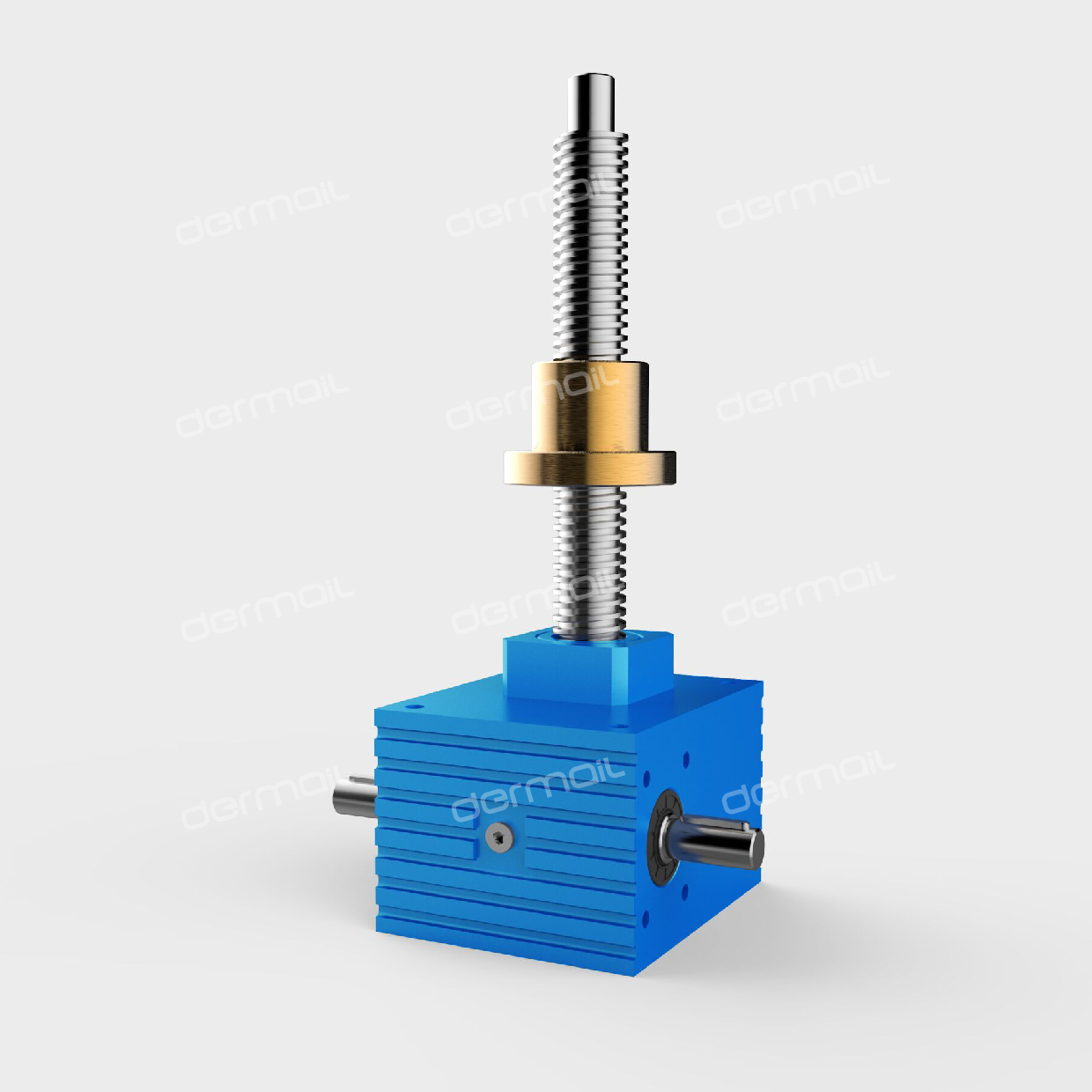
1. Enhanced Wear Resistance and Service Life
Lead screws in dermail transmission screw jacks are subjected to repetitive friction and high loads during operation, especially in heavy-duty applications like metallurgical equipment or construction machinery. Chromium plating forms a hard, low-friction surface layer (typically 65-70 HRC hardness) that significantly reduces wear.
- Mechanism: The chromium layer acts as a sacrificial barrier, preventing direct contact between the screw and nut. This minimizes abrasive wear caused by micro-particles in lubricants or contaminants.
- Effect: In a case study of a steel mill’s ingot lifting jack, chromium-plated lead screws exhibited 60% less wear than unplated ones after 3 years of continuous use, extending replacement intervals from 2 years to over 5 years.
2. Reduced Friction for Improved Efficiency
Friction between the lead screw and nut directly impacts energy consumption and heat generation. Chromium plating lowers the coefficient of friction (μ) from 0.15-0.2 (for steel surfaces) to 0.05-0.1, enhancing transmission efficiency.
- Benefit: Lower friction reduces power losses, enabling screw jacks to operate with smaller motors or manual input forces. For example, a manually operated screw jack for adjusting theater stages requires 30% less force after chromium plating, improving operator comfort.
- Thermal Management: Reduced friction also decreases heat buildup, preventing thermal expansion that could compromise positioning accuracy in precision applications like semiconductor manufacturing equipment.
3. Superior Corrosion Resistance for Harsh Environments
Screw jacks operating in outdoor, marine, or chemical-exposed environments face corrosion risks from moisture, salt spray, or chemicals. Chromium plating provides a passive, inert layer that isolates the base metal (e.g., carbon steel or stainless steel) from corrosive agents.
- Performance: In salt spray tests (ASTM B117), chromium-plated screws showed no rust after 500 hours, while unplated steel screws corroded within 48 hours.
- Application: Offshore platform lifting systems and food processing equipment (where sanitation is critical) widely adopt chromium-plated screws to ensure long-term reliability.
4. Improved Surface Finish for Precision Control
The surface roughness (Ra) of lead screws affects the smoothness of linear motion and positioning accuracy. Chromium plating can achieve Ra values as low as 0.05-0.2 μm through post-plating polishing, far exceeding the Ra 0.8-1.6 μm of untreated steel.
- Impact on Precision: In CNC machine tool feed systems, a smoother screw surface reduces vibration and 'stick-slip' phenomena, enabling repeatable positioning accuracy of ±0.001 mm.
- Case Example: A medical CT scanner’s bed lifting mechanism adopted chromium-plated screws, reducing layer thickness errors from 0.5 mm to 0.1 mm, which improved image resolution significantly.
5. Aesthetic and Functional Uniformity
Chromium plating creates a bright, reflective surface that not only enhances visual appeal but also ensures uniform thickness across the screw. This uniformity is critical for balanced load distribution and preventing stress concentrations that could lead to premature failure.
- Quality Control: Thickness variations in the chromium layer are typically controlled within ±5 μm, ensuring consistent performance across batches.
- Industry Standards: Aerospace and automotive industries mandate chromium plating for screw jacks to meet stringent reliability and safety requirements.
Conclusion
Chromium plating of lead screws in screw jacks is a multifaceted solution that addresses wear, friction, corrosion, precision, and durability challenges. By forming a hard, low-friction, corrosion-resistant layer with superior surface finish, it enables screw jacks to operate reliably in diverse environments—from heavy industrial settings to high-precision applications. As industries demand longer service life, lower maintenance costs, and higher efficiency, chromium plating remains an indispensable technology for optimizing lead screw performance.








Tel:+86-317-7369999
E-mail: demai@demai.org
Mobile:+86-18653450543 (Wechat)
Address:No. 6, Haihe Road, economic development zone, Wuqiao County, Cangzhou City, Hebei Province

点击右上角
分享给朋友吧
Copyright ©2023 All Rights Reserved Hebei Demai Transmission Machinery Co.,Ltd.
Copyright ©2025 All Rights Reserved Hebei Demai Transmission Machinery Co.,Ltd.
