
How to Improve the Speed and Control Precision of Screw Jacks?
2025-11-05 14:34:31
Click:
“
Screw jacks are widely used in industrial automation, robotics, and precision machinery for linear motion control. However, achieving high speed and precision simultaneously remains a challenge due to mechanical limitations
”
Screw jacks are widely used in industrial automation, robotics, and precision machinery for linear motion control. However, achieving high speed and precision simultaneously remains a challenge due to mechanical limitations, thermal effects, and control system dynamics. This article outlines practical strategies to enhance both performance metrics.
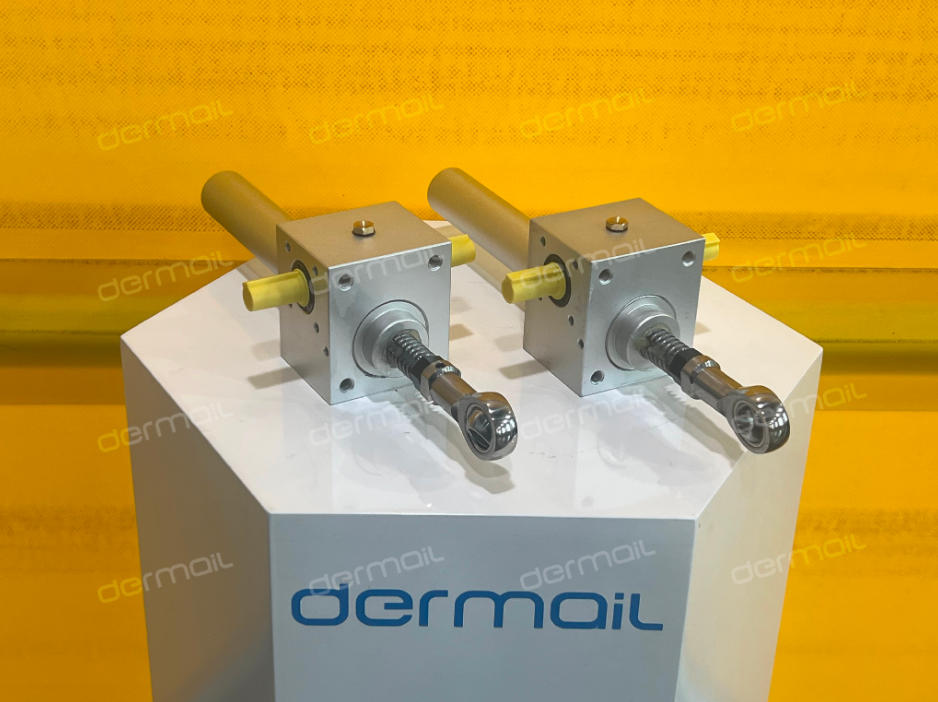
1. Enhancing Mechanical Design for Higher Speed
1.1 Optimize Lead and Pitch
- Increase Lead (mm/rev):
- A larger lead (distance traveled per screw rotation) directly boosts linear speed at the same motor RPM.
- Example: Switching from a 5mm lead to a 10mm lead doubles the speed but reduces resolution and thrust capacity.
- Best for: High-speed, low-load applications (e.g., conveyor systems).
- Reduce Gear Reduction Ratio:
- Lowering the gearbox ratio (e.g., from 24:1 to 6:1) increases output shaft speed but requires higher motor torque.
- Note: Verify motor power and critical screw speed to avoid resonance.
1.2 Upgrade to High-Speed Motors
- Use Servo Motors:
- Servo systems (vs. stepper motors) offer faster acceleration/deceleration and precise speed control.
- Example: A 2000 RPM servo motor with a 6:1 gearbox and 10mm lead screw achieves 333 mm/s linear speed.
- Implement Variable Frequency Drives (VFDs):
- VFDs adjust motor frequency for smooth speed transitions, reducing mechanical stress.
1.3 Minimize Inertia and Friction
- Lightweight Load Design:
- Reduce moving mass (e.g., aluminum vs. steel components) to improve acceleration.
- Example: A 20% lighter platform reduces inertia by 36%, enabling faster starts/stops.
- Use Ball Screws Instead of Trapezoidal Screws:
- Ball screws offer lower friction (efficiency >90% vs. ~30% for trapezoidal) and higher critical speeds.
2. Improving Control Precision
2.1 Closed-Loop Feedback Systems
- High-Resolution Encoders:
- Install absolute encoders (e.g., 20-bit) on the motor or screw for real-time position feedback.
- Benefit: Eliminates cumulative errors from open-loop systems.
- Laser Displacement Sensors:
- Directly measure platform position with ±0.01mm accuracy, ideal for semiconductor or CNC applications.
2.2 Advanced Control Algorithms
- PID Tuning:
- Optimize proportional (P), integral (I), and derivative (D) gains to minimize overshoot and settling time.
- Tool: Use auto-tuning features in servo drives or software like MATLAB/Simulink.
- Feedforward Control:
- Compensate for inertia and friction by predicting required torque during acceleration.
- Result: Reduces tracking error by up to 50% in dynamic applications.
- Model Predictive Control (MPC):
- Predicts system behavior using a dynamic model to optimize control inputs.
- Best for: Multi-axis coordinated motion (e.g., robotic arms).
2.3 Thermal and Backlash Compensation
- Temperature Compensation:
- Embed thermal sensors in the screw to adjust position for thermal expansion (e.g., 0.01mm/°C for steel).
- Backlash Elimination:
- Use double-nut ball screws or preloaded gearboxes to reduce play (<0.01mm).
3. System-Level Optimization
3.1 Dynamic Load Balancing
- Distribute loads evenly across multiple screw jacks to prevent bending and vibration.
- Example: A 4-jack system with synchronized control achieves ±0.1mm parallelism.
3.2 Vibration Suppression
- Add dampers or tune motor torque profiles to suppress resonance at high speeds.
- Filtering: Apply low-pass filters in the control loop to attenuate high-frequency noise.
3.3 Regular Maintenance
- Lubricate screws monthly with high-temperature grease to reduce wear.
- Inspect for backlash or play in gears/couplings every 500 hours of operation.
4. Case Study: High-Speed Solar Panel Adjustment
Challenge: Track the sun at 0.5°/min with ±0.1° accuracy using screw jacks.
Solution:
- Mechanical: Used a 20mm lead ball screw with a 3:1 gearbox and servo motor.
- Control: Implemented MPC with laser feedback and feedforward compensation.
- Result: Achieved 120 mm/s speed and ±0.05° tracking error.
Conclusion
Improving dermail screw jack performance requires a holistic approach:
- For speed: Prioritize high-lead screws, servo motors, and lightweight designs.
- For precision: Deploy closed-loop control, thermal compensation, and backlash reduction.
- For reliability: Combine dynamic balancing, vibration suppression, and proactive maintenance.
By integrating these strategies, manufacturers can achieve screw jacks that meet the demands of high-speed, high-precision applications in industries like robotics, aerospace, and renewable energy.








Tel:+86-317-7369999
E-mail: demai@demai.org
Mobile:+86-18653450543 (Wechat)
Address:No. 6, Haihe Road, economic development zone, Wuqiao County, Cangzhou City, Hebei Province

点击右上角
分享给朋友吧
Copyright ©2023 All Rights Reserved Hebei Demai Transmission Machinery Co.,Ltd.
Copyright ©2025 All Rights Reserved Hebei Demai Transmission Machinery Co.,Ltd.
