
Differences Between Ball Screw Jacks and Trapezoidal Screw Jacks
2025-11-04 14:16:46
Click:
“
Ball screw jacks and trapezoidal screw jacks are vital for precision linear motion systems, spanning industries like aerospace, military engineering, automation, and construction.
”
Ball screw jacks and trapezoidal screw jacks are critical components in precision linear motion systems, widely used in industries ranging from aerospace and military engineering to industrial automation and construction. Their distinct mechanical designs lead to significant differences in performance, efficiency, and application suitability. This article explores the core differences between the two types, providing insights for engineers and decision-makers in selecting the optimal solution.
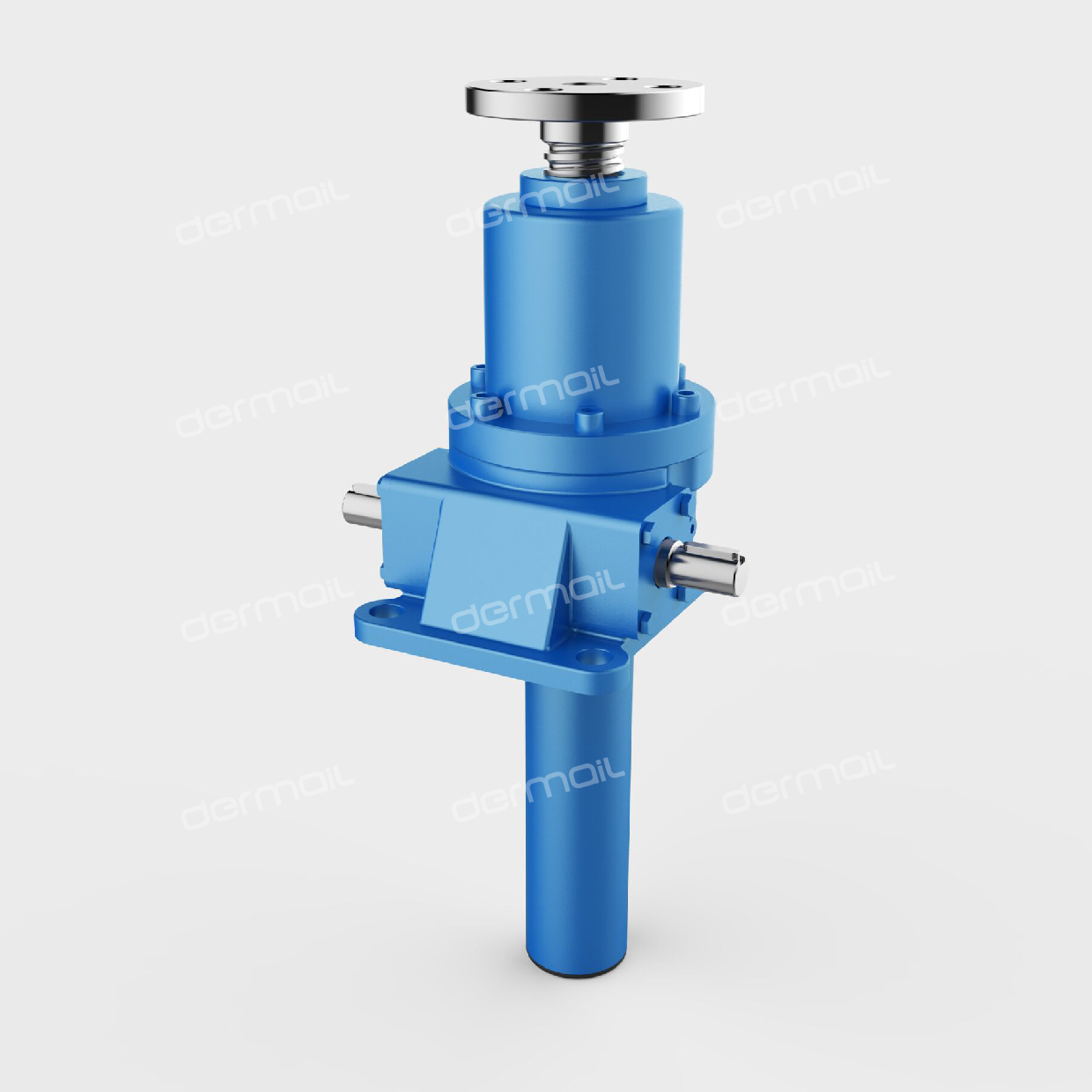
1. Mechanical Design and Transmission Principles
Ball Screw Jacks utilize rolling friction between ball bearings and the screw thread, reducing friction and wear. The ball bearings recirculate through a return tube, enabling continuous motion with minimal heat generation. This design supports high-speed operation (up to 2 m/s) and high dynamic loads.
Dermail transmission trapezoidal Screw Jacks rely on sliding friction between the trapezoidal-shaped screw and nut. The thread profile (typically a 7° or 14.5° lead angle) creates self-locking properties but generates higher friction, limiting speed (usually <0.5 m/s) and efficiency (30–50%).
2. Efficiency and Energy Consumption
Ball screw jacks achieve 90–95% mechanical efficiency due to rolling friction, making them ideal for energy-sensitive applications like robotics and CNC machines. They require less torque to drive the same load, reducing motor power demands.
Trapezoidal screw jacks, with 30–50% efficiency, convert more input energy into heat. While this inefficiency is a drawback in high-duty cycles, it simplifies braking requirements, as the self-locking thread prevents backdriving when power is cut.
3. Precision and Backlash
Ball Screw Jacks offer sub-micron positioning accuracy (±0.01 mm or better) and minimal backlash (<0.005 mm), achieved through preloaded ball nuts and precision-ground threads. This makes them indispensable in applications like semiconductor manufacturing, optical alignment, and missile guidance systems.
Trapezoidal Screw Jacks typically exhibit ±0.1–0.5 mm accuracy and significant backlash (0.1–1 mm) due to thread clearance. While unsuitable for high-precision tasks, their inherent backlash can be mitigated with anti-backlash nuts, albeit at the cost of increased friction.
4. Load Capacity and Durability
Trapezoidal screw jacks excel in static and shock loads, with thread designs capable of handling 10–100 tons in heavy-duty applications like shipboard weapon elevators and construction lifts. Their sliding friction distributes load evenly, reducing localized stress.
Ball screw jacks prioritize dynamic load performance, with optimized ball paths distributing forces across multiple contact points. While their static load capacity is lower than trapezoidal counterparts, advanced designs (e.g., double-nut ball screws) can achieve comparable ratings in specific configurations.
5. Self-Locking and Safety
Trapezoidal screw jacks are inherently self-locking when the lead angle is <5°, eliminating the need for external brakes in vertical applications. This feature is critical in military equipment (e.g., missile launchers) and emergency stop systems.
Ball screw jacks require braking mechanisms (e.g., servo brakes, counterweights) to prevent reverse rotation under load. However, modern servo-controlled systems can compensate for this limitation through real-time position feedback.
6. Environmental Adaptability
Ball screw jacks demand stringent environmental control, including dust-proof seals (IP54/IP65) and lubrication systems to prevent ball bearing contamination. They are vulnerable to abrasive particles, limiting use in harsh conditions without protective measures.
Trapezoidal screw jacks are more rugged, tolerating dust, debris, and intermittent lubrication. Their simplicity makes them preferred in outdoor or uncontrolled environments, such as construction sites and agricultural machinery.
7. Cost and Maintenance
Initial Cost: Ball screw jacks are 30–50% more expensive due to precision manufacturing and ball bearing components.
Maintenance: Trapezoidal screw jacks require only periodic lubrication, while ball screws need regular cleaning, re-lubrication, and occasional ball nut replacement.
Lifecycle Cost: Ball screws offer lower total cost of ownership in high-precision, high-speed applications due to their durability, whereas trapezoidal screws are cost-effective for low-duty, heavy-load scenarios.
8. Typical Applications
Ball Screw Jacks:
- Aerospace (satellite positioning, antenna adjustment)
- Military (missile guidance, radar elevation)
- Industrial automation (CNC machines, robotic arms)
- Medical devices (MRI tables, surgical robots)
Trapezoidal Screw Jacks:
- Construction (scissor lifts, concrete formwork)
- Marine (shipboard cargo elevators, hatch covers)
- Heavy machinery (mining equipment, foundry presses)
- Low-cost automation (manual adjustment systems, teaching models)
Conclusion
The choice between ball screw and trapezoidal screw jacks hinges on application priorities. Ball screws dominate in precision, speed, and efficiency, while trapezoidal screws excel in cost, simplicity, and self-locking safety. Hybrid systems, combining both technologies, are increasingly used in large-scale platforms to leverage their respective strengths.
Key Takeaway: For high-precision, dynamic applications, invest in ball screw jacks despite higher costs. For heavy-duty, low-maintenance, or vertical-load scenarios, trapezoidal screw jacks remain the practical choice.








Tel:+86-317-7369999
E-mail: demai@demai.org
Mobile:+86-18653450543 (Wechat)
Address:No. 6, Haihe Road, economic development zone, Wuqiao County, Cangzhou City, Hebei Province

点击右上角
分享给朋友吧
Copyright ©2023 All Rights Reserved Hebei Demai Transmission Machinery Co.,Ltd.
Copyright ©2025 All Rights Reserved Hebei Demai Transmission Machinery Co.,Ltd.
