
Advantages of Multi-Unit Screw Jack Synchronization Systems
2025-11-03 15:20:20
Click:
“
In industrial automation, heavy-duty material handling, and precision engineering, multi-unit screw jack systems have emerged as a superior alternative to traditional hydraulic or pneumatic solutions.
”
Introduction
In industrial automation, heavy-duty material handling, and precision engineering, multi-unit screw jack systems have emerged as a superior alternative to traditional hydraulic or pneumatic solutions. By integrating multiple screw jacks with advanced mechanical and electrical synchronization technologies, these systems deliver unparalleled precision, reliability, and adaptability. This article explores the key advantages of multi-unit screw jacks in modern industrial applications.
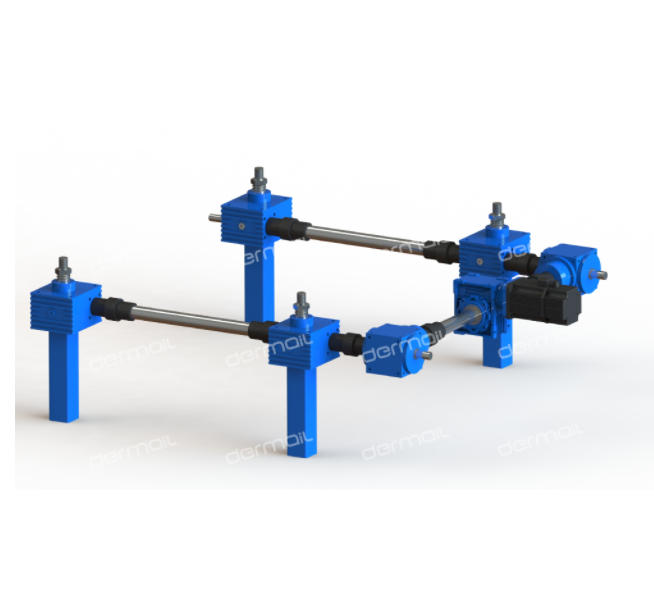
1. High-Precision Synchronization
Mechanical Rigid Synchronization
Multi-unit screw jack systems achieve synchronization through rigid mechanical linkages, such as drive shafts, bevel gearboxes, and couplings. This design ensures that all connected screw jacks move in perfect unison, eliminating positional errors caused by motor speed variations or hydraulic pressure fluctuations.
- Example: In automotive welding lines, 12 dermail transmission screw jacks synchronized via a central drive shaft achieve positional accuracy within ±0.05mm, ensuring consistent welding quality.
- Benefit: Critical for applications requiring strict alignment, such as semiconductor manufacturing, aerospace assembly, and high-precision machining.
Electrical Closed-Loop Control
For ultra-high-precision demands, electrical synchronization systems employ servo motors with encoders and PLC (Programmable Logic Controller) feedback. The PLC continuously monitors positional data from each screw jack and adjusts motor speeds in real time to maintain synchronization.
- Example: A solar panel production line uses 8 screw jacks with absolute encoders, achieving synchronization accuracy of ±0.02mm despite varying loads.
- Benefit: Enables dynamic adjustment during operation, compensating for load imbalances or external disturbances.
2. Enhanced Load-Bearing Capacity
Distributed Load Handling
When a single screw jack cannot support the required load, multi-unit systems distribute the weight across several jacks, significantly increasing the overall lifting capacity.
- Example: A 200-ton assembly platform in shipbuilding uses 16 screw jacks, each handling 12.5 tons, ensuring safe and stable lifting.
- Benefit: Reduces stress on individual components, extending equipment lifespan and minimizing maintenance needs.
Uniform Force Distribution
Symmetrical arrangement of screw jacks ensures even load distribution, preventing uneven settling or structural deformation.
- Example: In a large-scale stage lifting system, 4 screw jacks positioned at the corners of a 10m×10m platform maintain levelness within ±0.3mm during operation.
3. Superior Stability and Safety
ical Self-Locking
Screw jacks utilize worm gear and trapezoidal screw mechanisms that inherently lock under load, preventing unintended descent even during power failures or component malfunctions.
- Example: Hospital operating tables equipped with screw jacks remain stationary during emergencies, ensuring patient safety.
- Benefit: Eliminates the risk of sudden drops associated with hydraulic systems, which rely on continuous pressure to maintain position.
Reduced Vibration and Noise
Unlike hydraulic systems that generate pulsations and noise from pumps and valves, screw jack systems operate smoothly with minimal vibration.
- Example: In electronic component assembly lines, screw jacks reduce noise levels to below 65dB(A), creating a quieter work environment.
4. Flexibility and Adaptability
Customizable Layouts
Multi-unit screw jack systems can be configured in various layouts (I-type, T-type, H-type, U-type) to suit different spatial constraints and load requirements.
- Example: A compact I-type layout is used in robotic arm positioning systems, while an H-type layout supports heavy-duty cargo lifts in warehouses.
Scalable Performance
Systems can be easily expanded by adding more screw jacks or upgrading to higher-capacity models, accommodating future production needs.
- Example: An automotive stamping plant initially deployed 4 screw jacks and later scaled up to 8 units to handle larger molds.
5. Energy Efficiency and Cost Savings
Lower Energy Consumption
Screw jacks consume power only during movement, unlike hydraulic systems that require continuous pump operation to maintain pressure.
- Example: A 3D printer using screw jacks reduces energy consumption by 40% compared to a hydraulic equivalent.
Reduced Maintenance Costs
With fewer moving parts and no hydraulic fluid contamination risks, screw jack systems demand less frequent maintenance.
- Example: A photovoltaic equipment manufacturer reports a 60% reduction in maintenance costs after switching to screw jacks.
6. Environmental Friendliness
Oil-Free Operation
Screw jacks eliminate the need for hydraulic oil, preventing leaks and environmental contamination.
- Example: Lithium battery production lines adopt screw jacks to maintain cleanroom conditions free from oil particles.
Quiet and Clean Operation
The absence of hydraulic pumps and valves reduces noise pollution and airborne oil mist, aligning with sustainable manufacturing practices.
Conclusion
Multi-unit screw jack synchronization systems offer a compelling combination of precision, safety, and efficiency for industrial applications. Their ability to achieve micron-level synchronization, handle heavy loads, and operate reliably in diverse environments makes them indispensable in sectors ranging from automotive manufacturing to aerospace engineering. As industries continue to prioritize sustainability and automation, screw jack technology will play a pivotal role in driving innovation and productivity.
Keywords: Screw Jack Synchronization, Multi-Unit Lifting, Precision Engineering, Industrial Automation, Mechanical Synchronization.








Tel:+86-317-7369999
E-mail: demai@demai.org
Mobile:+86-18653450543 (Wechat)
Address:No. 6, Haihe Road, economic development zone, Wuqiao County, Cangzhou City, Hebei Province

点击右上角
分享给朋友吧
Copyright ©2023 All Rights Reserved Hebei Demai Transmission Machinery Co.,Ltd.
Copyright ©2025 All Rights Reserved Hebei Demai Transmission Machinery Co.,Ltd.
