
Differences Between Lifting Actuators and Screw Jacks
2025-10-29 15:15:27
Click:
“
Lifting actuators and screw jacks are both mechanical devices designed to convert rotational motion into linear motion, enabling vertical lifting, lowering, or positioning of loads.
”
Lifting actuators and screw jacks are both mechanical devices designed to convert rotational motion into linear motion, enabling vertical lifting, lowering, or positioning of loads. However, their structural designs, load capacities, environmental adaptability, and functional requirements lead to distinct application scenarios. This article explores the key differences in their use cases across industries.
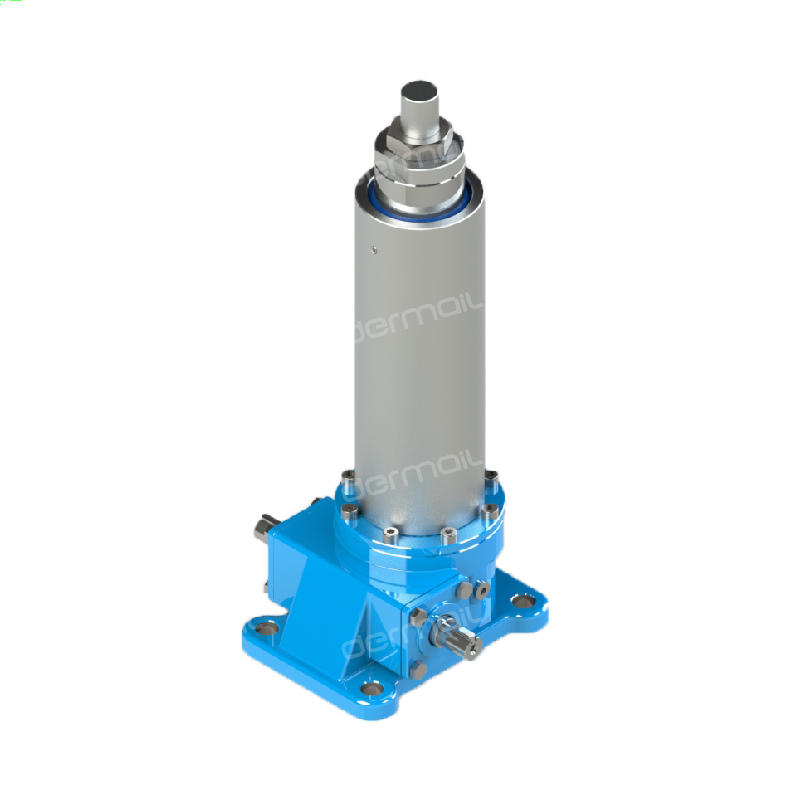
1. Load Capacity and Heavy-Duty Applications
Lifting Actuators: Optimized for Ultra-Heavy Loads
Lifting actuators are engineered to handle extremely high loads, often ranging from several tons to over 60 tons, making them ideal for heavy-duty industrial applications. Their robust design—typically featuring reinforced ball screws, high-strength gearboxes, or hydraulic systems—ensures stability under intense pressure.
Typical Use Cases:
- Construction & Mining Equipment:
- Hydraulic lifting actuators in excavator booms, crane outriggers, and dump truck beds withstand shock loads and sustained compression.
- Steel mill ladle tilting mechanisms and rolling mill adjustment systems rely on actuators for precise, high-force control.
- Marine & Port Machinery:
- Ship gangways, large crane counterweights, and container locking systems use actuators for reliable vertical movement in harsh, corrosive environments.
- Emergency Rescue Equipment:
- Hydraulic rescue tools (e.g., spreaders, rams) depend on actuators for rapid, forceful operations during disaster response.
- Hydraulic rescue tools (e.g., spreaders, rams) depend on actuators for rapid, forceful operations during disaster response.
Screw Jacks: Suitable for Moderate Loads with Long Strokes
Dermail transmission screw jacks generally handle lighter loads (up to a few tons) but excel in applications requiring long travel distances or multi-unit synchronization. Their design—often featuring trapezoidal or ball screws—prioritizes precision over brute force.
Typical Use Cases:
- Mechanical Processing & Assembly:
- Workpiece clamping devices, flipping mechanisms, and adjustable lifting tables in CNC machining centers.
- Building & Infrastructure:
- Movable scaffolding, window/wall adjustment systems, and solar panel tracking frameworks.
- Maintenance & Installation:
- Elevated work platforms and tool-lifting racks for safe high-altitude operations.
- Elevated work platforms and tool-lifting racks for safe high-altitude operations.
2. Environmental Adaptability
Lifting Actuators: Built for Extreme Conditions
Lifting actuators are designed to operate in harsh environments, including:
- Dust & Moisture Resistance:
- Double-sealed protective tubes (e.g., stainless steel or aluminum) with IP55-IP56 ratings protect internal components in mines, ports, and construction sites.
- Self-Locking Capability:
- Worm gear mechanisms provide inherent self-locking, preventing load drift during power failures—critical for vertical applications like lifting platforms.
- Explosion-Proof Design:
- Some models meet Ex d IIB T4 standards for use in hazardous environments like chemical plants or oil refineries.
Screw Jacks: Limited to Cleaner Environments
Screw jacks perform best in controlled settings due to:
- Lower Protection Levels:
- Reliance on external shielding makes them vulnerable to dust and moisture, restricting use to indoor or low-contamination areas.
- Temperature Sensitivity:
- Low-temperature operation may require special lubricants (e.g., for hydraulic-driven models) to maintain fluidity.
- Low-temperature operation may require special lubricants (e.g., for hydraulic-driven models) to maintain fluidity.
3. Functional Requirements: Precision vs. Power
Lifting Actuators: High-Speed, High-Precision Control
Modern lifting actuators integrate servo motors and closed-loop feedback systems, enabling:
- Dynamic Response:
- Speeds of 0.1–2 m/s with minimal backlash, suitable for AGV lifting platforms and robotic arms.
- Real-Time Monitoring:
- Built-in pressure sensors and fault diagnostics ensure safe operation under heavy loads.
Screw Jacks: Static Positioning & Low-Speed Stability
Screw jacks prioritize accuracy and stability over speed:
- High-Precision Positioning:
- Ball screw models achieve ±0.01 mm accuracy, ideal for semiconductor inspection equipment and medical imaging tables.
- Manual Override Capability:
- Some designs allow manual operation during power outages, enhancing safety in critical applications.
- Some designs allow manual operation during power outages, enhancing safety in critical applications.
4. Industry-Specific Applications
Lifting Actuators: Dominant in Heavy Industry
- Metallurgy:
- Continuous casting machines and blast furnace adjustment systems.
- Aerospace:
- Missile launchers and aircraft landing gear retraction mechanisms.
- Energy:
- Wind turbine blade pitch adjustment and nuclear reactor maintenance equipment.
Screw Jacks: Preferred for Lightweight Automation
- Healthcare:
- Surgical table height adjustment and hospital bed mobility systems.
- Renewable Energy:
- Solar tracker drives and wind turbine yaw adjustment mechanisms.
- Entertainment:
- Stage lifts and theater seating systems requiring smooth, quiet operation.
- Stage lifts and theater seating systems requiring smooth, quiet operation.
Conclusion
While both lifting actuators and screw jacks serve linear motion needs, their designs cater to divergent demands:
- Lifting actuators excel in heavy-duty, high-force, and harsh-environment applications, where reliability and self-locking are paramount.
- Screw jacks are better suited for moderate-load, high-precision, and clean-environment scenarios, emphasizing accuracy and cost-effectiveness.
Understanding these differences helps engineers select the optimal solution for specific projects, balancing performance, durability, and budget constraints.








Tel:+86-317-7369999
E-mail: demai@demai.org
Mobile:+86-18653450543 (Wechat)
Address:No. 6, Haihe Road, economic development zone, Wuqiao County, Cangzhou City, Hebei Province

点击右上角
分享给朋友吧
Copyright ©2023 All Rights Reserved Hebei Demai Transmission Machinery Co.,Ltd.
Copyright ©2025 All Rights Reserved Hebei Demai Transmission Machinery Co.,Ltd.
