
Why Can't Screw Jacks Withstand Lateral Forces?
2025-09-27 10:12:07
Click:
“
Screw jacks are widely used mechanical devices for converting rotational motion into linear motion, commonly applied in lifting, positioning, and load - bearing scenarios.
”
Screw jacks are widely used mechanical devices for converting rotational motion into linear motion, commonly applied in lifting, positioning, and load - bearing scenarios. However, they have a significant limitation: they are not designed to withstand lateral forces. This article delves into the reasons behind this limitation from multiple perspectives.
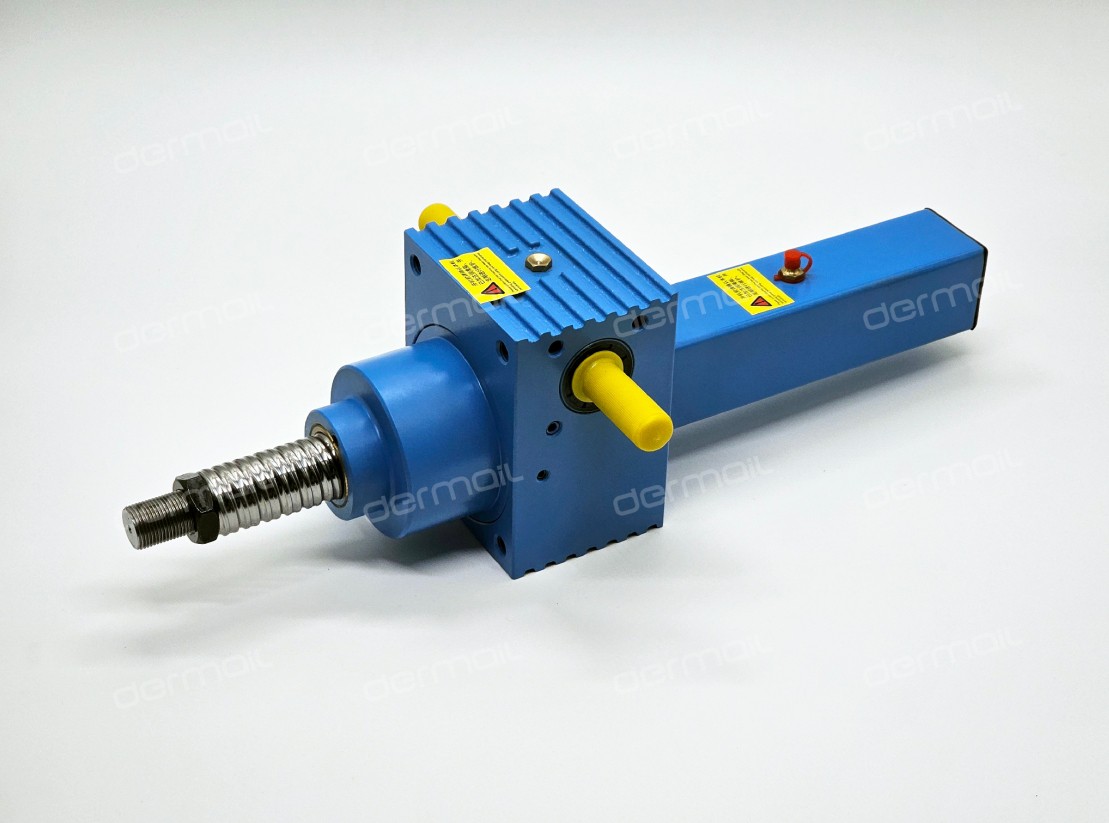
1. Structural Design Constraints
1.1 Thread Geometry and Force Distribution
The core of a dermail transmission’s screw jack lies in the threaded engagement between the screw (lead screw) and the nut. The threads are typically designed with specific profiles, such as trapezoidal or square threads, which are optimized for axial force transmission. When an axial load is applied, the force is evenly distributed along the thread flanks in a direction parallel to the screw axis.
In contrast, when a lateral force is introduced, it acts perpendicular to the screw axis. This lateral force creates uneven stress distribution on the thread flanks. The side of the thread facing the direction of the lateral force experiences excessive compression, while the opposite side may be subjected to tension. Such uneven stress can lead to thread deformation, including flattening of the thread flanks or even thread breakage. For example, in a trapezoidal - threaded screw jack, a lateral force can cause the trapezoidal threads to lose their geometric integrity, affecting the smooth engagement between the screw and the nut.
1.2 Screw and Nut Alignment
Screw jacks rely on precise alignment between the screw and the nut for efficient operation. The screw is usually supported by bearings at both ends to ensure it rotates smoothly around its axis. When a lateral force is applied, it can cause the screw to bend or deflect. This bending disrupts the alignment between the screw and the nut, leading to increased friction and wear.
As the screw bends, the contact area between the screw and the nut changes, and the force is no longer evenly distributed. The nut may start to bind on the screw, causing jerky motion or even complete seizure. In severe cases, the lateral force can cause the screw to come into contact with the housing or other components of the screw jack, resulting in damage to both the screw and the surrounding parts.
1.3 Supporting Structure Limitations
The supporting structure of a screw jack, which includes the housing, bearings, and other mounting components, is designed to handle axial loads. The bearings are typically selected based on their ability to support radial and axial loads in the direction of the screw axis. When a lateral force is applied, it imposes additional radial loads on the bearings that they are not designed to handle.
Excessive lateral forces can cause the bearings to overheat, wear prematurely, or even fail. The housing may also deform under the lateral load, affecting the overall stability and performance of the screw jack. For instance, if the housing is made of a relatively thin - walled material, a significant lateral force can cause it to buckle, compromising the integrity of the entire device.
2. Material Properties and Fatigue
2.1 Material Selection for Axial Loads
The materials used in the construction of screw jacks, such as steel for the screw and nut, are chosen based on their strength and durability under axial loads. These materials are optimized to resist compression, tension, and shear forces in the direction of the screw axis.
However, when subjected to lateral forces, the material properties are put to a different test. Lateral forces introduce bending stresses into the screw and nut, which can cause fatigue failure over time. Even if the initial lateral force is within the static strength limit of the material, repeated application of lateral forces can lead to the formation and propagation of cracks.
For example, in a high - cycle application where the screw jack is subjected to frequent lateral vibrations, the material may develop micro - cracks at the stress concentration points, such as the thread roots. These cracks can gradually grow until they cause catastrophic failure of the screw or nut.
2.2 Thermal Effects
Lateral forces can also lead to increased friction and heat generation within the screw jack. As the screw bends and the nut binds under the lateral load, more energy is dissipated as heat. This rise in temperature can have a detrimental effect on the material properties.
High temperatures can reduce the yield strength and fatigue resistance of the materials used in the screw jack. For instance, if the temperature exceeds the recommended operating range of the bearing grease, it can lead to lubrication failure, further increasing friction and wear. Over time, the combined effects of thermal stress and mechanical stress from lateral forces can significantly shorten the service life of the screw jack.
3. Operational and Safety Considerations
3.1 Predictable Performance
Screw jacks are designed to provide predictable and consistent linear motion under axial loads. Engineers can calculate the expected performance, such as the lifting capacity, speed, and accuracy, based on the known properties of the materials and the design of the threaded engagement.
When lateral forces are introduced, the performance of the screw jack becomes unpredictable. The increased friction, wear, and potential for component failure make it difficult to accurately control the linear motion. This lack of predictability can be a significant safety hazard, especially in applications where precise positioning is critical, such as in medical equipment or aerospace systems.
3.2 Safety Margins
The design of screw jack system incorporates safety margins to account for normal operating conditions and potential overloads within the axial load range. However, these safety margins are not intended to handle lateral forces. Applying lateral forces can quickly exceed the designed safety limits, leading to sudden and unexpected failures.
For example, if a screw jack is used to support a heavy load and a lateral force is accidentally applied, the combined stress on the components may cause the screw to break or the nut to disengage, resulting in the load falling and potentially causing serious injury or property damage.
In conclusion, screw jacks are not capable of withstanding lateral forces due to their structural design, material limitations, and operational and safety considerations. To ensure the reliable and safe operation of screw jacks, it is essential to use them within their designed load - bearing capacity and avoid subjecting them to lateral forces.








Tel:+86-317-7369999
E-mail: demai@demai.org
Mobile:+86-18653450543 (Wechat)
Address:No. 6, Haihe Road, economic development zone, Wuqiao County, Cangzhou City, Hebei Province

点击右上角
分享给朋友吧
Copyright ©2023 All Rights Reserved Hebei Demai Transmission Machinery Co.,Ltd.
Copyright ©2025 All Rights Reserved Hebei Demai Transmission Machinery Co.,Ltd.
