
Introduction and Application Scope of Bevel Gear Screw Jacks
2025-09-26 15:30:37
Click:
“
s article provides a comprehensive overview of bevel gear screw jacks, covering their basic structure, working principles, and delving into their wide - ranging application scenarios.
”
Abstract
Bevel gear screw jacks, as a crucial mechanical transmission device, play an indispensable role in various industrial sectors. This article provides a comprehensive overview of bevel gear screw jacks, covering their basic structure, working principles, and delving into their wide - ranging application scenarios.
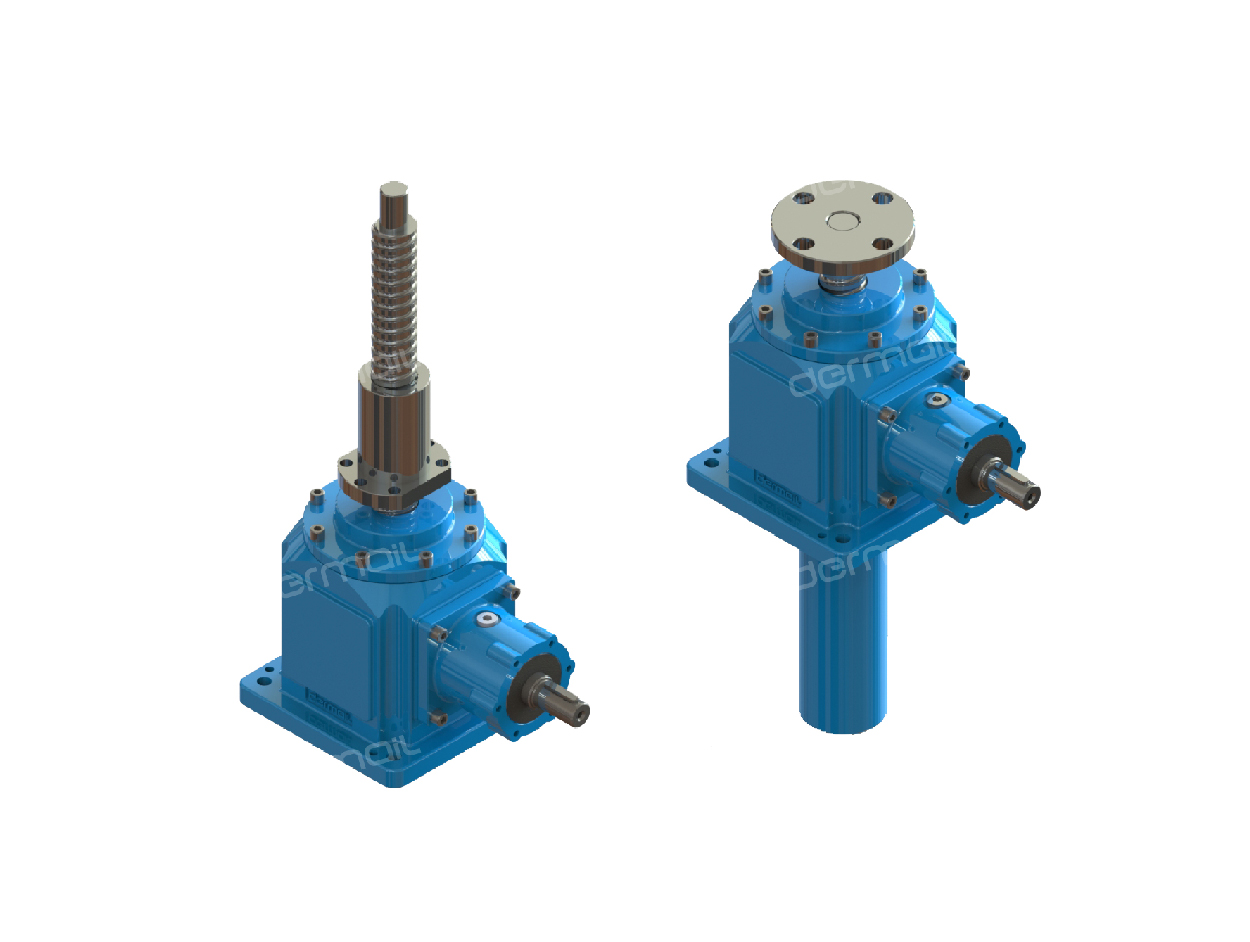
1. Introduction
In the realm of modern industrial machinery, the demand for precise, reliable, and versatile lifting and positioning solutions is ever - increasing. Dermail transmission bevel gear screw jacks have emerged as a popular choice to meet these requirements. They combine the advantages of bevel gear transmission and screw - nut mechanisms, offering efficient and stable performance in a variety of settings.
2. Basic Structure and Working Principle
2.1 Structure
A bevel gear screw jack typically consists of several key components. The bevel gear set is the core of the power transmission system. It includes an input bevel gear and an output bevel gear, which are meshed together at a right - angle. This arrangement allows for the change of the direction of power transmission, making it possible to drive the screw from different angles.
The screw is another essential part. It is usually a trapezoidal screw or a ball screw. The trapezoidal screw has a simple structure and is suitable for applications with relatively low precision requirements and high load - bearing capacity. The ball screw, on the other hand, offers higher precision and lower friction due to the use of ball bearings between the screw and the nut.
The nut is mounted on the screw and is connected to the load - bearing part. As the screw rotates, the nut moves linearly along the screw, thus achieving the lifting or lowering of the load. The housing encloses all these components, providing protection and support.
2.2 Working Principle
The operation of a bevel gear screw jacks starts with the input of rotational power, usually from an electric motor or a hand - operated crank. This power is transmitted to the input bevel gear. Through the meshing of the bevel gears, the rotational motion is redirected and transferred to the screw. As the screw rotates, the nut moves along its axis. Depending on the direction of the screw's rotation, the nut can either lift the load upwards or lower it downwards. The self - locking property of the screw - nut mechanism ensures that the load remains in a stable position even when the power is cut off, providing a high level of safety.
3. Application Scope
3.1 Industrial Manufacturing
- Machine Tool Adjustment: In machine tool applications, bevel gear screw jacks are used to adjust the height and position of worktables, tool holders, and other components. For example, in a milling machine, precise adjustment of the worktable is crucial for achieving accurate machining. The screw jack allows for fine - tuning of the table's position, ensuring that the workpiece is in the correct position relative to the cutting tool.
- Assembly Lines: On assembly lines, these screw jacks are employed to lift and position heavy components during the assembly process. In automotive manufacturing, they can be used to lift car bodies to the appropriate height for the installation of various parts, such as engines and chassis components. This improves the efficiency and accuracy of the assembly process.
3.2 Construction and Architecture
- Building Elevation: Bevel gear screw jacks are used in construction projects for elevating and leveling building components. For instance, in the construction of large - span structures like stadiums and bridges, they can be used to adjust the height of pre - fabricated sections during assembly. This helps in ensuring the proper alignment and stability of the structure.
- Stage and Theater Equipment: In theaters and concert halls, screw jacks are used to lift and lower stage platforms, scenery, and lighting equipment. They provide precise control over the movement of these elements, allowing for smooth transitions during performances.
3.3 Material Handling
- Conveyor Systems: In material handling applications, bevel gear screw jacks can be used to adjust the height of conveyor belts. This is useful in situations where different types of materials need to be processed at different heights or when the conveyor system needs to be integrated with other equipment.
- Warehouse Storage: In warehouses, screw jacks can be used to lift and position storage racks. This allows for efficient use of vertical space and easy access to stored goods.
3.4 Aerospace and Defense
- Aircraft Maintenance: In aircraft maintenance facilities, bevel gear screw jacks are used to lift and support aircraft during inspections, repairs, and maintenance operations. They provide a stable and reliable platform for technicians to work on the aircraft.
- Military Equipment: In the defense sector, these screw jacks can be used in various applications, such as adjusting the height of artillery pieces, radar antennas, and other military equipment. Their robust design and high load - bearing capacity make them suitable for harsh military environments.
4. Conclusion
Bevel gear screw jacks are versatile mechanical devices with a wide range of applications in different industries. Their unique combination of bevel gear transmission and screw - nut mechanisms provides efficient, precise, and reliable lifting and positioning solutions. As industrial technology continues to advance, the demand for bevel gear screw jacks is likely to grow, and further innovations in their design and performance can be expected to meet the evolving needs of various sectors.








Tel:+86-317-7369999
E-mail: demai@demai.org
Mobile:+86-18653450543 (Wechat)
Address:No. 6, Haihe Road, economic development zone, Wuqiao County, Cangzhou City, Hebei Province

点击右上角
分享给朋友吧
Copyright ©2023 All Rights Reserved Hebei Demai Transmission Machinery Co.,Ltd.
Copyright ©2025 All Rights Reserved Hebei Demai Transmission Machinery Co.,Ltd.
