
Essential Pre-Startup Inspection Checklist for Screw Jack Systems
2025-09-25 13:35:14
Click:
“
To ensure safe and efficient operation, a thorough pre-startup inspection is mandatory before initial use. This article outlines the key checks required to mitigate risks and extend equipment lifespan.
”
Screw jacks, also known as worm gear screw lifts, are critical components in industrial machinery for precise linear motion control. To ensure safe and efficient operation, a thorough pre-startup inspection is mandatory before initial use. This article outlines the key checks required to mitigate risks and extend equipment lifespan.
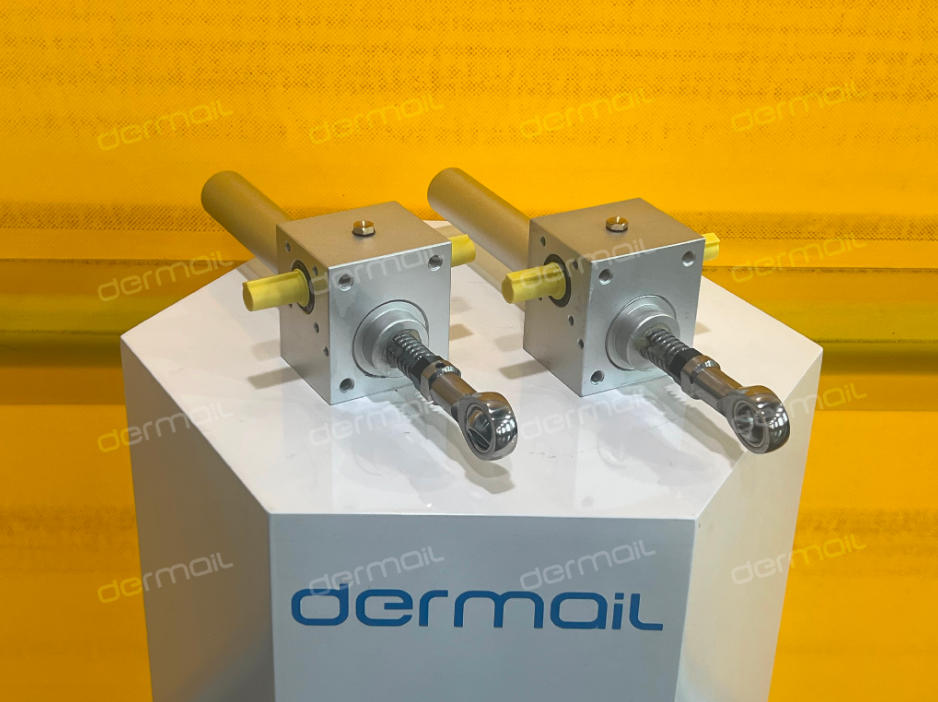
1. Mechanical Integrity Verification
1.1 Fastener Tightness
- Scope: Inspect all bolts, nuts, and retaining rings on the worm gear, screw rod, bearings, couplings, and motor mounts.
- Method: Use a calibrated torque wrench to verify tightness against manufacturer specifications (e.g., ISO 898-1 standards). Pay special attention to anti-backlash nuts on the screw rod to prevent loosening during operation.
- Risk: Loose fasteners can cause gear misalignment, screw bending, or catastrophic component failure.
1.2 Wear and Clearance Assessment
- Worm Gear Inspection:
- Measure backlash between worm and gear teeth using a dial indicator (typical tolerance: 0.1–0.3 mm).
- Check for pitting, scoring, or excessive wear (tooth thickness reduction >10% warrants replacement).
- Screw Rod Condition:
- Inspect for straightness (runout ≤0.1 mm/m via laser alignment tools).
- Verify surface finish (Ra ≤1.6 μm) to prevent premature wear on nut interfaces.
- Bearing Play Test:
- Manually rotate bearings to detect roughness or excessive endplay (>0.05 mm indicates replacement needs).
1.3 Structural Stability
- Confirm the mounting base is rigid and level (tilt angle <0.5°).
- Check for cracks or deformation in housing castings using dye penetrant testing.
- Ensure guide rails or linear bearings are parallel to the screw axis (parallelism error ≤0.05 mm/m).
2. Electrical System Safety Checks
2.1 Power Supply Compliance
- Verify voltage matches motor ratings (e.g., 380V ±10% for three-phase motors).
- Measure phase-to-phase voltage balance (deviation <5%) to prevent motor overheating.
- Test insulation resistance between motor windings and ground (≥0.5 MΩ at 500V DC).
2.2 Motor and Control Functionality
- Rotation Direction: Perform a brief jog test to confirm motor spin aligns with screw lift direction (markings on housing should match actual motion).
- Thermal Protection: Simulate overload conditions to validate thermal relay or PTC sensor activation (typically at 120–130°C).
- Soft Start Verification: For VFD-controlled systems, ensure acceleration/deceleration ramps are set per load requirements (e.g., 5–10 seconds for heavy loads).
2.3 Safety Interlocks
- Test upper/lower limit switches by manually triggering them during no-load operation.
- Verify emergency stop (E-stop) functionality: pressing the button should cut power within 0.5 seconds and engage mechanical brakes if equipped.
- Check overload clutches or torque limiters for proper disengagement at 110–120% of rated load.
3. Lubrication System Audit
3.1 Oil/Grease Quality
- Oil Level: Maintain oil between min/max marks on the sight glass (ISO VG 32–68 for most applications).
- Contamination Analysis: Use a dipstick to check for metal particles or water emulsion (cloudy appearance).
- Grease Condition: For grease-lubricated bearings, confirm consistency (NLGI grade 2 for general use) and absence of hardening.
3.2 Distribution Efficiency
- Inspect oil lines for blockages using compressed air (pressure ≤0.3 MPa).
- For automated lubricators, activate the system to confirm even grease dispensing at all points.
- Check seals (O-rings, lip seals) for leaks or compression set (replace if permanent deformation exceeds 20%).
4. Environmental and Safety Compliance
4.1 Protective Enclosures
- Ensure guard covers over rotating parts (worm gear, couplings) are securely fastened.
- Verify dust seals on screw rods are intact to prevent abrasive particle ingress.
4.2 Hazard Zones
- Mark operational clearance zones (typically 1.5× the screw diameter) with safety tape.
- Post warning signs for pinch points, high-temperature surfaces, and electrical hazards.
4.3 Environmental Controls
- In corrosive environments, confirm anti-corrosion coatings (e.g., epoxy resin) are undamaged.
- For low-temperature applications (below -10°C), check for proper lubricant viscosity and heater functionality.
5. Functional Testing Protocol
5.1 No-Load Trial Run
- Operate the jack for 10–15 minutes at 25% of rated speed.
- Monitor for abnormal noise (>85 dB indicates bearing/gear issues) or vibration (acceleration >2.8 mm/s² requires investigation).
5.2 Load Validation
- Gradually increase load to 50% and 100% of rated capacity, each stage lasting 30 minutes.
- Record temperature rise (ΔT ≤40°C for bearings, ΔT ≤50°C for motors).
- Confirm positional accuracy (±0.1 mm for precision jacks) using laser interferometry.
Conclusion
A rigorous pre-startup inspection covering mechanical, electrical, lubrication, and safety systems is non-negotiable for screw jack reliability. By adhering to this checklist, operators can minimize downtime, avoid costly repairs, and ensure compliance with international standards such as ISO 9001 and ANSI/ASME B30.1. Always consult the manufacturer’s manual for model-specific guidelines and retain inspection records for warranty purposes.








Tel:+86-317-7369999
E-mail: demai@demai.org
Mobile:+86-18653450543 (Wechat)
Address:No. 6, Haihe Road, economic development zone, Wuqiao County, Cangzhou City, Hebei Province

点击右上角
分享给朋友吧
Copyright ©2023 All Rights Reserved Hebei Demai Transmission Machinery Co.,Ltd.
Copyright ©2025 All Rights Reserved Hebei Demai Transmission Machinery Co.,Ltd.
