
How to Ensure Long-Term Stability and Reliability of Screw Jacks
2025-09-19 09:20:50
Click:
“
Screw jacks are critical components in industrial machinery, automation systems, and heavy-load handling applications. Their long-term stability and reliability directly impact operational efficiency and safety.
”
Screw jacks are critical components in industrial machinery, automation systems, and heavy-load handling applications. Their long-term stability and reliability directly impact operational efficiency and safety. This article outlines a systematic approach to maintaining screw jacks, covering installation precision, maintenance protocols, operational discipline, component selection, and environmental adaptation.
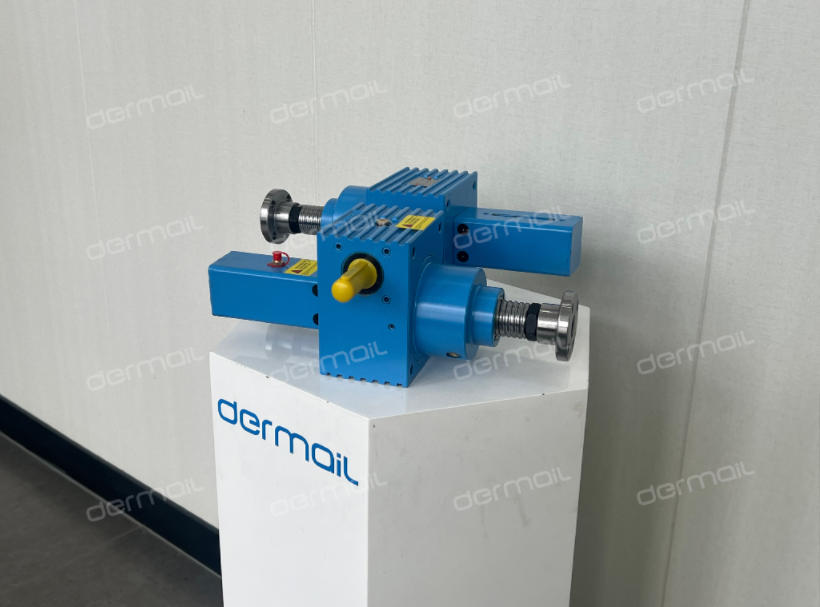
1. Precision Installation: The Foundation of Stability
a. Base and Shaft Alignment
- Leveling Accuracy: The installation base must be leveled with an error ≤ ±0.1 mm/m to prevent uneven load distribution. Use laser leveling tools for critical applications.
- Verticality Control: The screw shaft’s vertical deviation should not exceed 0.05°/m. Misalignment can induce side forces, accelerating wear on the nut and screw.
- Rigid Mounting: The housing must be securely fastened to a rigid structure (e.g., reinforced concrete or steel frame) to minimize vibration. Flexible mounts may cause resonance under dynamic loads.
b. Coupling and Drive System Calibration
- Coupling Tolerance: For flexible couplings, allowable misalignment should be within ±0.1 mm; rigid couplings require ≤ 0.02 mm form tolerance to avoid gear or worm shaft damage.
- Motor Alignment: Ensure the motor and gearbox share the same axis, with radial and axial errors ≤ 0.05 mm. Misalignment increases bearing stress and energy loss.
c. Guidance System Integration
- Load-Specific Guidance:
- Light loads (<1 ton): Use low-friction linear guides (μ ≤ 0.003) to reduce screw radial load.
- Heavy loads (≥1 ton): Install guide columns with sliding bushings (clearance: 0.1–0.3 mm) to absorb lateral forces.
- Anti-Rotation Design: For single-screw jacks, add anti-rotation keys or flanges to prevent nut rotation under load.
2. Proactive Maintenance: Preventing Premature Failure
a. Routine Inspections
- Daily Checks:
- Monitor lubrication levels (e.g., lithium grease for screw-nut pairs) and replenish as needed.
- Inspect bolts for tightness (e.g., M16 bolts require ≥180 N·m torque).
- Listen for abnormal noises (e.g., periodic clunking indicates gear pitting).
- Monthly Checks:
- Measure screw straightness with a dial indicator (full-stroke error ≤ 0.1 mm).
- Test limit switches for responsiveness (reaction time ≤ 0.1 s).
b. Scheduled Overhauls
- Minor Service (1,500 hrs):
- Replace gearbox oil (e.g., ISO VG 32/46 hydraulic oil).
- Clean breathers to prevent moisture ingress.
- Major Service (10,000 hrs):
- Inspect worm gear teeth for pitting (replace if wear exceeds 15% of tooth thickness).
- Recalibrate motor-gearbox alignment (error ≤ 0.05 mm).
c. Component Replacement Criteria
- Screw-Nut Pair: Replace if backlash exceeds 0.1 mm (trapezoidal screws) or 0.01 mm (ball screws).
- Bearings: Replace if vibration amplitude doubles or noise level rises above 75 dB(A).
3. Operational Discipline: Extending Service Life
a. Load Management
- Dynamic Load Limit: Operate within 80% of rated capacity to avoid shock loads (acceleration ≤ 0.5 m/s²).
- Eccentric Load Mitigation: Use counterbalance valves or dual-screw systems to limit load offset to ≤1/3 of screw diameter.
b. Speed and Temperature Control
- Velocity Limits:
- Trapezoidal screws: ≤0.5 m/s (higher speeds cause excessive heat).
- Ball screws: ≤1.2 m/s (with forced lubrication).
- Thermal Monitoring: Install infrared sensors to track housing temperature (alert at ≥65°C).
c. Emergency Protocols
- Overload Protection: Fit torque limiters (activation at 120–150% of rated torque).
- Fall Arrest: Equip safety clutches or brakes to engage within 0.5 s during power failure.
4. Component Selection: Matching Application Demands
a. Screw Type Selection
- Trapezoidal Screws: Preferred for static loads or self-locking applications (efficiency: 30–50%).
- Ball Screws: Ideal for high-speed, dynamic loads (efficiency ≥90%, backlash <0.01 mm).
- Planetary Roller Screws: Suitable for ultra-heavy loads (e.g., nuclear equipment) with 5× longer life than ball screws.
b. Material and Coating
- Corrosive Environments: Use 316L stainless steel or zinc-nickel plating (salt spray resistance ≥500 hrs).
- High-Temperature Settings: Opt for silicon-based lubricants (operable up to 200°C).
c. Redundancy Design
- Critical Applications: Deploy dual-screw systems with synchronized controllers (error ≤0.5 mm).
- Backup Units: Maintain spare jacks for rapid replacement during downtime.
5. Environmental Adaptation: Protecting Against External Factors
a. Dust and Moisture Control
- Sealing: Use IP65-rated housings or bellow covers to block contaminants.
- Ventilation: Install desiccant breathers in humid environments to maintain <40% RH inside gearboxes.
b. Thermal Management
- Sun Exposure: Add reflective coatings (albedo ≥85%) to outdoor units.
- Cold Climates: Use low-temperature grease (e.g., PAO-based oils for ≤-40°C operation).
Conclusion
By integrating precision installation, structured maintenance, disciplined operation, tailored component selection, and environmental safeguards, dermail transmission screw jacks can achieve MTBF (Mean Time Between Failures) exceeding 20,000 hours and service lives of 15+ years. For instance, automotive assembly lines adopting these practices reduced unplanned downtime by 70% and extended maintenance intervals by 40%. Continuous monitoring through IoT sensors (e.g., vibration, temperature analytics) further enhances predictive maintenance capabilities, ensuring peak performance in demanding industrial settings.








Tel:+86-317-7369999
E-mail: demai@demai.org
Mobile:+86-18653450543 (Wechat)
Address:No. 6, Haihe Road, economic development zone, Wuqiao County, Cangzhou City, Hebei Province

点击右上角
分享给朋友吧
Copyright ©2023 All Rights Reserved Hebei Demai Transmission Machinery Co.,Ltd.
Copyright ©2025 All Rights Reserved Hebei Demai Transmission Machinery Co.,Ltd.
