
Introduction and User Guide to Screw Jacks
2025-08-19 10:03:56
Click:
“
A screw jack, also known as a jack screw or worm gear screw jack, is a mechanical device designed to convert rotational motion into linear motion, enabling precise lifting, lowering, or positioning of heavy loads.
”
A screw jack is a mechanical device that converts rotational motion into precise linear motion, commonly used for lifting, lowering, or positioning heavy loads. It operates via a worm gear mechanism driving a threaded lead screw, offering high load capacity (up to hundreds of tons) and self-locking capabilities for safety.
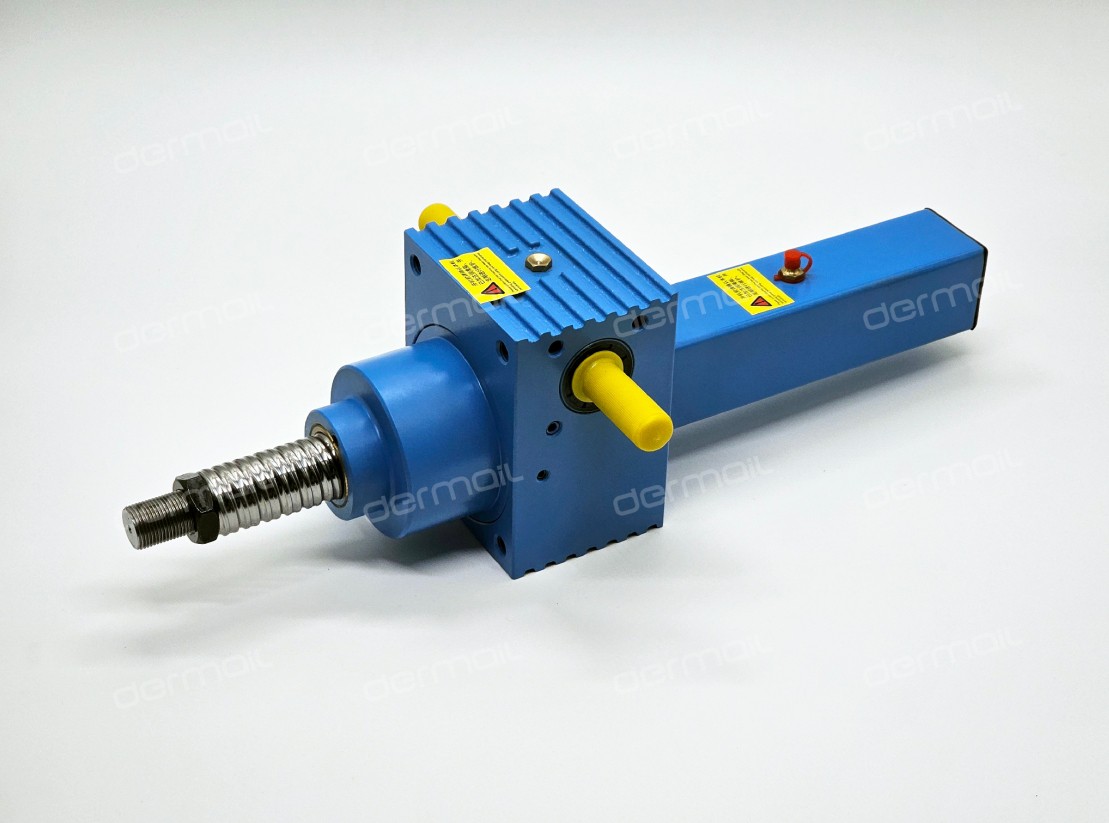
1. Overview of Screw Jacks
A screw jack, also known as a jack screw or worm gear screw jack, is a mechanical device designed to convert rotational motion into linear motion, enabling precise lifting, lowering, or positioning of heavy loads. It consists of a threaded screw (lead screw) and a worm gear mechanism, which provides mechanical advantage through high reduction ratios.
Key Features:
- High Load Capacity: Capable of handling loads ranging from a few kilograms to several hundred tons.
- Precision Control: Fine adjustments are possible due to the screw’s thread pitch.
- Compact Design: Space-efficient for applications with limited installation areas.
- Self-Locking: The trapezoidal or square thread design prevents unintended movement under load, enhancing safety.
- Durable Construction: Typically made of steel or aluminum alloys for long-term reliability.
Applications:
Dermail transmission screw jacks are widely used in industries such as construction, automotive, aerospace, manufacturing, and stage equipment for tasks like:
- Lifting platforms or heavy machinery.
- Adjusting conveyor systems.
- Positioning solar panels or antennas.
- Supporting structural testing rigs.
2. How Screw Jacks Work
The core components of a screw jack include:
- Worm Gear: Driven by a motor or manual crank, it rotates the worm shaft.
- Worm Wheel: Engages with the worm gear to transfer motion to the lead screw.
- Lead Screw: The threaded rod that moves linearly as the worm wheel rotates.
- Nut or Housing: Secures the screw and distributes the load.
When the worm gear rotates, it drives the worm wheel, which in turn rotates the lead screw. The screw’s threads interact with the nut or housing, converting rotational force into vertical or horizontal displacement.
3. User Instructions for Screw Jacks
3.1 Installation
- Mounting: Secure the screw jack to a stable, level surface using bolts or mounting brackets. Ensure alignment to prevent binding.
- Load Distribution: Position the load evenly to avoid eccentric forces that could damage the screw or housing.
- Lubrication: Apply grease or oil to the screw threads and gears as recommended by the manufacturer to reduce friction and wear.
3.2 Operation
- Manual Operation:
- Use a hand crank or lever to rotate the worm gear.
- Apply steady force and avoid sudden movements.
- Motorized Operation:
- Connect the motor to the worm shaft per the wiring diagram.
- Start the motor at low speed to ensure smooth engagement.
- Use limit switches or sensors to prevent over-travel.
3.3 Safety Precautions
- Overload Protection: Never exceed the rated load capacity. Use load cells or safety stops if required.
- Regular Inspections: Check for wear, corrosion, or misalignment. Replace worn components immediately.
- Lock Mechanisms: Engage brakes or locking pins when the jack is stationary under load.
- Environmental Considerations: Avoid exposure to dust, moisture, or extreme temperatures unless the jack is rated for such conditions.
3.4 Maintenance
- Cleaning: Remove debris from threads and gears periodically.
- Lubrication: Reapply lubricant every 6–12 months or as specified.
- Component Replacement: Worn screws, nuts, or gears should be replaced by qualified technicians.
4. Conclusion
Screw jacks are versatile, reliable tools for precise linear motion control in industrial and commercial settings. By following proper installation, operation, and maintenance procedures, users can maximize their lifespan and ensure safe performance. Always refer to the manufacturer’s guidelines for model-specific instructions and technical specifications.
For further assistance, contact your supplier or consult a mechanical engineer to select the right screw jack for your application.








Tel:+86-317-7369999
E-mail: demai@demai.org
Mobile:+86-18653450543 (Wechat)
Address:No. 6, Haihe Road, economic development zone, Wuqiao County, Cangzhou City, Hebei Province

点击右上角
分享给朋友吧
Copyright ©2023 All Rights Reserved Hebei Demai Transmission Machinery Co.,Ltd.
Copyright ©2025 All Rights Reserved Hebei Demai Transmission Machinery Co.,Ltd.
