
How Do Screw Jacks Achieve Self-Locking? Is This Mechanism Reliable?
2025-08-06 15:31:34
Click:
“
Screw jacks are widely used in industrial applications requiring precise lifting, lowering, or positioning of heavy loads, such as in manufacturing equipment, construction machinery, and aerospace systems.
”
Screw jacks are widely used in industrial applications requiring precise lifting, lowering, or positioning of heavy loads, such as in manufacturing equipment, construction machinery, and aerospace systems. A key feature of many screw jacks is their self-locking capability, which prevents unintended movement under load without external braking systems. This article explains the principles behind safely self-locking, factors affecting its reliability, and practical considerations for engineers.
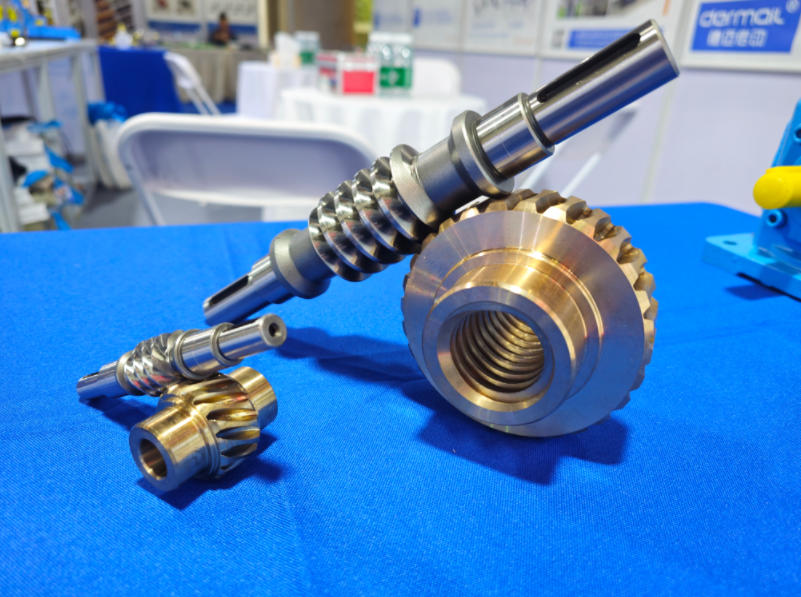
1. The Mechanics of Self-Locking in Screw Jacks
Self-locking occurs when a screw jack’s design inherently resists reverse rotation (i.e., the load cannot drive the screw backward). This is governed by the thread geometry and friction between the screw and the nut.
a. Thread Angle and Lead Angle
- The lead angle (λ) is the angle between the helix of the screw thread and a plane perpendicular to the screw axis.
- For a screw to be self-locking, the lead angle must satisfy:
λ≤arctan(μ)
where μ is the coefficient of friction between the screw and nut.
- Example: If μ=0.15 (steel-on-steel with lubrication), the critical lead angle is arctan(0.15)≈8.5∘. Screws with lead angles ≤8.5° will self-lock under load.
b. Friction’s Role
- Friction acts as a resistive force when an external load tries to rotate the screw.
- Static Friction: Dominates when the screw is stationary, preventing motion until the applied torque exceeds the breaking torque.
- Dynamic Friction: Reduces slightly during movement but still contributes to self-locking during intermittent loads.
c. Types of Self-Locking Screw Jacks
- Trapezoidal Threads (e.g., Acme, Tr):
- Widely used due to their high strength and moderate friction.
- Lead angles typically range from 5° to 15°, making them inherently self-locking under most loads.
- Ball Screws:
- Use recirculating ball bearings to reduce friction, often requiring external brakes for locking.
- Not self-locking unless preloaded with extreme force (impractical for most applications).
2. Factors Affecting Self-Locking Reliability
While self-locking is a robust mechanism, its reliability depends on several variables:
a. Coefficient of Friction (μ)
- Lubrication: Reduces μ, potentially compromising self-locking.
- Solution: Use high-friction lubricants (e.g., molybdenum disulfide) or dry-film coatings in self-locking designs.
- Material Pairing: Bronze nuts on steel screws offer higher μ than plastic-on-metal combinations.
b. Load Magnitude and Direction
- Axial Load: Self-locking is most effective under pure axial loads.
- Radial/Moment Loads: Introduce bending stresses that may reduce friction, increasing the risk of slippage.
c. Thread Wear and Backlash
- Worn threads reduce contact area, lowering μ and weakening self-locking.
- Mitigation: Regular maintenance (e.g., replacing worn nuts or adjusting preload) is critical.
d. Temperature and Environment
- High Temperatures: May soften materials or degrade lubricants, reducing μ.
- Contamination: Dust or moisture can act as lubricants, lowering friction.
3. Is Self-Locking Reliable? Practical Considerations
a. Safety-Critical Applications
- In systems like elevators or medical tables, self-locking alone may not suffice.
- Best Practice: Combine self-locking with mechanical brakes or redundant systems per ISO 13849 (safety of machinery).
b. Dynamic vs. Static Loads
- Static Loads: Self-locking is highly reliable (e.g., holding a platform in place).
- Dynamic Loads: Vibrations or shock loads can overcome static friction, necessitating additional locking mechanisms.
c. Design Verification
- Engineers should calculate the breaking torque (torque required to overcome self-locking):
Tbreak=2F⋅dm⋅tan(λ+ρ)
where F = axial load, dm = mean thread diameter, and ρ=arctan(μ).
- Testing: Validate self-locking performance under worst-case conditions (e.g., maximum load, high temperature).
4. Enhancing Self-Locking Performance
- Use Trapezoidal Threads: Prefer Acme or Tr threads over ball screws for self-locking needs.
- Optimize Lead Angle: Select a lead angle significantly below arctan(μ) (e.g., 5° for μ=0.15).
- Preload the Nut: Apply a slight compressive force to increase contact pressure and friction.
- Incorporate Fail-Safes: Add electromagnetic brakes or ratchet systems for redundancy.
Conclusion
Dermail Transmission screw jacks achieve self-locking through a combination of thread geometry and friction, offering a cost-effective and simple solution for preventing unintended motion. While inherently reliable under static or moderate loads, their performance can degrade due to wear, lubrication, or dynamic forces. Engineers must account for these factors during design and maintenance, supplementing self-locking with additional safety mechanisms in critical applications. By understanding the underlying physics and limitations, users can leverage screw jacks’ self-locking capabilities to create safe, efficient, and durable positioning systems.
References:
- ISO 3408 (Ball Screws – Specifications)
- Machinery’s Handbook, 30th Edition (Thread Geometry and Friction Calculations)
- ANSI B15.1 (Safety Standards for Mechanical Power Transmission)








Tel:+86-317-7369999
E-mail: demai@demai.org
Mobile:+86-18653450543 (Wechat)
Address:No. 6, Haihe Road, economic development zone, Wuqiao County, Cangzhou City, Hebei Province

点击右上角
分享给朋友吧
Copyright ©2023 All Rights Reserved Hebei Demai Transmission Machinery Co.,Ltd.
Copyright ©2025 All Rights Reserved Hebei Demai Transmission Machinery Co.,Ltd.
