
What Does the Speed Ratio Mean in Screw Jacks?
2025-07-26 09:13:09
Click:
“
In the realm of mechanical engineering and industrial automation, screw jacks pl
”
In the realm of mechanical engineering and industrial automation, screw jacks play a crucial role in lifting, lowering, and positioning heavy loads with precision and control. Among the various technical specifications associated with screw jacks, the speed ratio is a fundamental concept that significantly influences their performance and application. This article aims to demystify the meaning of the speed ratio in screw jacks, exploring its definition, calculation, and practical implications.
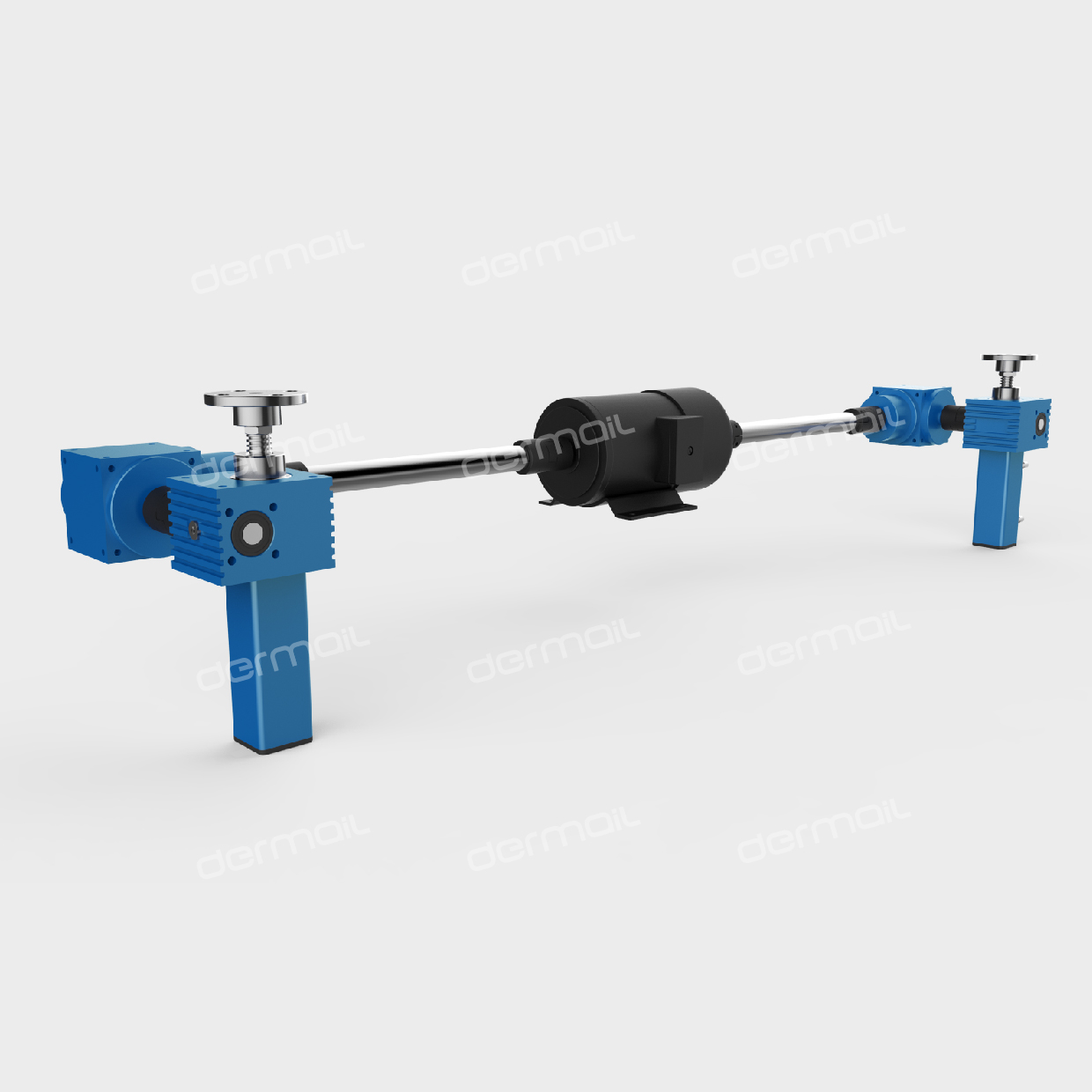
Definition of Speed Ratio in Screw Jacks
The speed ratio, also known as the reduction ratio, in a screw jack refers to the relationship between the input speed (usually the rotational speed of the driving mechanism, such as a motor or handwheel) and the output speed (the linear speed at which the load is lifted or lowered). It essentially quantifies how much the input speed is reduced or amplified to achieve the desired output speed.
Mathematically, the speed ratio (R) can be expressed as the ratio of the input speed (N_in) to the output speed (N_out):
R = N_in / N_out
However, in the context of screw jacks, where the output is linear motion, it's more common to relate the input rotational speed to the linear speed of the load. This relationship is influenced by the pitch of the screw (the distance between adjacent threads) and the gear reduction mechanism within the screw jack, if applicable.
Calculating Speed Ratio in Screw Jacks
To calculate the speed ratio in a screw jack, one must consider both the mechanical advantage provided by the screw's pitch and any additional gear reduction within the jack's housing. The basic formula for determining the linear speed (V_out) of the load, given the input rotational speed (N_in) and the screw pitch (P), is:
V_out = (N_in * P) / (60 * i)
Where:
- V_out is the linear output speed in units per minute (e.g., mm/min or inches/min).
- N_in is the input rotational speed in revolutions per minute (RPM).
- P is the pitch of the screw in the same units as V_out (e.g., mm or inches).
- i is the overall gear reduction ratio within the screw jack (if any). For a direct-drive screw jack without additional gearing, i = 1.
Rearranging this formula to solve for the speed ratio (considering i=1 for simplicity, unless gear reduction is specified) gives us an understanding of how the input speed translates to output speed based on the screw pitch:
R (in terms of speed conversion) ≈ (60 * desired output speed) / (input RPM * screw pitch)
However, in practice, the speed ratio is often provided by the manufacturer as a fixed value based on the design of the screw jack, incorporating both the screw pitch and any internal gearing.
Practical Implications of Speed Ratio
- Load Handling Capacity: A lower speed ratio (meaning higher output speed for a given input speed) may be suitable for applications requiring rapid positioning but with lighter loads. Conversely, a higher speed ratio (lower output speed) is preferred for heavy-duty applications where precise control and high force transmission are critical.
- Efficiency and Energy Consumption: The speed ratio affects the efficiency of the screw jack. Higher reduction ratios can lead to increased friction and energy losses, although modern designs with high-quality bearings and lubricants minimize this effect. Selecting an appropriate speed ratio helps optimize energy consumption for the specific application.
- Mechanical Advantage: The speed ratio is inversely related to the mechanical advantage of the screw jack. A higher speed ratio implies a lower mechanical advantage, meaning more input torque is required to lift the same load. This trade-off must be considered when selecting a screw jack for a particular task.
- System Design and Integration: Understanding the speed ratio is essential for integrating the screw jack into a larger mechanical system. It ensures compatibility with other components, such as motors, gearboxes, and control systems, in terms of speed and torque requirements.
Conclusion
The speed ratio in dermail transmission screw jacks is a vital parameter that dictates the relationship between input and output speeds, influencing load handling capacity, efficiency, mechanical advantage, and overall system design. By comprehending this concept, engineers and designers can make informed decisions when selecting and implementing screw jacks in various industrial applications, ensuring optimal performance, reliability, and cost-effectiveness. Whether for precise positioning tasks or heavy-duty lifting operations, choosing the right speed ratio is key to unlocking the full potential of screw jacks in modern machinery and automation systems.








Tel:+86-317-7369999
E-mail: demai@demai.org
Mobile:+86-18653450543 (Wechat)
Address:No. 6, Haihe Road, economic development zone, Wuqiao County, Cangzhou City, Hebei Province

点击右上角
分享给朋友吧
Copyright ©2023 All Rights Reserved Hebei Demai Transmission Machinery Co.,Ltd.
Copyright ©2025 All Rights Reserved Hebei Demai Transmission Machinery Co.,Ltd.
