
Multi-Unit Synchronous Operation Solution for Screw Jacks
2025-07-24 09:02:58
Click:
“
AbstractScrew jacks are widely used in industrial automation, construction machi
”
Abstract
Screw jacks are widely used in industrial automation, construction machinery, and precision lifting systems due to their high precision, compact structure, and self-locking capabilities. When handling heavy loads or requiring synchronized motion across multiple axes, multi-unit linkage solutions become essential. This article explores the technical principles, implementation methods, and key considerations for achieving reliable synchronous operation of multiple screw jacks.
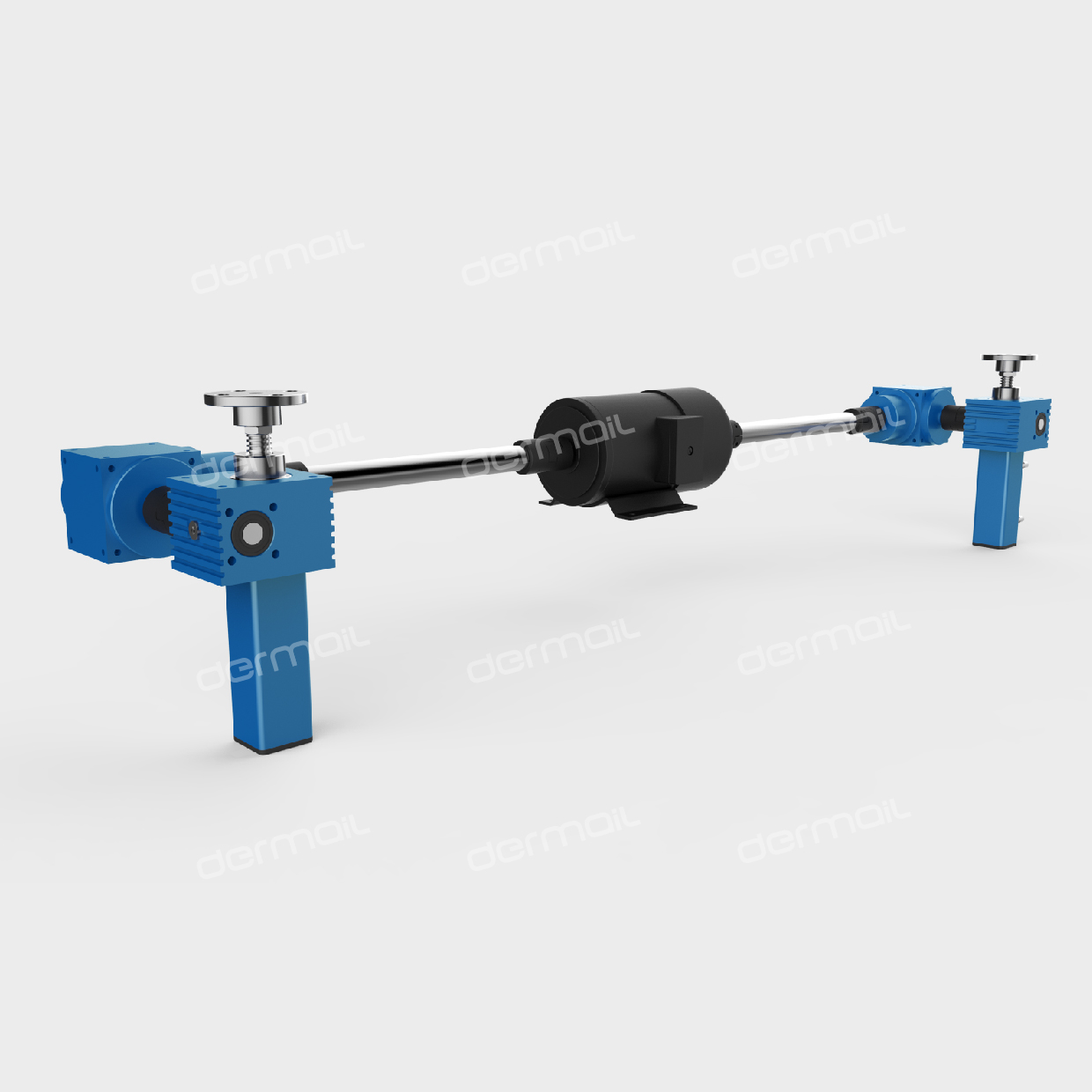
1. Overview of Multi-Unit Linkage Requirements
In applications such as large-scale stage lifting, heavy-duty conveyor systems, and solar tracking platforms, a single screw jack often fails to meet load capacity or stability demands. Multi-unit linkage enables:
- Enhanced Load Capacity: Distributing loads evenly across multiple units reduces stress on individual components.
- Improved Motion Precision: Synchronized lifting prevents platform tilting or deformation.
- System Redundancy: Failure of one unit does not necessarily halt operations, enhancing reliability.
Key challenges include maintaining synchronization accuracy (typically ≤0.1mm), minimizing mechanical backlash, and ensuring uniform load distribution.
2. Mechanical Linkage Design
2.1 Structural Layout Options
- I-Type Layout: Suitable for linear motion with parallel screw jacks.
- T-Type/H-Type Layout: Enables multi-directional force distribution (e.g., X-Y axis movement).
- Centralized Drive Configuration: A single motor drives multiple screw jacks via gearboxes or universal joints, reducing motor count.
2.2 Key Components Installation
- Coupling Alignment:
- Use flexible couplings to compensate for minor misalignment (angular error ≤1°, parallel error ≤0.1mm/m).
- Preheat couplings to 120–150°C for interference fits, ensuring concentricity within 0.05mm.
- Connecting Rods:
- Opt for high-strength alloy steel rods with precision machining (tolerance ±0.05mm).
- Incorporate telescopic joints or ball joints to accommodate thermal expansion and vibration.
- Load Platform:
- Ensure flatness error ≤0.05°/m to prevent radial forces on screw rods.
- Install linear guides or self-aligning bearings to constrain motion direction.
2.3 Synchronization Mechanisms
- Mechanical Synchronization:
- Rack-and-pinion systems or chain drives enforce rigid motion linkage.
- Suitable for low-speed, high-torque applications (e.g., heavy machinery adjustment).
- Electromechanical Synchronization:
- Each screw jack is equipped with an absolute encoder (resolution ≥10,000 pulses/rev).
- A PLC compares encoder feedback and adjusts motor speeds via variable frequency drives (VFDs) to compensate for deviations.
3. Electrical Control System Design
3.1 Drive System Selection
- Single-Motor Centralized Drive:
- Reduces cost and complexity but requires precise gear ratio matching.
- Example: A 7.5kW servo motor driving four screw jacks through a 10:1 gearbox.
- Multi-Motor Distributed Drive:
- Each screw jack has an independent motor with synchronized control.
- Requires real-time communication (e.g., EtherCAT, PROFINET) with cycle times ≤1ms.
3.2 Synchronization Control Strategies
- Master-Slave Control:
- One unit acts as the master, while others follow its position/speed feedback.
- Simple implementation but prone to error accumulation over long strokes.
- Cross-Coupled Control:
- Compares positions of all units and adjusts each motor’s output proportionally.
- Achieves synchronization accuracy ≤0.05mm in dynamic applications.
- Adaptive Control:
- Integrates load sensors to dynamically adjust torque distribution based on real-time stress data.
3.3 Safety Features
- Hardware Limit Switches:
- Mechanical stops at both ends of travel to prevent over-extension.
- Software Limits:
- Programmable position thresholds in the PLC to trigger emergency stops.
- Fault Diagnosis:
- Monitor current, vibration, and temperature to detect abnormal operation (e.g., overloading or misalignment).
4. Installation and Commissioning Procedures
4.1 Step-by-Step Installation
- Foundation Preparation:
- Ensure concrete base hardness ≥C30 and levelness ≤0.5mm/m.
- Unit Positioning:
- Use laser alignment tools to position screw jacks with spacing tolerance ±0.5mm.
- Mechanical Connection:
- Tighten coupling bolts to specified torque (e.g., M12 bolts at 85–105N·m).
- Electrical Wiring:
- Shield motor cables to reduce electromagnetic interference (EMI).
4.2 Commissioning Tests
- No-Load Test:
- Run the system at 25%, 50%, 75%, and 100% of rated speed to verify smooth operation.
- Load Test:
- Gradually apply load to 120% of rated capacity while monitoring synchronization error.
- Endurance Test:
- Continuous operation for 8 hours to check for thermal drift or component fatigue.
5. Case Study: Solar Tracking System
A 10MW solar power plant required precise tracking of 2,000 solar panels. The solution employed:
- 16 screw jacks (each rated for 50kN) arranged in an H-type layout.
- Centralized drive via a 15kW servo motor and planetary gearbox.
- Cross-coupled PLC control with absolute encoders achieving ±0.03mm synchronization accuracy.
- Result: Panel alignment error <0.1°, improving energy yield by 8% compared to single-axis systems.
6. Conclusion
Multi-unit linkage of Screw Jack systems combines mechanical precision with intelligent control to meet demanding industrial requirements. By optimizing layout design, selecting appropriate synchronization methods, and implementing rigorous testing protocols, engineers can achieve reliable, high-performance lifting systems. Future advancements in IoT-enabled predictive maintenance and AI-driven control algorithms will further enhance system efficiency and uptime.
Thank you for reading this article. If you have any demand for our products, please feel free to contact Dermail transmission at any time. Our technical engineers will serve you wholeheartedly.








Tel:+86-317-7369999
E-mail: demai@demai.org
Mobile:+86-18653450543 (Wechat)
Address:No. 6, Haihe Road, economic development zone, Wuqiao County, Cangzhou City, Hebei Province

点击右上角
分享给朋友吧
Copyright ©2023 All Rights Reserved Hebei Demai Transmission Machinery Co.,Ltd.
Copyright ©2025 All Rights Reserved Hebei Demai Transmission Machinery Co.,Ltd.
