
Comparative Study: Application Features of Bevel Gear Screw Jacks
2025-07-22 14:07:35
Click:
“
IntroductionBevel gear screw jacks, as precision mechanical devices combining be
”
Introduction
Bevel gear screw jacks, as precision mechanical devices combining bevel gear transmission and screw mechanism, are widely used in industrial automation, construction machinery, and logistics systems. However, different types of bevel gear screw jacks (such as single-drive, double-drive, and multi-drive systems) exhibit significant differences in practical applications due to their structural designs and transmission principles. This article systematically analyzes these differences from four perspectives: load capacity, motion control, installation flexibility, and environmental adaptability, providing practical guidance for engineering selection.
1. Load Capacity Differences
1.1 Single-Drive Systems
Single-drive bevel gear screw jacks feature compact structures with load capacities typically ranging from 0.5 to 50 tons. Their simple design makes them ideal for light-duty applications requiring precise positioning but limited force output. For instance, in semiconductor manufacturing equipment, single-drive jacks precisely adjust wafer stages with loads under 5 tons, achieving micron-level repeatability through high-precision screw threads (C3 grade or above) and minimal backlash bevel gears.
1.2 Multi-Drive Systems
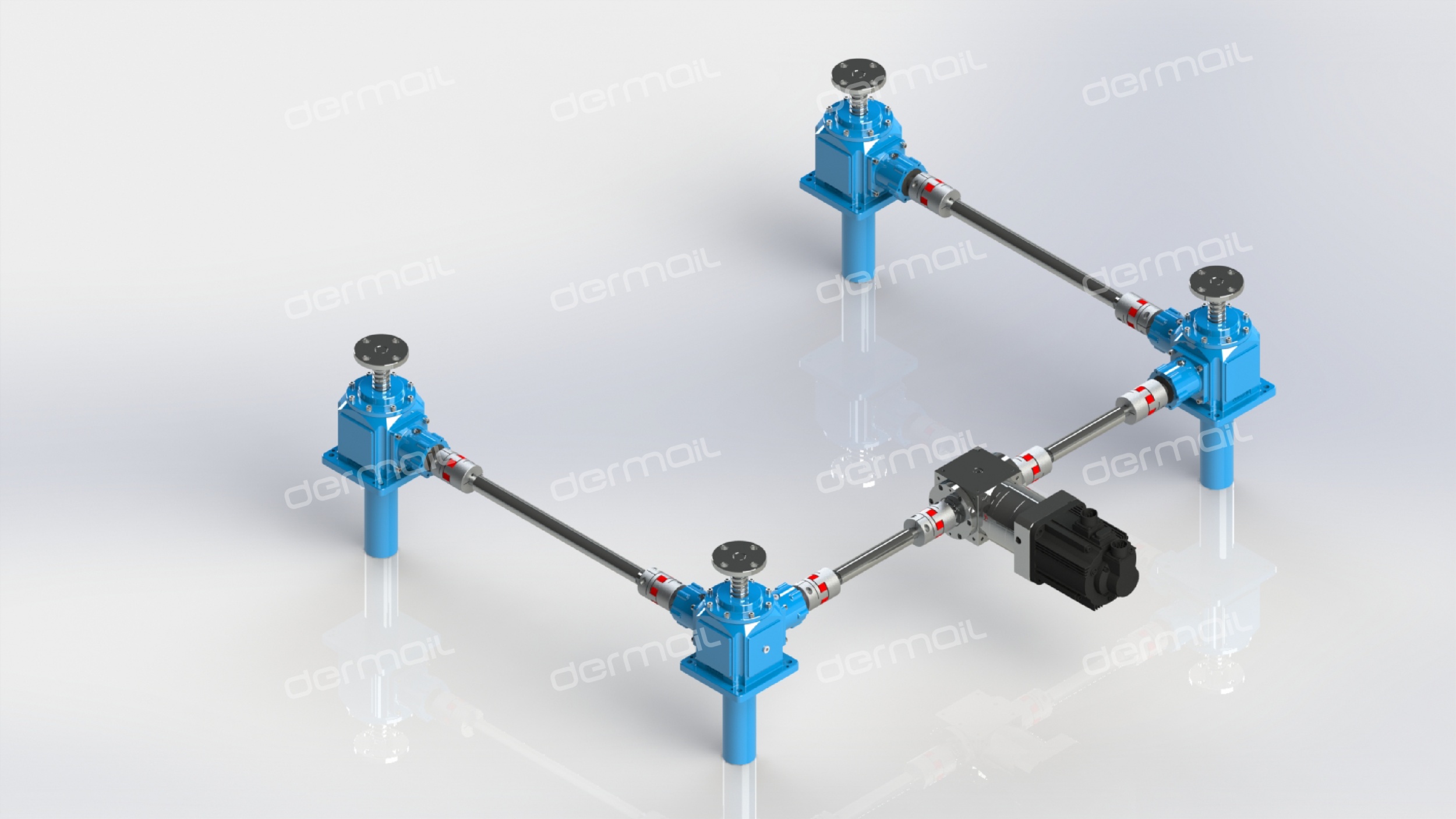
Multi-drive configurations (parallel or synchronous drive) distribute loads across multiple screws, enabling capacities exceeding 1000 tons. In heavy-duty applications like steel mill rolling mills, four synchronized bevel gear screw jacks jointly support 300-ton roll assemblies, with load distribution verified through finite element analysis to prevent single-point overload. The modular design allows capacity expansion by simply adding drive units.
2. Motion Control Characteristics
2.1 Single-Drive Precision Control
Single-drive systems offer superior motion control with positioning accuracy typically ±0.05mm and repeatability ±0.02mm. When integrated with servo motors and absolute encoders, they achieve closed-loop control with 0.001mm resolution. This precision makes them indispensable in CNC machine tool Z-axis drives, where thermal stability is enhanced through forced lubrication systems maintaining operating temperatures below 60°C.
2.2 Multi-Drive Synchronization Challenges
Multi-drive systems require sophisticated synchronization mechanisms to counteract manufacturing tolerances and installation errors. Advanced solutions include:
- Mechanical synchronization: High-precision coupling shafts with flexible elements compensate for angular misalignment (≤0.5°)
- Electronic synchronization: Dual-encoder feedback systems with cross-coupling control algorithms achieve synchronization errors <0.1mm
- Hydraulic synchronization: In extreme cases, proportional hydraulic valves maintain pressure balance across multiple cylinders
3. Installation Flexibility
3.1 Single-Drive Space Efficiency
The compact footprint of single-drive units (typically 150×150×300mm for 5-ton capacity) enables installation in confined spaces. Their vertical/horizontal universal mounting capability simplifies retrofitting in existing equipment. For example, in food packaging lines, right-angle bevel gear designs allow motor input at 90° to the screw axis, optimizing layout in cleanroom environments.
3.2 Multi-Drive System Configuration
Multi-drive installations demand precise geometric alignment:
- Parallel configurations: Require screw center distance tolerance ≤0.1mm/m
- Synchronous systems: Need phase alignment within ±5° to prevent vibration
- Foundation requirements: Heavy-duty applications mandate reinforced concrete bases with vibration isolation mounts to minimize resonance
4. Environmental Adaptability
4.1 Single-Drive Environmental Protection
Single-drive units offer versatile protection options:
- IP65 enclosure: Standard for dusty environments like woodworking machinery
- Stainless steel construction: Essential for food-grade applications requiring FDA compliance
- High-temperature variants: Special lubricants enable operation up to 150°C in foundry equipment
4.2 Multi-Drive System Robustness
Heavy-duty systems incorporate enhanced environmental protection:
- Double-seal designs: Prevent contaminant ingress in cement plants
- Corrosion-resistant coatings: Nickel plating for marine applications
- Explosion-proof variants: ATEX-certified for oil and gas industry use
Case Study Comparison
Automobile Welding Line Application
Single-Drive Solution:
- 8 units independently position welding clamps
- ±0.03mm positioning accuracy
- 2-ton capacity per unit
- Installation time: 4 hours/unit
Multi-Drive Solution:
- 4 synchronized units support 12-ton workpiece
- ±0.1mm synchronization error
- Reduced foundation cost by 30%
- Initial alignment time: 8 hours
Conclusion
The selection between single-drive and multi-drive bevel gear screw jacks depends on specific application requirements:
- Single-drive systems excel in precision-critical, light-duty applications with space constraints
- Multi-drive systems dominate heavy-load scenarios requiring force distribution and cost optimization
Future developments focus on:
- Smart jacks with integrated sensors for predictive maintenance
- Additive manufacturing of complex gear geometries for improved efficiency
- Magnetic gear alternatives eliminating mechanical wear
Engineers must evaluate total lifecycle costs, not just initial purchase price, when selecting between these configurations to achieve optimal system performance.








Tel:+86-317-7369999
E-mail: demai@demai.org
Mobile:+86-18653450543 (Wechat)
Address:No. 6, Haihe Road, economic development zone, Wuqiao County, Cangzhou City, Hebei Province

点击右上角
分享给朋友吧
Copyright ©2023 All Rights Reserved Hebei Demai Transmission Machinery Co.,Ltd.
Copyright ©2025 All Rights Reserved Hebei Demai Transmission Machinery Co.,Ltd.
