
Key Components of Screw Jacks: A Comprehensive Overview
2025-06-11 16:07:39
Click:
“
Screw jacks are essential mechanical devices widely used for lifting, lowering,
”
Screw jacks are essential mechanical devices widely used for lifting, lowering, and positioning heavy loads with precision. Their robust design and reliable performance make them indispensable in various industries, from manufacturing and construction to aerospace and automotive. To understand how screw jacks function and how to maintain them effectively, it is crucial to be familiar with their main components. This article provides an in-depth look at the key parts that make up a screw jack.
1. Screw (Lead Screw)
The screw, also known as the lead screw, is the heart of a screw jack. It is a long, threaded rod that converts rotational motion into linear motion. When the input shaft rotates, the screw moves either up or down, depending on the direction of rotation, thus lifting or lowering the load.
Screws are typically made from high-strength materials such as alloy steel or stainless steel to withstand the heavy loads and stresses they encounter. The thread profile of the screw can vary, with common types including trapezoidal, acme, and ball screws. Each thread profile has its own advantages in terms of efficiency, load capacity, and self-locking ability. For example, ball screws offer higher efficiency and lower friction compared to trapezoidal or acme screws, making them suitable for applications requiring fast and precise movement.
2. Nut
The nut is a threaded component that meshes with the screw. As the screw rotates, the nut moves along its length, transmitting the linear motion to the load. The nut is usually made from a material with good wear resistance, such as bronze or plastic, to reduce friction and extend the lifespan of the screw jack.
There are different types of nuts used in screw jacks, including self-lubricating nuts and anti-backlash nuts. Self-lubricating nuts contain embedded solid lubricants that reduce the need for external lubrication, while anti-backlash nuts are designed to minimize the clearance between the screw and the nut, improving the accuracy and repeatability of the screw jack's movement.
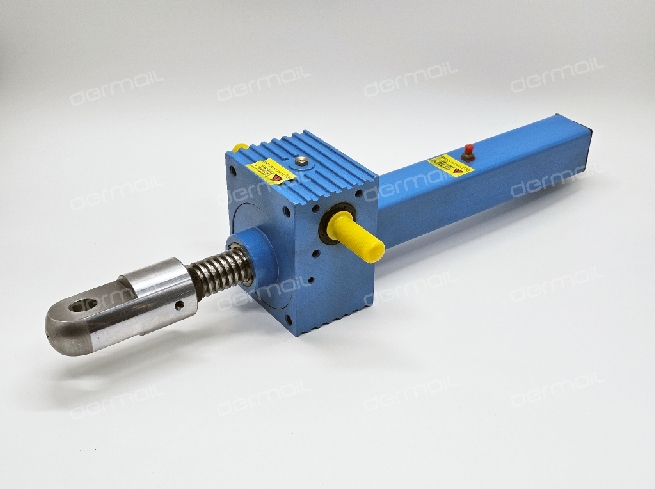
3. Housing
The housing is the outer casing that encloses and protects the internal components of the screw jack. It provides structural support and helps to align the screw and nut, ensuring smooth and efficient operation. The housing is typically made from cast iron, steel, or aluminum, depending on the application's requirements for strength, weight, and corrosion resistance.
In addition to its protective function, the housing may also include features such as mounting flanges, which allow the screw jack to be easily attached to other equipment or structures. Some housings are designed with integrated bearings to support the input shaft and reduce friction, further enhancing the performance of the screw jack.
4. Input Shaft
The input shaft is the component that transfers rotational motion to the screw. It is connected to a power source, such as an electric motor, hand crank, or hydraulic motor, and is responsible for driving the screw's rotation. The input shaft is usually made from high-strength steel and is supported by bearings within the housing to ensure smooth and stable operation.
The design of the input shaft can vary depending on the type of power source and the application's requirements. For example, some input shafts may have a keyway or spline to allow for easy connection to the power source, while others may have a worm gear or bevel gear arrangement to change the direction of rotation or increase the torque output.
5. Bearings
Bearings are critical components in a screw jack as they support the rotating parts, such as the input shaft and the screw, and reduce friction. There are several types of bearings used in screw jacks, including ball bearings, roller bearings, and plain bearings.
Ball bearings and roller bearings offer high efficiency and low friction, making them suitable for applications requiring high-speed operation. Plain bearings, on the other hand, are simpler in design and are often used in applications where low cost and self-lubrication are important. The selection of the appropriate bearing type depends on factors such as the load capacity, speed, and operating environment of the screw jack.
6. Seals
Seals are used to prevent contaminants, such as dust, dirt, and moisture, from entering the screw jack and damaging the internal components. They also help to retain lubricants within the jack, ensuring smooth and reliable operation. Common types of seals used in screw jacks include lip seals, O-rings, and mechanical seals.
Lip seals are a popular choice as they provide a good balance between sealing performance and cost. O-rings are simple and effective seals that are often used in static applications, while mechanical seals offer superior sealing performance and are suitable for high-pressure or high-temperature applications.
7. End Stops
End stops are safety devices that limit the travel of the screw jack to prevent over-extension or over-retraction. They can be mechanical, such as limit switches or adjustable stops, or electrical, such as proximity sensors. End stops help to protect the screw jack and the load from damage due to excessive movement and ensure safe operation.
In conclusion, a screw jack is a complex mechanical device composed of several key components that work together to provide reliable and precise lifting and positioning capabilities. Understanding the function and importance of each component is essential for proper selection, installation, and maintenance of screw jacks. By ensuring that all components are in good condition and functioning correctly, users can maximize the performance and lifespan of their screw jacks, reducing downtime and maintenance costs in the long run.








Tel:+86-317-7369999
E-mail: demai@demai.org
Mobile:+86-18653450543 (Wechat)
Address:No. 6, Haihe Road, economic development zone, Wuqiao County, Cangzhou City, Hebei Province

点击右上角
分享给朋友吧
Copyright ©2023 All Rights Reserved Hebei Demai Transmission Machinery Co.,Ltd.
Copyright ©2025 All Rights Reserved Hebei Demai Transmission Machinery Co.,Ltd.
