
An Introduction to the Functions of Screw Jacks
2025-06-11 11:44:16
Click:
“
An Introduction to the Functions of Screw JacksScrew jacks, also known as mechan
”
An Introduction to the Functions of Screw Jacks
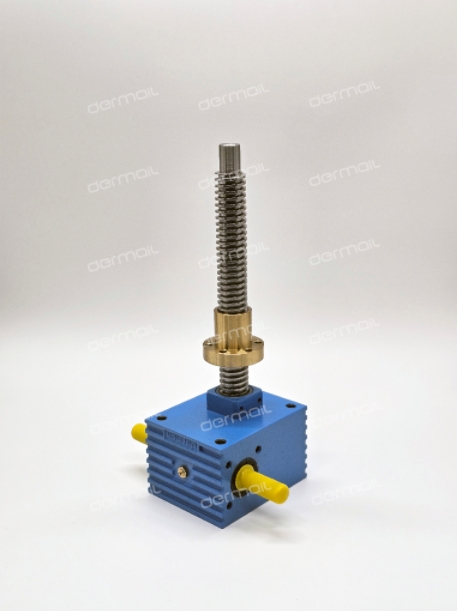
Screw jacks, also known as mechanical jacks or lead screw actuators, are versatile mechanical devices widely used in various industries for lifting, lowering, positioning, and applying force. These devices operate on the principle of converting rotational motion into linear motion, making them indispensable in applications requiring precise control and reliable performance. This article provides an overview of the key functions of screw jacks.
1. Lifting and Lowering Loads
The primary function of a screw jack is to lift and lower heavy loads with precision and stability. By rotating the input shaft, either manually or via an electric, hydraulic, or pneumatic motor, the screw within the jack moves linearly, raising or lowering the attached load. This capability is crucial in applications such as automotive lifts, stage equipment, and industrial machinery, where objects need to be positioned at different heights safely and accurately.
Screw jacks are known for their high load-bearing capacity. They can handle substantial weights, ranging from a few hundred kilograms to several tons, depending on the design and size of the jack. This makes them suitable for a wide range of industrial and commercial applications, from small-scale workshops to large manufacturing plants.
2. Positioning and Alignment
In addition to simple lifting and lowering, screw jacks excel at precise positioning and alignment tasks. The self-locking nature of most screw jacks, which prevents the load from descending unintentionally when the input shaft is not rotating, allows for accurate and stable positioning of loads. This is particularly important in applications where even slight misalignments can lead to significant problems, such as in the assembly of precision machinery, optical equipment, and aerospace components.
By using multiple screw jacks in a synchronized system, complex positioning tasks can be achieved. For example, in a large platform or stage, several screw jacks can be controlled simultaneously to ensure level and precise movement, enabling the adjustment of the platform's height, tilt, or orientation with high accuracy.
3. Force Application
Screw jacks can also be used to apply and control force in various mechanical systems. When a load is placed on the screw jack, the rotational input generates a linear force that can be used to push, pull, or clamp objects. This function is valuable in applications such as presses, tensioning systems, and material handling equipment, where a controlled and adjustable force is required.
The force output of a screw jack can be calculated based on the screw's pitch, lead, and the input torque. By adjusting these parameters, different force levels can be achieved, allowing for customization to meet specific application requirements. This flexibility makes screw jacks a popular choice in industries where varying force levels are needed, such as in the manufacturing of automotive parts, construction materials, and consumer electronics.
4. Speed Control
Screw jacks offer a degree of speed control, which is another important function in many applications. The linear speed of the screw's movement is directly related to the rotational speed of the input shaft and the screw's pitch. By varying the input speed, either through manual adjustment or by using a variable-speed motor, the lifting or lowering speed of the load can be controlled.
This speed control capability is beneficial in applications where a gradual or controlled movement is necessary, such as in the deployment of antennas, the adjustment of solar panels, and the operation of conveyor systems. It allows for smooth and precise movement, minimizing the risk of damage to the load or the surrounding equipment.
5. Overload Protection
Many screw jack system are designed with built-in overload protection mechanisms to ensure the safety of the equipment and operators. These mechanisms can include features such as torque limiters, shear pins, or electronic overload sensors. When an excessive load is applied to the screw jack, these protection devices activate, preventing damage to the jack and the connected machinery.
Overload protection is particularly important in applications where the load conditions may vary or where there is a risk of unexpected overloading, such as in material handling, construction, and mining operations. It helps to extend the lifespan of the screw jack and reduces the likelihood of costly downtime and repairs.
In conclusion, screw jacks are highly functional mechanical devices that play a vital role in a wide range of industries. Their ability to lift and lower loads, position and align objects, apply and control force, regulate speed, and provide overload protection makes them a versatile and reliable solution for many mechanical applications. As technology continues to advance, screw jacks are likely to evolve further, offering even greater precision, efficiency, and durability in the future.








Tel:+86-317-7369999
E-mail: demai@demai.org
Mobile:+86-18653450543 (Wechat)
Address:No. 6, Haihe Road, economic development zone, Wuqiao County, Cangzhou City, Hebei Province

点击右上角
分享给朋友吧
Copyright ©2023 All Rights Reserved Hebei Demai Transmission Machinery Co.,Ltd.
Copyright ©2025 All Rights Reserved Hebei Demai Transmission Machinery Co.,Ltd.
