
The Working Principle of Screw Jacks: A Mechanical Marvel
2025-06-11 16:34:33
Click:
“
Screw jacks are fundamental mechanical devices widely employed across various in
”
Screw jacks are fundamental mechanical devices widely employed across various industries for lifting, lowering, and positioning heavy loads with precision and reliability. Their simple yet effective design has made them indispensable in applications ranging from automotive manufacturing and construction to aerospace and material handling. To truly appreciate the value and versatility of screw jacks, it is essential to delve into their working principle.
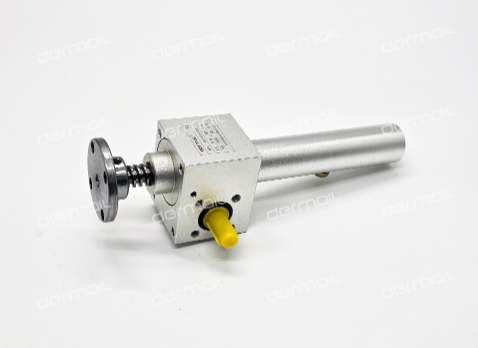
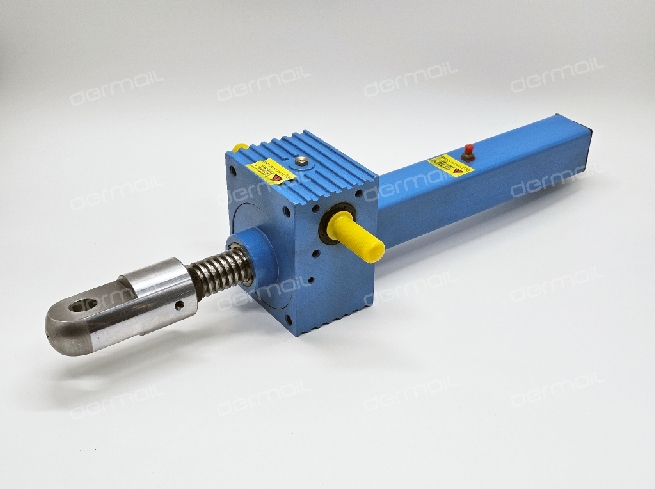
Basic Mechanism: Rotary to Linear Motion Conversion
At the core of a screw jack's operation lies the conversion of rotational motion into linear motion. This transformation is achieved through the interaction between two key components: the screw (also known as the lead screw) and the nut.
The screw is a long, threaded rod with a specific pitch, which is the distance between adjacent threads. The nut is a threaded component that meshes with the screw. When an external force, typically provided by a motor, hand crank, or other power source, rotates the input shaft connected to the screw, the nut is compelled to move along the length of the screw.
If the nut is fixed in position and the screw is rotated, the screw will move linearly up or down, depending on the direction of rotation. Conversely, if the screw is held stationary and the nut is rotated (though this is less common in traditional screw jack designs), the nut will travel along the screw. In most practical applications of screw jacks, the screw is the moving part that lifts or lowers the load attached to it, while the nut remains relatively stationary within the housing of the jack.
Self-Locking Feature: Ensuring Safety and Stability
One of the most significant advantages of screw jacks is their self-locking property. This feature arises from the friction between the screw and the nut. When the input rotational force is removed, the high friction between the mating threads prevents the screw from descending under the weight of the load on its own.
The self-locking ability of a screw jack depends on several factors, including the thread pitch, the coefficient of friction between the screw and the nut materials, and the load being lifted. Generally, screws with a finer pitch and higher friction coefficients are more likely to be self-locking. This self-locking mechanism ensures that the load remains in position even in the absence of a continuous power input, providing a high level of safety and stability in various applications. It eliminates the need for additional braking systems in many cases, simplifying the design and reducing costs.
Torque and Force Relationship
The force that a screw jack can exert to lift a load is directly related to the input torque applied to the screw. The mechanical advantage of a screw jack is determined by the ratio of the linear distance the load is lifted per revolution of the screw (the lead) to the circumference of the screw.
Mathematically, the mechanical advantage (MA) can be expressed as:
where is the mean diameter of the screw and is the pitch of the screw.
The force exerted by the screw jack to lift the load is related to the input torque by the equation:
This relationship shows that a smaller pitch will result in a higher mechanical advantage, meaning that less input torque is required to lift a given load. However, a smaller pitch also leads to slower linear movement of the screw for a given rotational speed of the input shaft. Therefore, there is a trade-off between the force output and the speed of operation in screw jack design.
Types of Screw Jacks and Their Working Variations
There are different types of screw jacks, each with slight variations in their working principles to suit specific applications.
Machine Screw Jacks
Machine screw jacks typically use a trapezoidal or acme thread profile. They are known for their high load - carrying capacity and self-locking ability. The screw in a machine screw jack rotates within a fixed nut, and the linear movement of the screw is used to lift or lower the load. These jacks are commonly used in heavy-duty industrial applications where large loads need to be positioned accurately.
Ball Screw Jacks
Ball screw jacks utilize ball bearings between the screw and the nut to reduce friction significantly. This results in higher efficiency compared to machine screw jacks, allowing for faster linear movement with the same input torque. However, ball screw jacks generally have lower self-locking capabilities and may require additional braking mechanisms in some applications. They are often used in applications where high speed and precision are required, such as in CNC machines and robotics.
Worm Gear Screw Jacks
Worm gear screw jacks incorporate a worm gear mechanism to drive the screw. The worm gear provides a high gear reduction ratio, which allows for high torque output with relatively low input torque. This makes them suitable for applications where a large load needs to be lifted with a small motor or manual input. The self-locking property of the worm gear also enhances the overall self-locking capability of the screw jack.
In conclusion, the working principle of screw jacks is based on the conversion of rotational motion into linear motion through the interaction of a screw and a nut, combined with the self-locking feature that ensures safety and stability. Understanding this principle and the variations in screw jack designs is crucial for selecting the right type of screw jack for a specific application, optimizing performance, and ensuring reliable operation.
That's all for today. I hope I can help you. If you have other questions about the screw lifter, you are welcome to contact Demai Transmission at any time. Our technical engineers will serve you wholeheartedly.








Tel:+86-317-7369999
E-mail: demai@demai.org
Mobile:+86-18653450543 (Wechat)
Address:No. 6, Haihe Road, economic development zone, Wuqiao County, Cangzhou City, Hebei Province

点击右上角
分享给朋友吧
Copyright ©2023 All Rights Reserved Hebei Demai Transmission Machinery Co.,Ltd.
Copyright ©2025 All Rights Reserved Hebei Demai Transmission Machinery Co.,Ltd.
