
Heavy-Load Screw Jack Selection: Which Parameters Really Matter?
2026-05-13 08:31:37
Click:
“
When it comes to selecting a screw jack, the logic for heavy-load applications i
”
When it comes to selecting a screw jack, the logic for heavy-load applications is completely different from light-load scenarios. For light loads, you can focus on speed, precision, and noise. But in heavy-load applications, there is only one core question — can it handle the load, handle it for a long time, and handle it stably? Getting the parameters wrong can lead to anything from poor efficiency and frequent maintenance to equipment damage and even safety incidents.
This article walks you through the key parameters you must prioritize when selecting a screw jack for heavy-load applications, along with the reasoning behind each one.
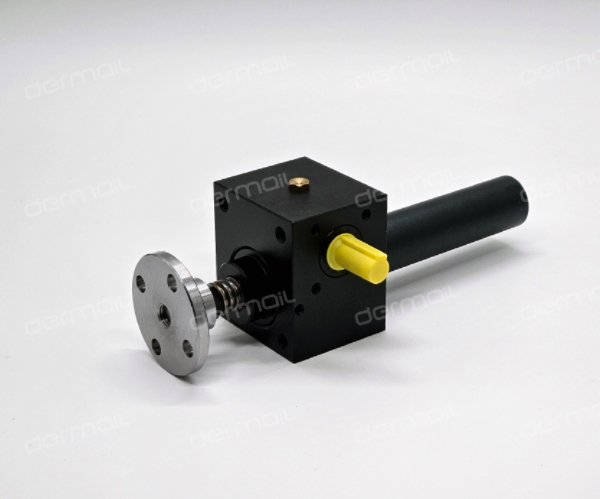
One. Load Parameters: The First Line of Defense in Selection
The first step in heavy-load selection is not flipping through a catalog. It is honestly calculating exactly how much you need to carry.
Here is a common mistake many people make: they only calculate the static load and ignore the dynamic load. Static load is simply the weight of the equipment plus the workpiece, multiplied by 9.8 to convert to Newtons. But in heavy-load applications, what really matters is the dynamic load — the inertial impact force during startup and braking, which is typically 1.2 to 1.5 times the static load.
That is why the safety factor must be generous. The general industrial standard is 1.5 to 2.0 times. For heavy-load scenarios, we recommend reserving at least 30 percent more torque margin. For example, if your actual load is 500 kilograms, you should size for at least 600 to 650 kilograms. Never size right at the rated value for heavy-load applications — one surge and you are overloaded.
There is another factor that is often overlooked — eccentric loading. If the load center of gravity is not on the screw axis, it creates an additional torque equal to the eccentric force multiplied by the eccentricity distance. Under eccentric loading conditions, you either need to select a larger unit or install a guide mechanism to share the lateral forces. Otherwise, the screw and nut will wear out accelerated, and service life will drop dramatically.
Two. Screw Diameter and Lead: The Hard Indicators of Load Capacity
Screw diameter is the single most critical parameter for determining load capacity. There is no argument about this. In heavy-load applications, the screw diameter directly determines how much force this jack can carry.
Generally speaking, the larger the screw diameter, the higher the load capacity. But at the same time, the rotational speed is limited. You need to balance the actual load against the required speed. If you need high thrust but speed is not a priority, go with a large diameter and small lead combination. If you need both high thrust and reasonable speed, you will need to increase the screw diameter while also increasing the lead. But be aware that as the lead increases, the self-locking performance decreases, so you need to evaluate whether an external brake is required.
Lead selection also directly affects the lifting speed. The larger the lead, the greater the travel per revolution, and the faster the speed. But at the same time, the axial force on the screw increases, which puts higher demands on the nut and support bearings. In heavy-load applications, lead selection is always a trade-off between speed and capacity. You cannot simply chase speed.
Three. Lifting Speed and Motor Power Matching: Faster Is Not Always Better
Many customers in heavy-load applications ask 'what is the fastest speed you can offer' right away. This is actually a dangerous mindset.
In heavy-load applications, speed and power are tightly coupled. The faster the speed, the greater the motor power required, and the more severe the friction heat generated at the screw and nut interface. Under heavy loads, if the speed is set too high, three problems will arise. First, the motor will overheat and overload. Second, friction heat at the screw and nut will be severe, and the lubricant will degrade rapidly. Third, inertial impact increases, and the shock load on the gearbox and coupling multiplies.
The correct approach is: first determine the load and stroke, then establish a reasonable lifting speed based on process requirements, and then work backward to calculate the required motor power and gear ratio. In heavy-load applications, it is always better to choose a slower, more stable setup than to blindly pursue speed.
Four. Safety Factor and Service Life: The Bottom-Line Thinking for Heavy-Load Selection
The biggest difference between heavy-load and light-load applications is that when a heavy-load machine fails, the consequences are often catastrophic. Therefore, the safety factor used in selection must be more conservative than for light-load applications.
Our general recommendations are as follows: use a safety factor of 1.5 times or more for static loads, and 2.0 times or more for dynamic loads. If the working conditions involve shock loads, frequent starts and stops, or harsh environments such as high temperature, dust, or corrosion, the safety factor should be increased further — we recommend 2.5 or even 3.0 times.
You should also pay close attention to L10 life calculation. The service life of a screw jack is primarily determined by wear of the screw and nut, and that wear is directly related to load magnitude, speed, and lubrication conditions. In heavy-load applications, if you do not perform a life calculation, the equipment may reach the end of its useful life due to nut wear long before the design life is reached. Always ask the manufacturer for an L10 life calculation report and confirm that the expected service life can be achieved under your actual working conditions.
Five. Mounting Method and Support Structure: A Critical Factor Often Overlooked Under Heavy Loads
Many people focus only on the jack parameters during selection but ignore the mounting method and support structure. In heavy-load applications, this is a potentially fatal oversight.
The main mounting methods for screw jacks include flange mounting, foot mounting, threaded mounting, and trunnion mounting. Different mounting methods have significantly different impacts on load capacity. For example, with foot mounting under heavy-load conditions, if the rigidity of the bottom support is insufficient, the jack will tilt under load, causing uneven force on the screw, accelerated wear, and even jamming.
For heavy-load applications, we recommend flange mounting as the preferred option, and the base must be fitted with reinforcement ribs or welded to a steel structure with sufficient rigidity. If space constraints force you to use foot mounting, the base area should be as large as possible, and the number and specification of bolts must be selected based on calculated values — never reduce them arbitrarily.
Additionally, when multiple jacks are used in linkage, synchronization must be guaranteed. In heavy-load applications, if the jacks are not synchronized, eccentric loading will occur — one unit becomes overloaded while the others run unloaded — and the overall service life drops sharply.
Six. Lubrication Method and Heat Dissipation: The Hidden Killers in Heavy-Load Applications
Under heavy-load working conditions, the friction heat generated at the screw and nut interface is enormous. If lubrication is inadequate or heat dissipation is poor, the lubricant will degrade and carbonize in a very short time, causing dry friction between the nut and screw. This can destroy the unit in just a few hours.
There are two key issues to focus on during selection:
First, the lubrication method. For heavy-load applications, we recommend a forced lubrication system (oil pump supply) rather than relying on manual oiling or oil bath lubrication. Forced lubrication ensures that there is always a sufficient oil film protecting the friction surfaces under high-speed, heavy-load conditions.
Second, heat dissipation capacity. You must confirm that under your actual working conditions, the surface temperature of the jack does not exceed 60 degrees Celsius and the oil temperature does not exceed 80 degrees Celsius. If calculations show that heat dissipation is insufficient, you need to install cooling fans or oil coolers, or even reduce the operating speed to control temperature rise.
The choice of grease is also critical. Under heavy-load and high-temperature conditions, you must use high-temperature synthetic grease. Ordinary lithium grease will soften and flow away quickly under heavy-load, high-temperature conditions, losing its lubricating effect entirely.
Seven. Protection Rating and Environmental Adaptability
Heavy-load equipment is typically used in harsh environments such as mines, steel plants, and ports. The protection rating cannot be taken lightly during selection.
The screw extension must be fitted with a dust cover. We recommend canvas or nylon weather-resistant boots paired with double-lip skeleton oil seals, with a protection rating of at least IP65. If there is a risk of water spray or immersion, select IP67 or even IP68.
You should also pay attention to the material of the seals. Under heavy-load conditions, the seals are under high pressure, and ordinary rubber sealing rings are easily extruded and deformed. We recommend polyurethane or fluoroelastomer seals, which offer high pressure resistance, wear resistance, and high-temperature resistance.
Final Thoughts: The Core Principles of Heavy-Load Selection
To sum up, the core principle of heavy-load screw jack selection can be captured in eight words — size up, never size down; slow down, never speed up.
Do not select right at the rated value. Always leave enough safety margin. Do not blindly chase speed. Prioritize stability and service life. Do not look at the jack in isolation. Include mounting method, lubrication, heat dissipation, and protection rating in your selection considerations.
If you are struggling with heavy-load selection, our technical team is ready to help. We offer free sizing calculations and life assessments based on your actual working conditions, ensuring that the equipment you select can handle the load and last for years to come.








Tel:+86-317-7369999
E-mail: demai@demai.org
Mobile:+86-18653450543 (Wechat)
Address:No. 6, Haihe Road, economic development zone, Wuqiao County, Cangzhou City, Hebei Province

点击右上角
分享给朋友吧
Copyright ©2023 All Rights Reserved Hebei Demai Transmission Machinery Co.,Ltd.
Copyright ©2025 All Rights Reserved Hebei Demai Transmission Machinery Co.,Ltd.
