
Material Requirements for Worm and Worm Gear in Screw Jacks
2026-05-11 09:00:59
Click:
“
The worm and worm gear set is the heart of every screw jack. It converts rotary motion into linear motion and, most critically, provides the self-locking capability that prevents the load from back-driving.
”
Introduction
The worm and worm gear set is the heart of every screw jack. It converts rotary motion into linear motion and, most critically, provides the self-locking capability that prevents the load from back-driving. The longevity, load capacity, and efficiency of a screw jack depend almost entirely on the material selection, heat treatment, and hardness matching of these two components.
This article outlines the specific material requirements for worm and worm gear assemblies in screw jacks, covering steel grades, bronze alloys, cast iron, heat treatment processes, hardness pairing rules, and applicable standards.
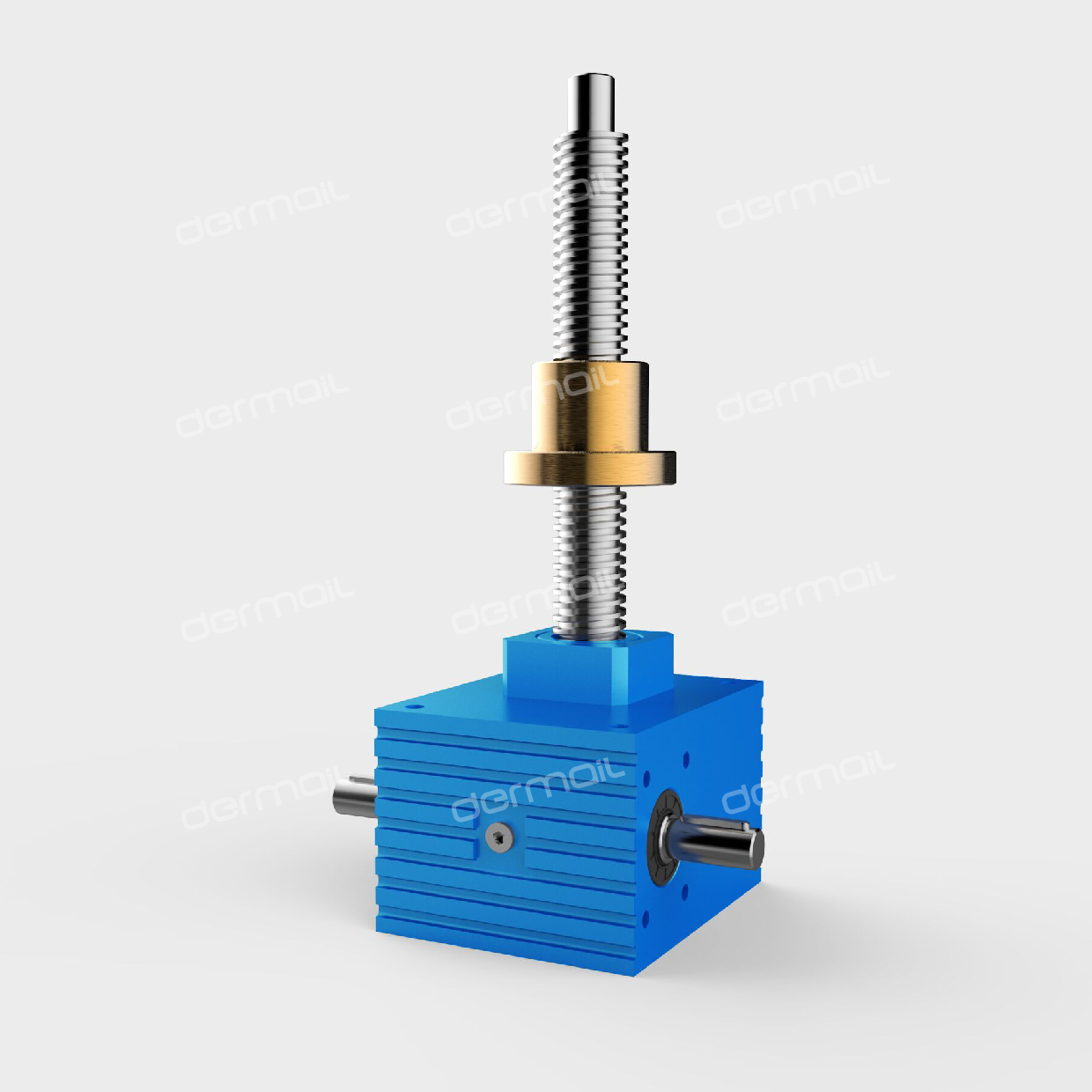
1. The Worm Shaft: Steel Is Non-Negotiable
The worm is always made of steel. The key decisions are which steel grade and what heat treatment to apply, based on operating speed, load, and duty cycle.
20CrMnTi is the most widely used material for heavy-duty screw jacks. This low-alloy carburizing steel undergoes carburizing, quenching, and grinding to achieve a surface hardness of HRC 58–62. The carburizing depth is typically controlled between 0.8 and 1.2 mm, creating a hard wear-resistant surface while retaining a tough, ductile core that resists shock loading. The manganese and titanium additions refine grain size and form stable carbides, improving both wear resistance and fatigue life. Grinding after heat treatment is mandatory — the surface roughness must be Ra ≤ 0.4 μm — because without it, pitting and scuffing occur rapidly at sliding speeds above 5 m/min.
For medium-speed, medium-load applications, 42CrMo (equivalent to AISI 4140) or 40Cr are common choices. These medium-carbon alloy steels are surface-quenched or induction-hardened to HRC 45–55. They offer a good balance of strength and toughness for general-purpose industrial platforms.
For light-duty, low-frequency, or manual jacks, plain carbon steel 45# (equivalent to AISI 1045) is acceptable. It is quenched and tempered to HB 220–270. However, this material is not recommended for anything beyond intermittent, low-load service.
20CrMo serves as an alternative carburizing steel when 20CrMnTi is unavailable. It achieves HRC 56–60 after carburizing and quenching and performs comparably in heavy-duty applications.
Process compliance is critical. Carburizing depth must be precisely controlled — too shallow and the surface spalls, too deep and the core becomes brittle. Oil quenching must limit distortion to less than 0.05 mm, because excessive distortion causes misalignment with the worm gear. Shot peening, while optional, can improve fatigue life by 20–40% in shock-load applications by introducing compressive residual stress on the worm surface.
2. The Worm Gear: Bronze Is Standard, But Which One?
The worm gear material is the single most important variable for wear life, load capacity, and resistance to scuffing. Steel-on-steel pairing is never used in standard screw jacks because the friction coefficient is too high and scuffing is inevitable. The low elastic modulus of bronze — roughly 100 GPa compared to 210 GPa for steel — allows the worm gear teeth to elastically conform to the hardened worm surface, spreading contact stress over a larger area. This is the fundamental reason bronze worm gears outlast any alternative.
Tin bronze (ZCuSn10Pb1, UNS C90300) is the gold standard for heavy-duty screw jacks. Its composition is approximately 10% tin, 1% lead, and the balance copper. The lead forms soft inclusions that act as solid lubricant reservoirs and help absorb shock. Tin bronze excels in anti-scuffing performance and has excellent run-in characteristics. It can handle sliding speeds up to 25 m/s. The casting method matters significantly — metal mold (permanent mold) casting produces finer grain structure, higher density, and hardness of HB 140–150, with contact stress capacity up to 270 MPa. Sand casting yields coarser grain, HB 120–135, and contact stress capacity around 200–250 MPa. For SWL, WSH, and similar heavy-duty series rated 5–120 tons, tin bronze is the default and recommended choice.
Aluminum bronze (ZQAl9-4, UNS C95400) is the cost-effective alternative. With approximately 9% aluminum, 4% iron, 2% manganese, and balance copper, it offers tensile strength of 500–600 MPa — significantly higher than the 300–400 MPa of tin bronze — making it better suited for shock loads. However, its anti-scuffing performance is lower, and it should not be used above 12 m/s sliding speed. Aluminum bronze is best suited for medium-tonnage jacks (5–25 tons) running below 5 m/min with adequate lubrication.
Gray cast iron (HT200 or HT250) is only acceptable for light-duty jacks of 2 tons or less, operating at very low speed below 0.5 m/min, and in intermittent duty of less than 30 minutes per hour. Critically, cast iron worm gears must be paired with a softened worm of HB 220–270 to avoid galling — but this eliminates the self-locking advantage that makes screw jacks valuable in the first place.
3. Hardness Pairing: The Critical Rule
The hardness difference between worm and worm gear determines wear rate, efficiency, and scuffing resistance. The rule is simple: the worm must always be harder than the worm gear, and the difference must be substantial.
When the worm is carburized to HRC 58–62, it should be paired with tin bronze of HB 120–150. The hardness difference should be at least 350 HB, yielding a contact stress capacity of 200–270 MPa depending on casting quality.
When the worm is induction-hardened to HRC 45–55, aluminum bronze of HB 160–200 is the appropriate match. The hardness difference should be at least 250 HB, with contact stress capacity of 180–230 MPa.
When the worm is merely quenched and tempered to HB 220–270, gray cast iron of HB 170–240 can be used — but the hardness difference is only about 50 HB, and contact stress capacity drops to a mere 80–130 MPa.
Three key principles govern pairing: the hardness difference should be at least 200 HB for reliable anti-scuffing performance; the worm must always be harder than the worm gear — never the reverse; and if the worm is not hardened above HRC 45, the allowable contact stress must be reduced by 15–20%. Poor lubrication demands an additional reduction of roughly 30%.
4. Typical Material Specification for Heavy-Duty Screw Jacks
For reference, major manufacturers such as Bonfiglioli, Tsubaki, Nook, and vom Scheidt use the following standard material package for SWL, WSH, and JWM series jacks rated 5–120 tons.
The worm shaft is 20CrMnTi, carburized, quenched, and ground to HRC 58–62 with a case depth of 1.0–1.3 mm. The worm gear is ZCuSn10Pb1 tin bronze, metal mold cast and aged, at HB 130–150, with a contact area of at least 70% of the tooth surface. The lead screw is 42CrMo, quenched, tempered, and induction-hardened to HRC 52–56 on the surface, ground to Ra ≤ 0.8 μm. The trapezoidal nut is typically a steel base with bronze lining or high-force brass, with self-lubricating grades preferred. The housing is ductile iron QT500-7 or cast steel ZG270-500 at HB 170–240, and must resist deformation under full load. Input shafts use 40Cr with GCr15 bearings — the shafts at HRC 30–35 and the bearing races at HRC 60–65.
5. Applicable Standards
Several standards govern material and quality requirements for screw jack worm drives.
GB/T 10089 (China) defines 12 accuracy grades for cylindrical worm drives. Screw jacks typically use Grade 7–9, which dictates permissible profile deviations and thus influences the required grinding precision of the worm.
JB/T 8809 (China) specifies technical conditions for worm gear screw jacks, including material grades, heat treatment requirements, contact pattern (minimum 70% tooth surface contact), and test load procedures.
AGMA 6022 (USA) and ISO 14521 (International) cover design and rating of worm gearing, providing allowable stress tables for various bronze-steel pairings.
DIN 3996 (Germany) addresses load capacity calculation of worm gears and includes material factors for different bronze alloys.
ISO 4382 defines chemical composition specifications for bronze castings, including Cu-Sn-Pb and Cu-Al alloys.
6. Special Environment Requirements
Material selection must adapt to harsh or regulated environments.
In food and pharmaceutical applications, the worm gear must be lead-free tin bronze or stainless bronze, and the housing should be SS304/316 or anodized aluminum 6061. Lead content is strictly limited or prohibited.
In marine and offshore environments, the worm shaft of 20CrMnTi should receive corrosion-resistant plating such as CrN or DLC. The worm gear in tin bronze needs anti-corrosion coating, and all fasteners must be A4-80 stainless steel.
At high ambient temperatures above 80°C, high-lead tin bronze (ZCuSn10Pb5) is preferred for the worm gear. Synthetic PAG lubricant or mineral oil with extreme pressure additives should be used. The housing may be cast aluminum with cooling fins.
In clean room applications, grease leakage is unacceptable. Sealed worm gear housings with labyrinth seals are required, and the bronze must be a low-outgassing grade.
7. Common Material-Related Failures and Prevention
Understanding failure modes helps prevent costly downtime.
Scuffing and galling result from using the wrong bronze grade for the operating speed or insufficient hardness difference. Prevention: use ZCuSn10Pb1 for sliding speeds above 10 m/min and ensure hardness difference of at least 350 HB.
Pitting is caused by low-density sand castings or insufficient carburizing depth. Prevention: switch to metal mold casting and ensure carburizing depth of at least 0.8 mm.
Tooth breakage of the worm gear occurs when aluminum bronze is used in high-speed applications or when castings contain defects. Prevention: use tin bronze for demanding applications and perform X-ray or ultrasonic inspection on all castings.
Worm shaft fatigue fracture stems from excessive case depth creating a brittle core, or from stress concentrations at keyways. Prevention: limit case depth to 1.3 mm maximum, use fillet radii of at least 1.5 mm at keyway transitions, and apply shot peening.
Excessive wear and backlash growth typically indicate a cast iron worm gear or inadequate lubrication. Prevention: upgrade to bronze and install a forced lubrication system.
8. Decision Summary
The selection process follows a clear logic. Start by defining the application — load, speed, duty cycle, and environment. For heavy-duty, high-speed, or safety-critical lifts, the answer is almost always 20CrMnTi worm with ZCuSn10Pb1 tin bronze gear, carburized to HRC 58–62, ground to Ra ≤ 0.4 μm, metal mold cast. For medium-duty general industrial use, 42CrMo or 40Cr worm with ZQAl9-4 aluminum bronze gear is a sound, cost-effective choice. For light-duty intermittent service, 45# steel with HT200 cast iron can work — but expect significantly reduced life and loss of self-locking.
The single most common mistake in the field is underspecifying the worm gear material. Swapping tin bronze for aluminum bronze to save cost, or using cast iron in a moderately loaded application, will reduce service life by 50–80% and often leads to catastrophic scuffing within months. Material cost is typically less than 15% of the total jack cost — the savings are never worth the reliability penalty.








Tel:+86-317-7369999
E-mail: demai@demai.org
Mobile:+86-18653450543 (Wechat)
Address:No. 6, Haihe Road, economic development zone, Wuqiao County, Cangzhou City, Hebei Province

点击右上角
分享给朋友吧
Copyright ©2023 All Rights Reserved Hebei Demai Transmission Machinery Co.,Ltd.
Copyright ©2025 All Rights Reserved Hebei Demai Transmission Machinery Co.,Ltd.
