
The Benefits of Ball Screws in Worm Gear Screw Jacks
2026-04-17 13:34:48
Click:
“
Worm gear screw jacks are essential in industrial systems requiring precise lift
”
Worm gear screw jacks are essential in industrial systems requiring precise lifting, heavy-duty load handling, and self-locking functionality. Traditionally, these jacks use trapezoidal (acme) screws, which are cost-effective but limited by friction and efficiency. Upgrading to ball screws in worm gear screw jacks addresses these limitations while unlocking superior performance. Below are the key advantages:
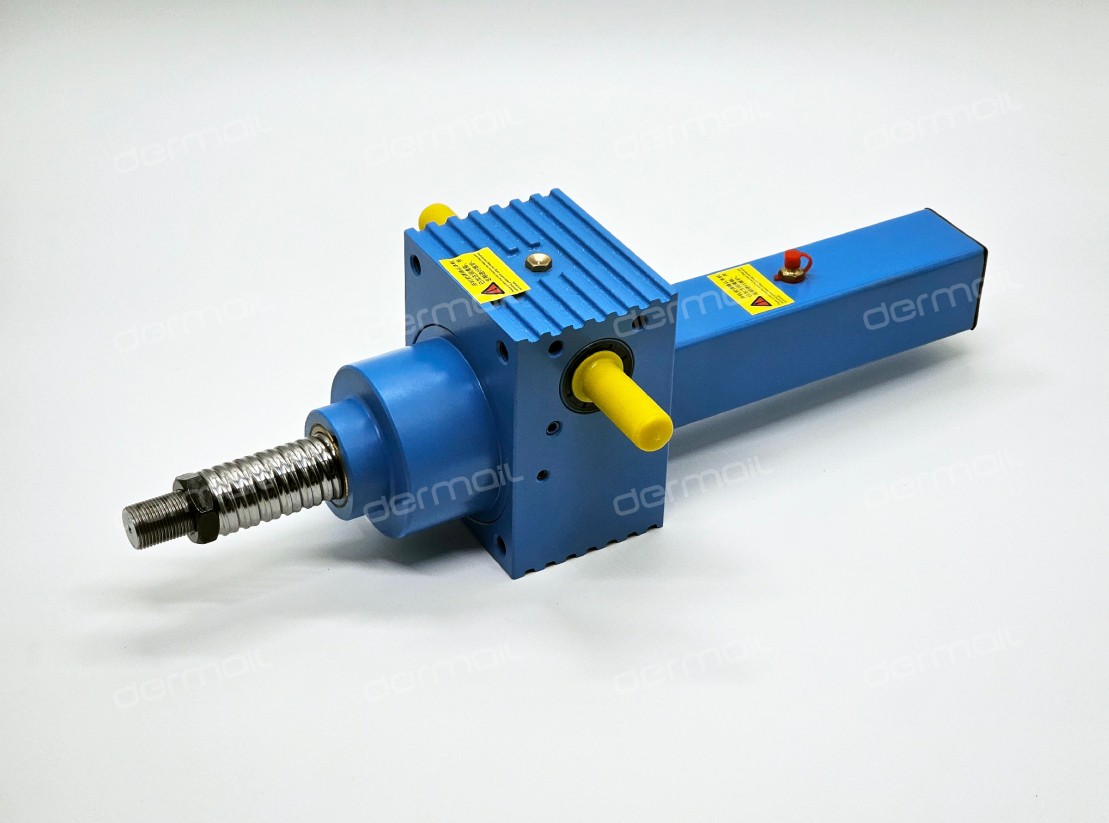
1. Higher Efficiency and Energy Savings
Ball screws operate on rolling friction instead of the sliding friction inherent in trapezoidal screws. This reduces energy loss significantly:
- Ball screw efficiency: 90–95% (vs. 60–70% for trapezoidal screws).
- Impact: Lower power consumption reduces operational costs and minimizes heat generation, extending the lifespan of the motor and gearbox.
2. Increased Speed and Acceleration
The reduced friction of ball screws enables faster linear motion without sacrificing precision:
- Higher RPM tolerance: Ball screws can handle higher rotational speeds, making them ideal for applications requiring rapid lifting or frequent cycling (e.g., automated assembly lines).
- Smoother operation: Less vibration and noise compared to trapezoidal screws, even at high speeds.
3. Improved Durability and Longevity
Ball screws are engineered for heavy-duty use:
- Wear resistance: Recirculating steel balls distribute loads evenly, reducing wear on the screw and nut.
- Corrosion resistance: Available in stainless steel or coated variants for harsh environments (e.g., food processing, outdoor applications).
- Maintenance: Less frequent lubrication required compared to trapezoidal screws, lowering upkeep costs.
4. Precision and Repeatability
Ball screws offer sub-millimeter accuracy, making them suitable for applications requiring tight tolerances:
- Backlash elimination: Preloaded ball nuts minimize play, ensuring consistent positioning.
- Repeatable motion: Critical for robotics, CNC machinery, and medical devices where precision is non-negotiable.
5. Retained Self-Locking (With Design Adjustments)
While traditional worm gear jacks are self-locking due to high friction, ball screws alone lack this feature. However, when paired with a worm gear reduction unit, the system can maintain self-locking capabilities:
- The worm gear’s high reduction ratio (typically 10:1 to 60:1) creates sufficient resistance to prevent backdriving, even with the ball screw’s lower friction.
- This hybrid design combines the efficiency of ball screws with the safety of self-locking worm gears.
6. Compact Design and Higher Load Capacity
Ball screws can transmit higher loads in a smaller footprint:
- Higher dynamic load ratings: Enable lifting heavier loads without increasing jack size.
- Reduced weight: Lighter than trapezoidal screws of equivalent capacity, simplifying integration into machinery.
Applications Best Suited for Ball Screw Worm Gear Jacks
- High-speed automation: Packaging, material handling, and robotics.
- Precision industries: Aerospace, semiconductor manufacturing, and medical equipment.
- Heavy-duty yet efficient systems: Construction machinery, renewable energy (solar tracking), and industrial presses.
Conclusion
While trapezoidal screws remain viable for low-speed, low-efficiency applications, ball screws in worm gear screw jacks represent a superior upgrade for modern industrial demands. By combining the self-locking strength of worm gears with the precision, speed, and efficiency of ball screws, manufacturers achieve a versatile, reliable, and cost-effective solution for demanding linear motion tasks.
For optimal performance, ensure the ball screw is properly preloaded, lubricated, and paired with a high-quality worm gear reduction unit to balance efficiency and safety.








Tel:+86-317-7369999
E-mail: demai@demai.org
Mobile:+86-18653450543 (Wechat)
Address:No. 6, Haihe Road, economic development zone, Wuqiao County, Cangzhou City, Hebei Province

点击右上角
分享给朋友吧
Copyright ©2023 All Rights Reserved Hebei Demai Transmission Machinery Co.,Ltd.
Copyright ©2025 All Rights Reserved Hebei Demai Transmission Machinery Co.,Ltd.
