
How Electric Linear Actuators Achieve Self-Locking
2026-03-31 13:31:40
Click:
“
Electric linear actuators are widely used in industrial automation, medical equipment, and home automation systems due to their precise linear motion control and compact design.
”
Electric linear actuators are widely used in industrial automation, medical equipment, and home automation systems due to their precise linear motion control and compact design. One of their critical features is the self-locking function, which ensures that the actuator maintains its position even when power is cut off or during unexpected system failures. This article explores the mechanisms behind this self-locking capability and its practical applications.
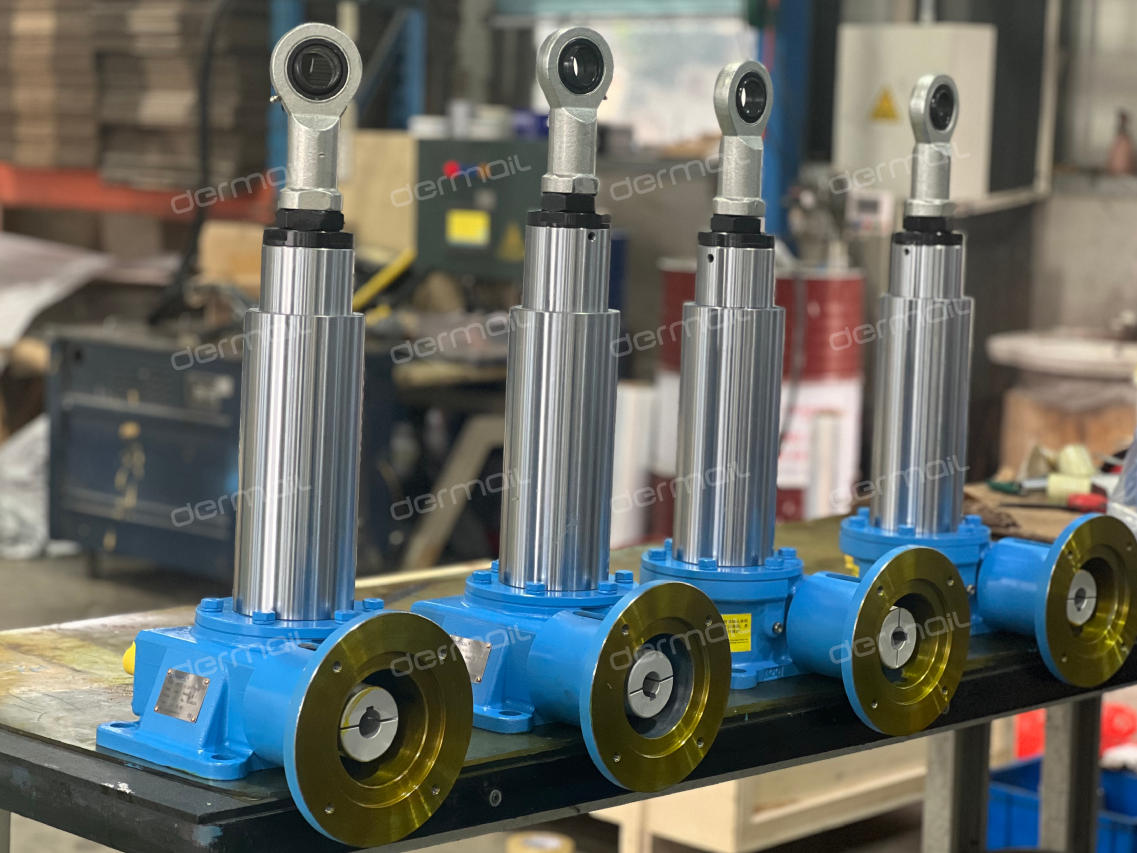
1. Mechanical Self-Locking Mechanisms
1.1 Lead Screw Design
The core of an electric linear actuator's self-locking function lies in its lead screw (or screw drive) mechanism, which converts rotational motion into linear motion. Two primary types of lead screws are used:
- Trapezoidal Lead Screws:
These screws feature a trapezoidal thread profile with a relatively high friction coefficient between the screw and nut. When the motor stops rotating, the friction generated by the thread engagement prevents the nut (and thus the actuator rod) from moving backward under load. This inherent friction acts as a natural brake, making trapezoidal lead screws self-locking by default without requiring additional components. - Ball Screws:
Ball screws use recirculating ball bearings between the screw and nut to reduce friction, enabling smoother and more efficient motion. However, their low friction means they lack natural self-locking. To achieve self-locking in ball screw actuators, manufacturers often integrate electromagnetic brakes or spring-loaded clutches that engage when power is cut off, physically locking the screw in place.
1.2 Gear Reduction Systems
Most electric linear actuators incorporate a gearbox (e.g., worm gears or planetary gears) to amplify torque and reduce speed. Worm gears, in particular, are highly effective for self-locking:
- Worm Gear Mechanism:
In a worm gear setup, the worm (a threaded shaft) meshes with a worm wheel (a gear). The angle of the worm thread is designed such that the worm can easily turn the worm wheel, but the reverse motion (worm wheel turning the worm) is nearly impossible due to friction. This one-way transmission ensures that the actuator rod remains stationary when the motor stops, even under heavy loads.
2. Electrical Self-Locking Solutions
2.1 Motor Braking Systems
While mechanical self-locking is dominant, some actuators use electrical braking to enhance safety:
- Dynamic Braking:
When power is cut, the motor’s controller shorts its terminals, converting the motor into a generator. The energy generated creates a counter-torque that rapidly stops the screw’s rotation, preventing drift. - Electromagnetic Brakes:
Actuators equipped with electromagnetic brakes use a solenoid to engage a friction disc or brake pad when de-energized. This provides instant locking, commonly used in high-load applications like hospital beds or industrial machinery.
3. Practical Applications of Self-Locking
The self-locking function is critical in scenarios where position retention under load is essential:
- Medical Equipment:
Adjustable hospital beds and surgical tables rely on self-locking actuators to maintain patient positions safely during procedures. - Industrial Automation:
In conveyor systems or robotic arms, self-locking ensures that components stay in place during power failures, preventing accidents or product damage. - Home Automation:
Electric recliners, TV lifts, and kitchen appliances use self-locking actuators to hold positions without drifting, enhancing user safety and convenience. - Aerospace and Defense:
Actuators in aircraft landing gear or missile systems must remain locked under extreme vibrations and loads, where mechanical self-locking is irreplaceable.
4. Advantages and Limitations
Advantages:
- Safety: Prevents unintended movement, reducing injury risks.
- Energy Efficiency: No continuous power is needed to hold positions.
- Reliability: Mechanical self-locking is less prone to electronic failures.
Limitations:
- Load Capacity: Trapezoidal screws may struggle with very high loads compared to ball screws with brakes.
- Backlash: Worm gears may introduce slight play, affecting precision in some applications.
- Speed: Self-locking mechanisms can limit maximum travel speed due to friction.
Conclusion
The self-locking function of electric linear actuators is primarily achieved through mechanical friction (trapezoidal lead screws, worm gears) or electrical braking systems (dynamic braking, electromagnetic brakes). This feature ensures stability, safety, and energy efficiency across industries, from healthcare to heavy manufacturing. When selecting an actuator, engineers must balance load requirements, precision, and cost to choose the optimal self-locking mechanism for their application.








Tel:+86-317-7369999
E-mail: demai@demai.org
Mobile:+86-18653450543 (Wechat)
Address:No. 6, Haihe Road, economic development zone, Wuqiao County, Cangzhou City, Hebei Province

点击右上角
分享给朋友吧
Copyright ©2023 All Rights Reserved Hebei Demai Transmission Machinery Co.,Ltd.
Copyright ©2025 All Rights Reserved Hebei Demai Transmission Machinery Co.,Ltd.
