
Why Trapezoidal Screw Jacks Can Achieve Self-Locking
2026-03-20 10:10:54
Click:
“
Trapezoidal screw jacks are widely used in industrial applications requiring precise linear motion and load stability, such as heavy-duty lifting, stage machinery, and material handling.
”
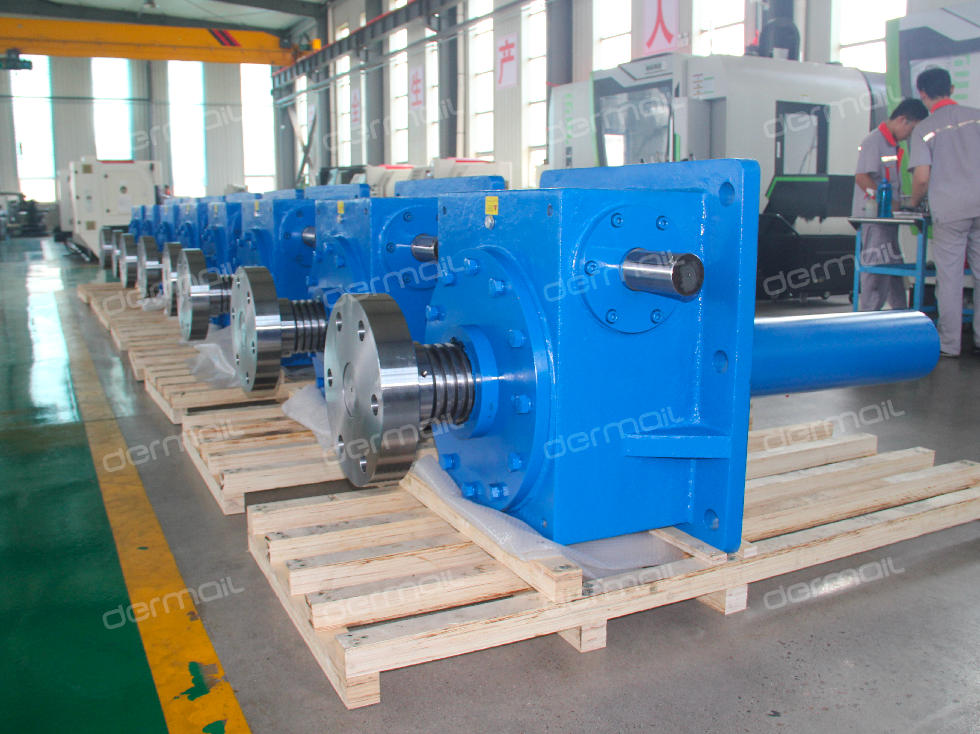
Trapezoidal screw jacks are widely used in industrial applications requiring precise linear motion and load stability, such as heavy-duty lifting, stage machinery, and material handling. A critical advantage of these devices is their self-locking ability, which ensures that the load remains stationary even when power is removed, eliminating the need for additional braking systems. This self-locking property stems from the geometric and frictional characteristics of trapezoidal threads, combined with material selection and mechanical design.
1. Thread Geometry: The Foundation of Self-Locking
The self-locking mechanism of trapezoidal screw jacks is rooted in the relationship between the thread lead angle (λ) and the friction angle (φ).
- Thread Lead Angle (λ): This is the angle between the helix of the thread and the axis of the screw. For trapezoidal threads (typically with a 30° included angle), the lead angle is designed to be small (usually ≤8°). A smaller lead angle reduces the tendency of the screw to rotate backward under load.
- Friction Angle (φ): Defined as φ = arctan(μ), where μ is the coefficient of friction between the screw and nut. The friction angle represents the resistance to sliding caused by surface roughness and lubrication.
Self-locking condition: When λ < φ, the frictional force exceeds the component of the load’s weight acting to rotate the screw backward. This ensures that the screw remains locked in position without external power.
For example, if the friction coefficient (μ) between steel components is 0.15, the friction angle φ ≈ 8.5°. A trapezoidal screw with a lead angle of 5° will easily satisfy λ < φ, achieving reliable self-locking.
2. Thread Profile Advantages
Trapezoidal threads (e.g., Tr 20×4, where 20 mm is the nominal diameter and 4 mm is the pitch) offer several benefits for self-locking:
- Higher Friction: Compared to square threads (which have minimal friction), trapezoidal threads have a larger contact area and a 30° included angle, increasing frictional resistance.
- Load Distribution: The trapezoidal shape distributes stress more evenly across the thread flanks, reducing localized wear and maintaining consistent friction over time.
- Durability: The robust design resists deformation under heavy loads, ensuring long-term self-locking performance.
3. Material and Surface Treatments
The choice of materials and surface finishes further enhances self-locking:
- High-Friction Materials: Using steel-on-steel or steel-on-bronze combinations increases μ. For example, bronze nuts paired with hardened steel screws are common in heavy-duty applications.
- Surface Coatings: Treatments like blackening, phosphating, or diamond-like carbon (DLC) coatings can raise μ by altering surface roughness.
- Lubrication Strategy: While lubrication reduces friction for smooth operation, excessive lubrication can lower μ below the self-locking threshold. Thus, dry or semi-dry lubricants (e.g., molybdenum disulfide) are often preferred.
4. Mechanical Design Reinforcements
In addition to thread geometry, mechanical design elements reinforce self-locking:
- Worm Gear Integration: Many trapezoidal screw jacks incorporate worm gears, which inherently provide self-locking due to their high reduction ratios (e.g., 50:1 or more). The worm’s shallow helix angle ensures that the worm wheel cannot drive the worm backward.
- Safety Nuts: A secondary nut can be added to engage if the primary nut wears, preventing load drop.
- Brake Motors: For critical applications, electric motors with electromagnetic brakes can supplement self-locking, though trapezoidal screws often eliminate this need.
5. Practical Applications and Limitations
Applications:
- Vertical lifting systems (e.g., elevator platforms, warehouse lifts).
- Load-holding in static positions (e.g., solar panel trackers, medical imaging tables).
- Safety-critical mechanisms where power failure must not cause movement.
Limitations:
- Dynamic Loads: Self-locking may fail under high-speed or shock loads, as inertia can overcome friction.
- Temperature Effects: High temperatures reduce lubricant viscosity, lowering μ and risking self-locking failure.
- Thread Wear: Prolonged use can erode thread flanks, reducing friction and requiring maintenance.
Conclusion
Dermail trapezoidal screw jacks achieve self-locking through a synergy of thread geometry, material friction, and mechanical design. By ensuring the lead angle remains smaller than the friction angle, these devices reliably hold loads without external power, making them indispensable in safety-sensitive and heavy-duty applications. However, proper material selection, lubrication, and periodic maintenance are essential to sustain this performance over time.








Tel:+86-317-7369999
E-mail: demai@demai.org
Mobile:+86-18653450543 (Wechat)
Address:No. 6, Haihe Road, economic development zone, Wuqiao County, Cangzhou City, Hebei Province

点击右上角
分享给朋友吧
Copyright ©2023 All Rights Reserved Hebei Demai Transmission Machinery Co.,Ltd.
Copyright ©2025 All Rights Reserved Hebei Demai Transmission Machinery Co.,Ltd.
