
Advantages of Screw Jacks Over Pneumatic Transmission Systems
2025-12-02 08:48:22
Click:
“
This article systematically compares the technical characteristics of both systems, highlighting the scenarios where screw jacks outperform pneumatic alternatives.
”
Abstract
In industrial automation and precision engineering, screw jacks and pneumatic transmission systems are two widely used linear motion solutions. While pneumatic systems offer simplicity and cost-effectiveness in certain applications, screw jacks demonstrate superior performance in terms of precision, stability, synchronization, long-term reliability, safety, environmental adaptability, and energy efficiency. This article systematically compares the technical characteristics of both systems, highlighting the scenarios where screw jacks outperform pneumatic alternatives.
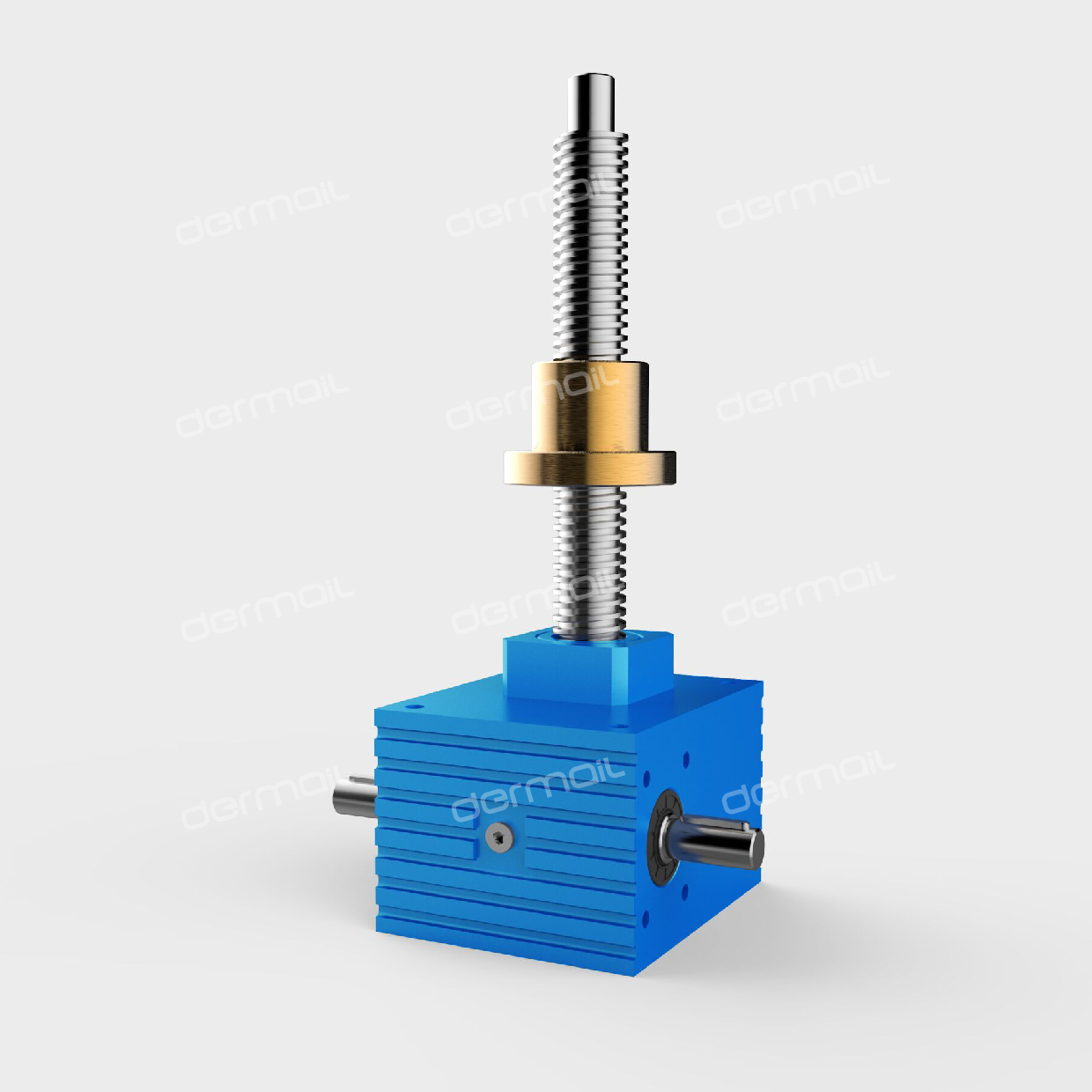
1. Precision: Sub-Micron Positioning Capability
Screw jacks achieve sub-micron positioning accuracy (±0.005mm for ball screw types) through their rigid mechanical transmission mechanism, which combines precision-ground screw threads with worm gear or planetary gear reduction units. In contrast, pneumatic systems typically exhibit ±0.1mm positioning error due to air compressibility and valve response delays.
Case Study: In semiconductor wafer handling equipment, screw jacks enable wafer transfer robots to achieve ±0.01mm repeatability over 100,000 cycles, while pneumatic actuators struggle to maintain ±0.1mm accuracy under similar conditions.
2. Stability: Vibration-Free Operation
The inherent mechanical rigidity of screw jack system ensures vibration velocity below 2.8mm/s (ISO 10816-3 Class A) and noise levels under 65dB(A), making them ideal for:
- Precision machining: Eliminating tool chatter in CNC machine tool Z-axes
- Medical imaging: Maintaining patient stability during CT scanner table movements
- Optical systems: Preventing vibration-induced image distortion in laser engraving machines
Pneumatic systems, by contrast, generate higher-frequency vibrations (≥80dB(A)) from cylinder impacts and lower-frequency oscillations from air pressure fluctuations.
3. Synchronization: Rigid Multi-Axis Coordination
Screw jacks enable sub-0.1mm synchronization across multiple axes through mechanical coupling or servo control, without requiring complex feedback systems. This capability supports applications like:
- Shipbuilding: Synchronized lifting of 200-ton ship sections using 8 jacks with ±0.05mm deviation
- 3D printing: Coordinated movement of large-format print platforms
- Solar tracking: Precise alignment of photovoltaic panels across multiple actuators
Pneumatic synchronization requires expensive proportional valves and sensors, yet still struggles to achieve better than ±1mm alignment.
4. Long-Term Reliability: Wear-Resistant Design
Screw jacks incorporate self-lubricating materials (copper-based nuts) and hardened screw surfaces (HRC58-62) that maintain positioning accuracy over 100,000 cycles. Their sealed housing prevents contamination ingress, while pneumatic systems suffer from:
- Seal wear causing 0.2mm positioning drift after 50,000 cycles
- Valve contamination leading to erratic operation
- Condensate accumulation requiring frequent drainage
5. Safety: Mechanical Self-Locking
The worm gear mechanism in dermail screw jacks provides inherent self-locking that prevents load descent during power failure or overload, meeting stringent safety standards for:
- Lifting platforms: Compliance with EN 1570-1 safety requirements
- Nuclear equipment: Maintaining critical component positions during emergencies
- Aerospace: Secure positioning of satellite components during testing
Pneumatic systems require additional braking mechanisms to prevent load drop when air pressure is lost.
6. Environmental Adaptability: Cleanroom Compatibility
Screw jacks operate oil-free in Class 10 cleanrooms, with vibration levels that won't dislodge particles. Their sealed design withstands:
- Corrosive environments: Stainless steel models for marine applications
- Extreme temperatures: -40°C to +80°C operation ranges
- Dusty conditions: IP65 protection against particulate ingress
Pneumatic systems risk oil mist contamination in cleanrooms and require frequent filter changes in dusty environments.
7. Energy Efficiency: 30-50% Lower Consumption
Screw jacks consume power only during movement, with standby power near zero. In contrast, pneumatic systems maintain constant compressed air generation, resulting in:
- 30-50% higher energy costs for equivalent workload
- 20-30% higher CO₂ emissions in energy-intensive industries
- Need for dedicated air compressors increasing facility footprint
Conclusion
While pneumatic systems remain suitable for simple, low-precision applications with rapid movement requirements, screw jacks offer unmatched performance in precision positioning, vibration-free operation, multi-axis synchronization, and safety-critical environments. The total cost of ownership analysis often favors screw jacks in medium- to high-precision applications, where their longer service life and reduced maintenance requirements offset initial cost differences. As Industry 4.0 demands ever-higher precision and reliability, screw jacks are establishing themselves as the preferred solution for demanding linear motion applications.
Key Selection Criteria:
- Choose screw jacks for: Precision (<±0.05mm), heavy loads (>1 ton), safety-critical applications
- Opt for pneumatics for: Rapid cycling (<1s stroke), lightweight loads (<100kg), explosive environments
This technical comparison demonstrates that screw jacks provide superior performance in most industrial applications requiring precision, stability, and reliability, making them the preferred choice for modern automated systems.








Tel:+86-317-7369999
E-mail: demai@demai.org
Mobile:+86-18653450543 (Wechat)
Address:No. 6, Haihe Road, economic development zone, Wuqiao County, Cangzhou City, Hebei Province

点击右上角
分享给朋友吧
Copyright ©2023 All Rights Reserved Hebei Demai Transmission Machinery Co.,Ltd.
Copyright ©2025 All Rights Reserved Hebei Demai Transmission Machinery Co.,Ltd.
