
Differences Between Ball Screw Jacks and Trapezoidal Screw Jacks
2025-11-15 13:37:05
Click:
“
In industrial automation, material handling, and precision engineering, screw jacks are essential components for converting rotational motion into linear motion.
”
In industrial automation, material handling, and precision engineering, screw jacks are essential components for converting rotational motion into linear motion. Among them, ball screw jacks and trapezoidal screw jacks are two widely used types, each with distinct advantages tailored to specific applications. This article explores their key differences in terms of working principles, efficiency, precision, load capacity, lifespan, self-locking ability, and cost.
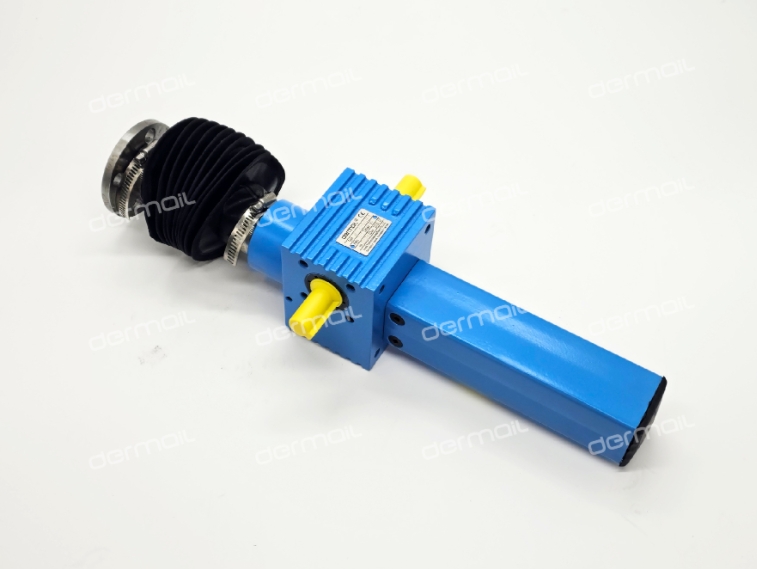
1. Working Principle
Ball Screw Jacks
Dermail Ball screw jacks operate on the principle of rolling friction. They incorporate steel balls between the screw (lead screw) and the nut (ball nut). As the screw rotates, the balls roll in the grooves, reducing friction and enabling smooth, high-speed linear motion. This design converts sliding friction into rolling friction, minimizing energy loss.
Trapezoidal Screw Jacks
Trapezoidal screw jacks rely on sliding friction. The nut and screw feature trapezoidal threads that mesh directly, creating linear motion through mechanical sliding. While simpler in design, this method generates higher friction compared to ball screw jacks.
2. Efficiency
Ball Screw Jacks
Ball screw jacks boast high efficiency (up to 90% or more) due to reduced rolling friction. They require less torque to operate, making them ideal for applications requiring frequent or continuous motion, such as robotic arms, CNC machines, and high-speed automation systems.
Trapezoidal Screw Jacks
Trapezoidal screw jacks have lower efficiency (typically 30–50%) because of sliding friction. They generate more heat during operation, limiting their suitability for high-speed or high-duty-cycle applications. However, they excel in low-speed, intermittent-use scenarios.
3. Precision
Ball Screw Jacks
Ball screw jacks are engineered for high precision, with repeatable positioning accuracy of ±0.01 mm or better. They eliminate backlash through preloaded ball nuts, ensuring smooth motion without crawling. This makes them indispensable in semiconductor manufacturing, medical imaging, and aerospace applications.
Trapezoidal Screw Jacks
Trapezoidal screw jacks offer moderate precision (±0.1 mm or worse) due to inherent backlash and thread wear. They are suitable for applications where fine positioning is less critical, such as conveyor systems, stage lifts, and general-purpose lifting.
4. Load Capacity
Ball Screw Jacks
Despite point contact between balls and threads, ball screw jacks distribute stress effectively, enabling dynamic load capacities 3–5 times higher than trapezoidal screw jacks. They handle both axial and radial loads efficiently, making them ideal for heavy-duty, high-speed applications like wind turbine blade adjustment and automotive assembly lines.
Trapezoidal Screw Jacks
Trapezoidal screw jacks feature strong axial load-bearing capabilities due to their robust thread design. However, their dynamic load capacity is lower, and they are more prone to wear under high-speed or high-frequency operation. They are commonly used in static or slow-moving heavy-load scenarios, such as construction hoists and solar panel tracking systems.
5. Lifespan
Ball Screw Jacks
Ball screw jacks exhibit long service lives (tens of thousands to hundreds of thousands of cycles) due to minimal rolling friction and wear. They require less frequent lubrication (e.g., grease every 6–12 months) and are less susceptible to thread damage.
Trapezoidal Screw Jacks
Trapezoidal screw jacks have shorter lifespans (thousands to tens of thousands of cycles) because of sliding friction and thread wear. They demand regular lubrication to mitigate wear and are more prone to failure under heavy or continuous use.
6. Self-Locking Ability
Ball Screw Jacks
Ball screw jacks lack self-locking capability because their efficiency exceeds 50%. Vertical installations require additional braking mechanisms (e.g., electromagnetic brakes) to prevent unintended load descent.
Trapezoidal Screw Jacks
Trapezoidal screw jacks are self-locking when efficiency drops below 35%, meaning they can hold loads in place without external power. This feature makes them suitable for vertical applications requiring safety against load slippage, such as elevator platforms and gate control systems.
7. Cost
Ball Screw Jacks
Ball screw jacks are more expensive due to their complex design, precision manufacturing, and high-quality materials (e.g., hardened steel balls and screws). However, their long-term reliability and low maintenance costs justify the investment in high-performance applications.
Trapezoidal Screw Jacks
Trapezoidal screw jacks are cost-effective for budget-conscious projects with lower precision and speed requirements. Their simplicity and durability make them a practical choice for general-purpose lifting and positioning tasks.
Conclusion
| Feature | Ball Screw Jacks | Trapezoidal Screw Jacks |
|---|---|---|
| Working Principle | Rolling friction (balls) | Sliding friction (direct thread contact) |
| Efficiency | High (90%+) | Low (30–50%) |
| Precision | ±0.01 mm or better | ±0.1 mm or worse |
| Load Capacity | High dynamic load, multi-directional | High axial load, limited dynamic use |
| Lifespan | Long (low wear) | Short (higher wear) |
| Self-Locking | No (requires brakes) | Yes (under certain conditions) |
| Cost | Higher initial cost | Lower initial cost |
Choose ball screw jacks for high-speed, high-precision, and heavy-duty applications where efficiency and longevity are critical. Opt for trapezoidal screw jacks when cost, simplicity, and self-locking capabilities are prioritized over speed and precision. Understanding these differences ensures optimal selection for your specific engineering needs.








Tel:+86-317-7369999
E-mail: demai@demai.org
Mobile:+86-18653450543 (Wechat)
Address:No. 6, Haihe Road, economic development zone, Wuqiao County, Cangzhou City, Hebei Province

点击右上角
分享给朋友吧
Copyright ©2023 All Rights Reserved Hebei Demai Transmission Machinery Co.,Ltd.
Copyright ©2025 All Rights Reserved Hebei Demai Transmission Machinery Co.,Ltd.
