
How Precise Can Screw Jacks Be? A Comprehensive Analysis
2025-11-08 10:57:18
Click:
“
The precision of screw jacks spans a wide range, from ±2mm for trapezoidal models to ±0.005mm for planetary roller screw variants. By selecting the appropriate screw type, optimizing design parameters
”
Screw jacks, also known as mechanical actuators, are widely used in industrial automation, heavy-duty lifting, and precision positioning systems. Their precision—a critical parameter influencing performance—depends on factors such as screw type, structural design, and environmental conditions. This article explores the precision capabilities of screw jacks, their influencing factors, and practical applications.
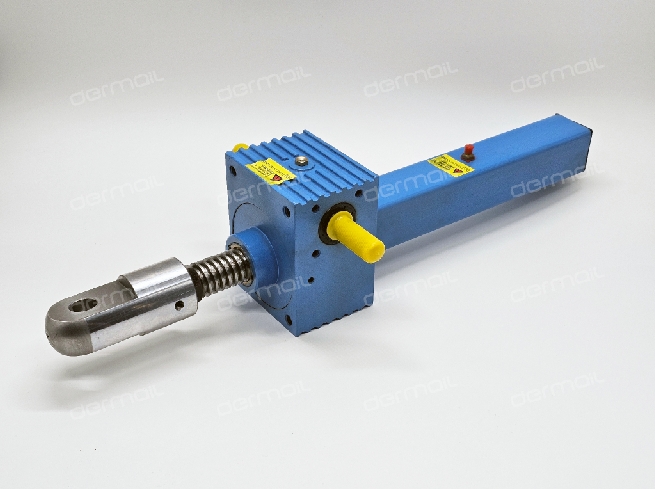
1. Types of Screw Jacks and Their Precision Ranges
The precision of screw jacks is primarily determined by the type of screw mechanism employed:
a. Trapezoidal Screw Jacks
- Precision Range: ±0.1mm to ±2mm (repeatability).
- Characteristics:
- Trapezoidal screws (e.g., Tr8×1.5, Tr12×3) feature a self-locking design, preventing backdriving under load.
- Their precision is moderate due to friction-based transmission, which introduces slight positioning errors.
- Suitable for applications requiring basic load-holding and moderate accuracy, such as conveyor systems, stage lifting, and light industrial machinery.
b. Ball Screw Jacks
- Precision Range: ±0.01mm to ±0.05mm (repeatability).
- Characteristics:
- Ball screws use recirculating ball bearings to minimize friction, enabling high-precision linear motion.
- They achieve superior accuracy through low backlash (typically <0.01mm) and high efficiency (up to 90%).
- Ideal for applications demanding high repeatability, such as CNC machines, robotic arms, and semiconductor manufacturing equipment.
c. Planetary Roller Dermail Screw Jacks
- Precision Range: ±0.005mm to ±0.02mm (repeatability).
2. Key Factors Influencing Precision
Several factors determine the achievable precision of screw jacks:
a. Backlash
- Definition: The clearance between screw and nut components, causing positional inaccuracy during direction changes.
- Mitigation:
- Ball screws and roller screws use preloaded nuts to eliminate backlash.
- Trapezoidal screws may incorporate anti-backlash nuts or dual-screw designs.
b. Screw Pitch and Lead
- Pitch: The distance between screw threads; finer pitches improve precision but reduce speed.
- Lead: The linear distance traveled per screw revolution; shorter leads enhance resolution but limit stroke length.
- Trade-off: Engineers must balance pitch/lead selection based on application requirements (e.g., high-speed vs. high-precision).
c. Material and Manufacturing Tolerances
- Materials: High-grade steel or aluminum alloys reduce thermal expansion and deformation.
- Tolerances: Tight manufacturing tolerances (e.g., ISO Class 5 for ball screws) ensure consistent performance.
- Surface Finish: Polished screw surfaces minimize friction and wear, preserving precision over time.
d. Environmental Conditions
- Temperature: Thermal expansion can alter screw dimensions, affecting accuracy. Temperature-controlled environments or compensation algorithms may be necessary.
- Vibration/Shock: External disturbances can introduce positional errors. Damping systems or rigid mountings help stabilize performance.
- Contamination: Dust or debris in ball screw recirculation channels can degrade precision. Sealed designs or protective covers are recommended.
3. Enhancing Precision Through System Integration
To maximize screw jack precision, engineers often integrate additional components:
- Servo Motors: Provide closed-loop control via encoders, enabling real-time position feedback and correction.
- Linear Guides: Support loads and guide motion, reducing lateral play and improving straightness.
- Load Cells: Monitor force application, preventing overloading that could compromise accuracy.
- Software Compensation: Algorithms adjust for backlash, thermal drift, and other errors in automated systems.
4. Practical Applications of High-Precision Screw Jacks
- Aerospace: Aligning satellite components during assembly (roller screw jacks with ±0.005mm accuracy).
- Medical Imaging: Positioning MRI scanner beds (ball screw jacks with ±0.01mm repeatability).
- Semiconductor Manufacturing: Handling wafer stages (ball screw jacks with nanometer-level precision).
- Robotics: Joint actuation in collaborative robots (roller screw jacks for smooth, accurate motion).
Conclusion
The precision of screw jacks spans a wide range, from ±2mm for trapezoidal models to ±0.005mm for planetary roller screw variants. By selecting the appropriate screw type, optimizing design parameters, and integrating advanced control systems, engineers can achieve the accuracy required for even the most demanding applications. As industries continue to prioritize precision and reliability, screw jacks will remain indispensable components in modern automation and heavy-duty machinery.
This article provides a technical yet accessible overview of screw jack precision, suitable for engineers, procurement specialists, and industry professionals seeking to understand the capabilities and limitations of these versatile actuators.








Tel:+86-317-7369999
E-mail: demai@demai.org
Mobile:+86-18653450543 (Wechat)
Address:No. 6, Haihe Road, economic development zone, Wuqiao County, Cangzhou City, Hebei Province

点击右上角
分享给朋友吧
Copyright ©2023 All Rights Reserved Hebei Demai Transmission Machinery Co.,Ltd.
Copyright ©2025 All Rights Reserved Hebei Demai Transmission Machinery Co.,Ltd.
