
Screw Jacks: Mechanics and Industrial Automation Applications
2025-10-04 09:19:53
Click:
“
Screw jacks, mechanical devices that convert rotational motion into linear displacement, are indispensable in industrial systems requiring precise load control and positioning.
”
Screw jacks, mechanical devices that convert rotational motion into linear displacement, are indispensable in industrial systems requiring precise load control and positioning. Comprising a threaded screw and a mating nut (often driven by a worm gear), these compact yet robust units excel in applications demanding high force transmission, repeatability, and minimal maintenance.
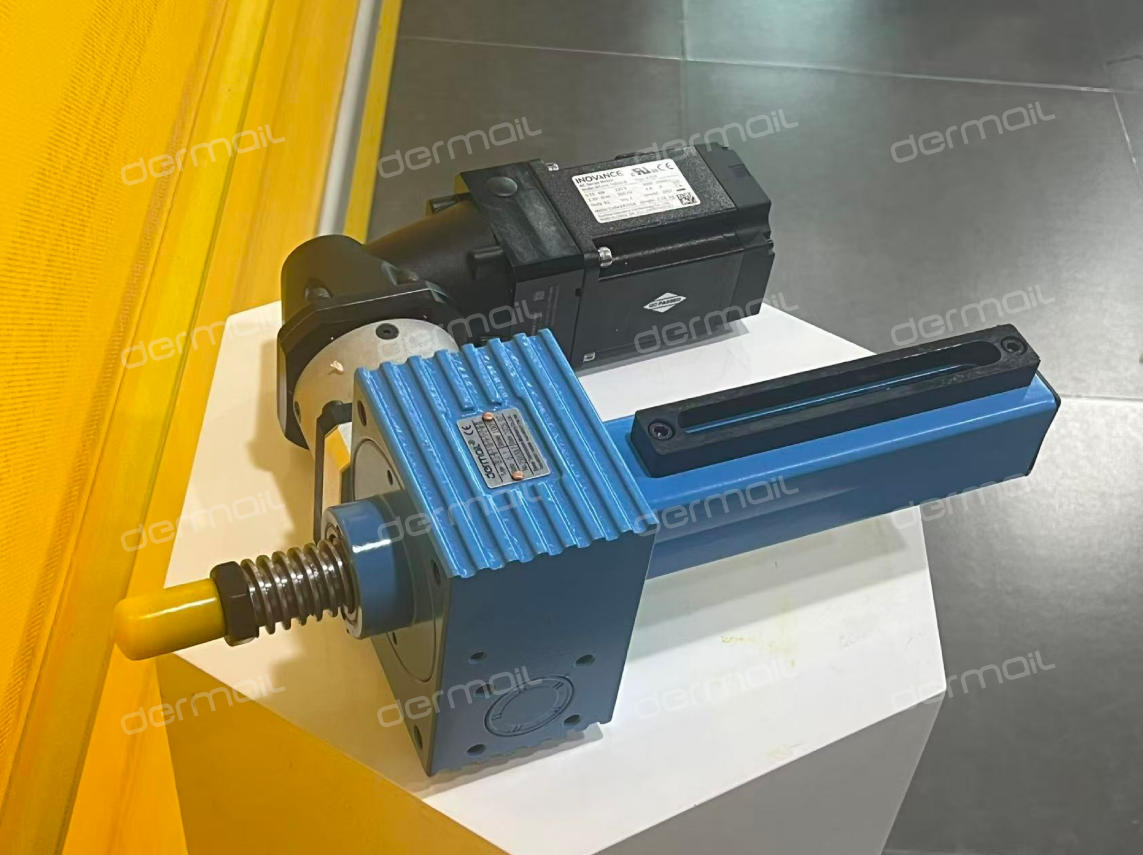
Core Mechanics and Advantages
Screw jacks operate through the interaction of a precision-engineered screw and nut. The screw’s thread profile—typically trapezoidal or ball-screw—determines performance:
- Trapezoidal Screw Jacks: Self-locking under load, these are ideal for static applications (e.g., platform elevation) where holding position without power is critical.
- Ball Screw Jacks: Offer high efficiency (90–95%) and low friction, enabling rapid, reversible motion for dynamic tasks like robotic arm positioning.
Key benefits include:
- High Load Capacity: Supports tons of weight with compact footprints.
- Precision Control: Sub-millimeter accuracy for tasks like CNC tool alignment.
- Durability: Hardened threads and corrosion-resistant materials ensure longevity in harsh environments.
- Versatility: Customizable gear ratios, screw pitches, and mounting options adapt to diverse needs.
Applications in Industrial Automation
- Material Handling and Assembly Lines
Dermail transmission‘s Screw jacks automate vertical motion in conveyor systems, elevating workpieces for robotic assembly or inspection. For example, in automotive plants, they position car bodies at ergonomic heights for welding robots, improving cycle times and reducing operator strain. - Robotics and Motion Control
Integrated into robotic “seventh axes,” screw jacks extend the reach of industrial arms, enabling tasks like large-scale 3D printing or palletizing. Their precision ensures consistent tool positioning, critical in semiconductor manufacturing where tolerances are microscopic. - Heavy-Duty Lifting and Positioning
In aerospace, screw jacks synchronize the elevation of aircraft fuselages during assembly, maintaining balance across multiple support points. Similarly, in renewable energy, they adjust solar panel angles to track sunlight, optimizing energy capture. - Testing and Metrology
Ball screw jacks drive test benches in automotive crash simulations, applying controlled forces to evaluate material strength. Paired with linear encoders, they achieve nanometer-level positioning for optical component inspection. - Packaging and Logistics
Automated warehouses use screw jacks to lift pallets to storage heights, while packaging machines rely on them to adjust sealing heads for products of varying sizes. Their quiet operation suits noise-sensitive environments like food processing.
Future Trends
Advancements in IoT integration enable real-time monitoring of screw jack performance, predicting maintenance needs and reducing downtime. Additionally, lightweight composite materials are expanding their use in portable automation systems, such as drones for infrastructure inspection.
By blending mechanical reliability with automation-ready features, screw jacks continue to be a cornerstone of industrial efficiency, driving innovation in sectors from manufacturing to renewable energy.








Tel:+86-317-7369999
E-mail: demai@demai.org
Mobile:+86-18653450543 (Wechat)
Address:No. 6, Haihe Road, economic development zone, Wuqiao County, Cangzhou City, Hebei Province

点击右上角
分享给朋友吧
Copyright ©2023 All Rights Reserved Hebei Demai Transmission Machinery Co.,Ltd.
Copyright ©2025 All Rights Reserved Hebei Demai Transmission Machinery Co.,Ltd.
