
How to Minimize Vibration and Noise in Multi-Unit Screw Jack Systems
2025-09-16 16:38:29
Click:
“
AbstractMulti-unit screw jack systems are widely used in industrial lifting, pre
”
Abstract
Multi-unit screw jack systems are widely used in industrial lifting, precision positioning, and heavy-load handling. However, vibration and noise often arise during synchronized operation due to misalignment, mechanical resonance, or improper component selection. This article explores the root causes of these issues and provides practical solutions, including design optimizations, control strategies, and maintenance practices, to enhance system reliability and workplace safety.
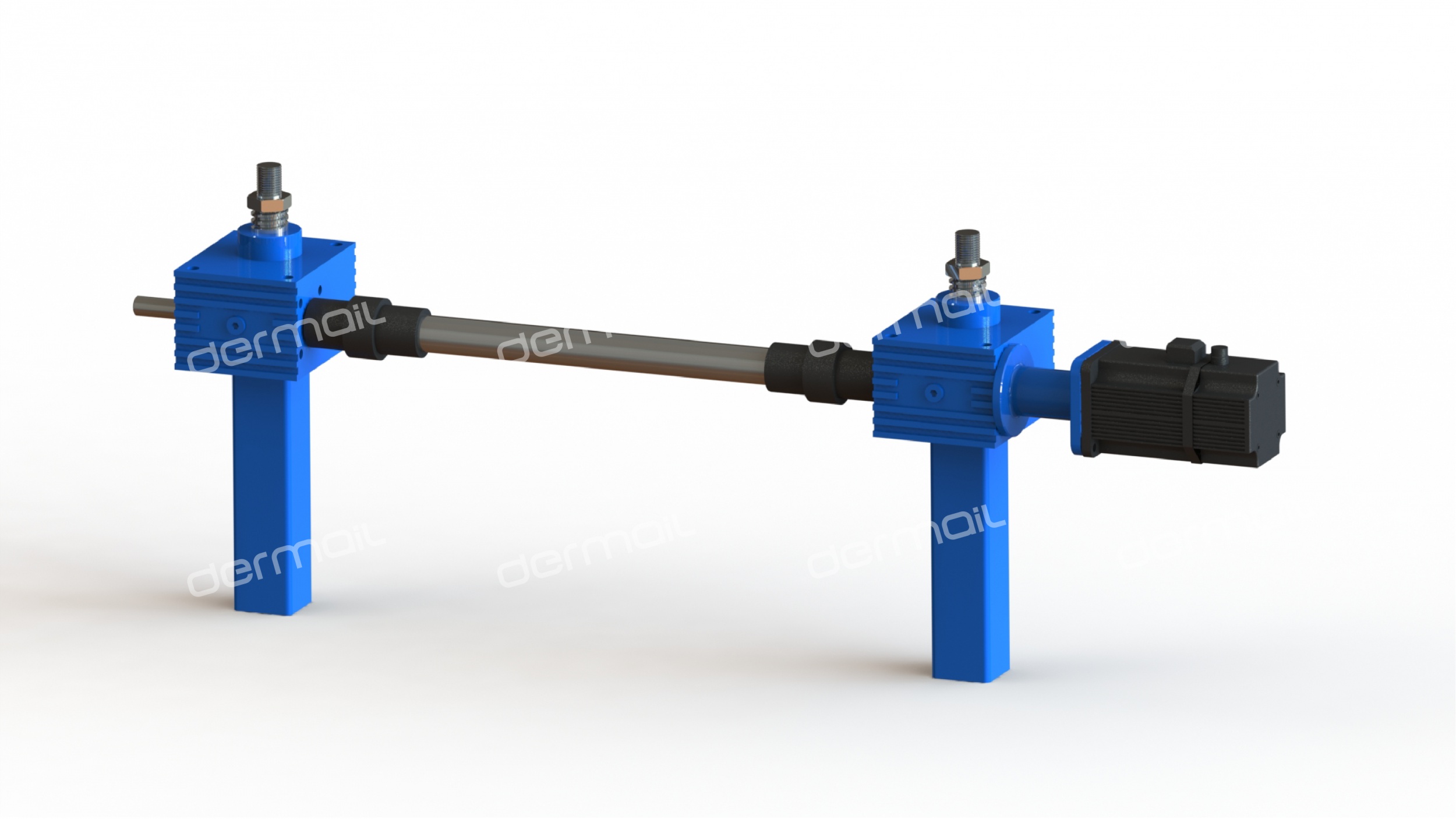
1. Introduction
Screw jacks are favored for their high load capacity and self-locking ability, but when multiple units operate in tandem (e.g., in platform lifts, conveyor systems, or stage machinery), vibrations and noise can compromise performance and operator comfort. Excessive vibration accelerates component wear, while noise exceeds occupational safety limits (typically >85 dB). Addressing these challenges requires a systematic approach to mechanical design, control engineering, and maintenance.
2. Root Causes of Vibration and Noise
2.1 Mechanical Misalignment
- Parallel Misalignment: Incorrect spacing between dermail screw jacks leads to uneven load distribution, causing lateral forces and vibration.
- Angular Misalignment: Tilted screw jacks or couplings introduce bending stresses, amplifying noise during rotation.
- Example: A 0.5° angular misalignment in a 1-meter-long screw jack can generate a 8.7 mm axial deviation, triggering resonant vibrations.
2.2 Resonance Effects
- Natural Frequency Matching: When motor speed coincides with the system’s natural frequency (e.g., due to rigid coupling or lightweight components), resonance occurs, drastically increasing vibration amplitude.
- Case Study: A manufacturing plant reported 120 dB noise levels when four screw jacks operated at 1,200 rpm; the issue resolved after reducing speed to 900 rpm to avoid resonance.
2.3 Component Quality Issues
- Backlash in Gearboxes: Worn gears or improperly meshed helical gears create rhythmic clunking noises.
- Ball Screw Defects: Damaged ball nuts or contaminated lubrication in ball screw jacks produce high-frequency squealing.
- Bearing Failures: Misaligned or under-lubricated bearings in motors or couplings generate grinding noises.
2.4 Control System Limitations
- Open-Loop Control: Without real-time feedback, motors may overshoot or undershoot target positions, causing jerky motion.
- Asynchronous Start/Stop: Delays between motor activations create transient loads, inducing vibrations.
3. Solutions to Reduce Vibration and Noise
3.1 Mechanical Design Optimizations
- Precision Alignment:
- Use laser alignment tools to ensure parallelism (<0.1 mm/m) and angular accuracy (<0.05°).
- Install flexible couplings (e.g., elastomeric or bellow-type) to compensate for minor misalignment.
- Dynamic Damping:
- Add vibration isolators (e.g., rubber mounts or spring dampers) between screw jacks and the base frame to decouple vibrations.
- Incorporate tuned mass dampers (TMDs) near resonant components to absorb energy at critical frequencies.
- Component Upgrades:
- Replace trapezoidal screw jacks with ball screw jacks to reduce friction and backlash.
- Select low-noise gearboxes with helical gears (quieter than spur gears) and high-precision machining (AGMA quality grade 10+).
3.2 Advanced Control Strategies
- Closed-Loop Synchronization:
- Use servo motors with encoder feedback and PID controllers to maintain positional accuracy within ±0.01 mm.
- Implement electronic gearing or cross-coupling control to synchronize motor speeds in real time.
- Soft Start/Stop Functions:
- Program VFDs or servo drives to ramp up/down torque gradually, avoiding sudden acceleration (e.g., S-curve acceleration profiles).
- Add deadbands to control loops to prevent hunting (oscillations around setpoints).
- Anti-Resonance Algorithms:
- Deploy adaptive control algorithms that detect resonance frequencies via accelerometers and adjust motor speed dynamically to avoid excitation.
3.3 Maintenance and Monitoring
- Predictive Maintenance:
- Use vibration analysis tools (e.g., FFT spectrum analyzers) to detect early signs of bearing wear or misalignment.
- Schedule lubrication intervals based on temperature and load conditions (e.g., synthetic grease for high-speed applications).
4. Case Study: Automated Warehouse Lifting System
A logistics center used eight trapezoidal screw jacks to lift 30-ton storage racks. Initial operation suffered from 95 dB noise and frequent motor trips due to vibration-induced overload.
Solutions Implemented:
- Replaced trapezoidal screws with preloaded ball screws to reduce backlash.
- Installed elastomeric couplings and rubber mounts to isolate vibrations.
- Upgraded to servo motors with closed-loop control and soft start functions.
- Added acoustic enclosures around motor-gearbox assemblies.
Results:
- Noise reduced to 68 dB (below OSHA limits).
- Motor lifespan extended from 12 to 48 months.
- System uptime improved to 99.8%.
5. Future Trends
- AI-Driven Diagnostics: Machine learning models can predict vibration patterns and recommend maintenance actions before failures occur.
- Magnetic Levitation: Emerging maglev screw jacks eliminate mechanical contact, virtually eliminating friction-induced noise and vibration.
- IoT Integration: Wireless sensors enable real-time monitoring of vibration, temperature, and load, facilitating remote troubleshooting.
6. Conclusion
Minimizing vibration and noise in multi-unit screw jack systems requires a multifaceted approach combining precise mechanical design, intelligent control strategies, and proactive maintenance. By addressing root causes such as misalignment, resonance, and component wear, engineers can create quieter, more reliable systems that enhance both productivity and workplace safety. As Industry 4.0 technologies evolve, smart diagnostics and contactless designs will further revolutionize this field.
Keywords: Screw jack synchronization, vibration control, noise reduction, mechanical alignment, closed-loop control.








Tel:+86-317-7369999
E-mail: demai@demai.org
Mobile:+86-18653450543 (Wechat)
Address:No. 6, Haihe Road, economic development zone, Wuqiao County, Cangzhou City, Hebei Province

点击右上角
分享给朋友吧
Copyright ©2023 All Rights Reserved Hebei Demai Transmission Machinery Co.,Ltd.
Copyright ©2025 All Rights Reserved Hebei Demai Transmission Machinery Co.,Ltd.
