
Multi-Unit Screw Jack System: Principles, Applications & Technical Aspects
2025-07-12 13:56:13
Click:
“
AbstractScrew jack systems are widely used in industrial automation, heavy-duty
”
Abstract
Screw jack systems are widely used in industrial automation, heavy-duty lifting, and precision positioning applications. When a single unit cannot meet the load, stroke, or stability requirements, multi-unit synchronous operation becomes essential. This article explores the principles, control strategies, applications, and key technical considerations for linking multiple screw jacks to achieve coordinated motion.
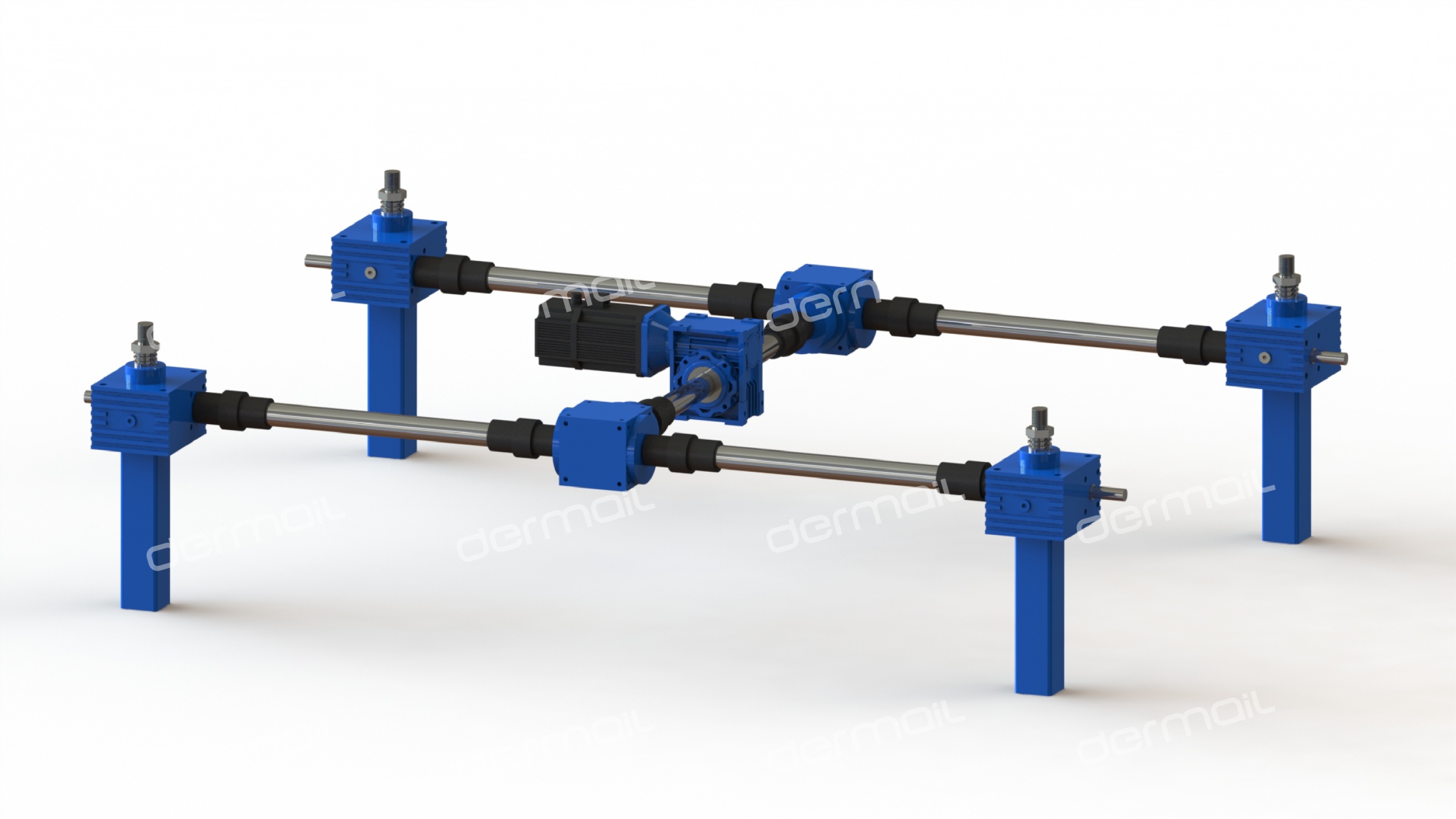
1. Introduction to Screw Jack Synchronization
Screw jacks convert rotational motion into linear displacement via worm gears and threaded rods. In multi-unit systems, two or more jacks operate in tandem to distribute loads evenly, enhance structural stability, or achieve longer strokes. Synchronous control ensures all units move at identical speeds and positions, preventing misalignment, overloading, or mechanical failure.
2. Common Synchronization Methods
2.1 Mechanical Linkage
- Principle: Connecting screw jacks via rigid shafts, couplings, or timing belts to enforce rotational uniformity.
- Advantages: Simple, cost-effective, and maintenance-free.
- Limitations:
- Limited flexibility for non-parallel installations.
- Accumulated errors from shaft deflection or misalignment.
- Applications: Conveyor systems, platform lifts, and simple linear actuators.
2.2 Electrical Synchronization
- Principle: Using motors with integrated encoders or servo drives to control speed and position.
- Control Strategies:
- Master-Slave Configuration: One unit (master) dictates motion, while others (slaves) follow via feedback loops.
- Closed-Loop PID Control: Adjusts motor torque in real-time to compensate for load variations.
- Advantages: High precision (±0.01 mm), adaptable to complex layouts.
- Limitations: Requires electrical wiring and programming expertise.
- Applications: CNC machinery, robotic arms, and optical alignment systems.
2.3 Hybrid (Electro-Mechanical) Synchronization
- Principle: Combines mechanical coupling with electronic feedback for redundancy.
- Example: A timing belt ensures rough synchronization, while encoders fine-tune position accuracy.
- Advantages: Balances cost and precision, tolerant of minor misalignment.
- Applications: Heavy-duty stage lifts, automotive testing rigs.
3. Key Technical Considerations
3.1 Load Distribution
- Ensure equal load sharing by aligning screw jacks vertically and using rigid mounting frames.
- Avoid eccentric loads that cause side forces on threaded rods, leading to premature wear.
3.2 Backlash Compensation
- Worm gears inherently have backlash (play), which can cause positioning errors in multi-unit systems.
- Solutions:
- Use double-worm or preloaded gears to minimize clearance.
- Implement software backlash compensation in servo-driven systems.
3.3 Speed and Travel Consistency
- Select screw jacks with identical thread pitches and gear ratios.
- For variable-speed applications, use synchronous motors or variable-frequency drives (VFDs).
3.4 Safety Mechanisms
- Install overload clutches or torque limiters to prevent damage from jamming.
- Incorporate mechanical brakes for vertical applications to prevent sudden drops during power failure.
4. Applications of Multi-Unit Screw Jack Systems
4.1 Heavy-Duty Lifting
- Used in bridge construction, shipbuilding, and wind turbine maintenance to lift multi-ton loads uniformly.
4.2 Precision Positioning
- Enable sub-millimeter accuracy in semiconductor manufacturing, 3D printing, and medical imaging equipment.
4.3 Dynamic Adjustment
- Synchronized tilt/rotation platforms for simulation systems (e.g., flight trainers, automotive crash testing).
4.4 Long-Stroke Applications
- Combine multiple jacks with telescoping rods to achieve strokes exceeding 10 meters, such as in theater stage lifts.
5. Case Study: Automated Warehouse Storage System
A logistics company required a vertical conveyor to lift 2-ton pallets at 0.5 m/s with ±1 mm accuracy. The solution involved:
- Four screw jacks mechanically linked via a central driveshaft.
- Servo motors with absolute encoders for closed-loop control.
- A PLC coordinating motor speeds and monitoring load cells for balance.
The system achieved 99.9% uptime and reduced maintenance costs by 40% compared to hydraulic alternatives.
6. Conclusion
Multi-unit screw jack synchronization enhances load capacity, precision, and reliability in industrial applications. The choice of synchronization method depends on factors like cost, layout complexity, and accuracy requirements. By addressing backlash, load distribution, and safety, engineers can design robust systems capable of handling demanding tasks across diverse industries.
Keywords: Screw jack, synchronous control, multi-axis lifting, precision positioning, industrial automation.
This article provides a comprehensive guide for Dermail transmission engineers and technicians seeking to implement multi-unit screw jack systems, balancing theoretical knowledge with practical insights.








Tel:+86-317-7369999
E-mail: demai@demai.org
Mobile:+86-18653450543 (Wechat)
Address:No. 6, Haihe Road, economic development zone, Wuqiao County, Cangzhou City, Hebei Province

点击右上角
分享给朋友吧
Copyright ©2023 All Rights Reserved Hebei Demai Transmission Machinery Co.,Ltd.
Copyright ©2025 All Rights Reserved Hebei Demai Transmission Machinery Co.,Ltd.
