
Input Speed Requirements for Screw Jacks
2026-05-22 14:28:27
Click:
“
The input speed of a screw jack lift is not merely a number on a specification sheet — it is the lifeblood of the entire system. Exceed it, and you invite catastrophic failure: overheating, lubrication breakdown, and even gear seizure.
”
Introduction
The input speed of a screw jack lift is not merely a number on a specification sheet — it is the lifeblood of the entire system. Exceed it, and you invite catastrophic failure: overheating, lubrication breakdown, and even gear seizure. Stay within it, and you unlock decades of reliable, self-locking linear motion. This article breaks down every critical requirement you need to know.
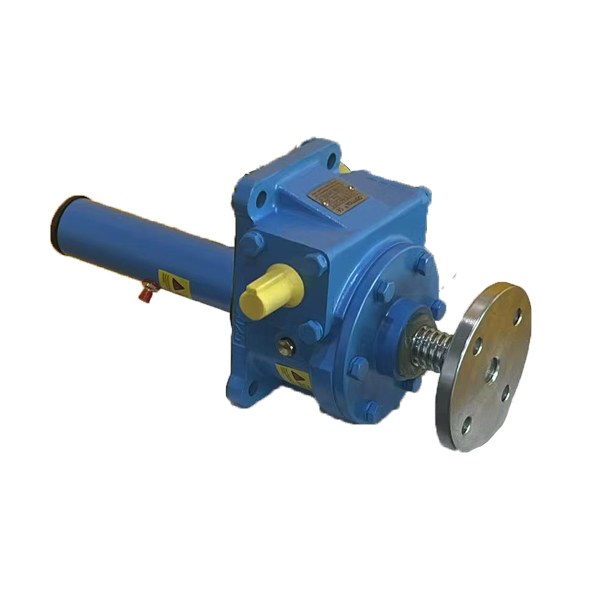
1. The Golden Rule: 1500 RPM Is the Ceiling (Mostly)
For the vast majority of screw jack lifts — including the widely used SWL series and CS series — the maximum allowable input speed is 1500 r/min. This is not a suggestion; it is a hard limit dictated by the physics of worm gear transmission.
The worm wheel is typically made of non-ferrous metals, while the worm is hardened steel. During sliding friction transmission, enormous heat is generated. Exceeding the rated speed sends temperatures soaring, thinning the lubricant and triggering failure.
The standard speed ratio configurations vary significantly. For fast-type units (N / P type) with a 6:1 ratio, the lift per worm revolution is 6 mm, which translates to a linear speed of 1,450 mm/min at 1500 RPM. For slow-type units (M / L type) with a 24:1 ratio, the lift per revolution is also 6 mm, but the linear speed drops to just 362 mm/min at the same input speed.
For the CS series, the difference is even more pronounced. The N-type lifts 1 mm per revolution, reaching 1,500 mm/min at 1500 RPM, while the L-type lifts only 0.25 mm per revolution, achieving a mere 375 mm/min at 1500 RPM.
2. The Hidden Trap: Speed Varies by Gear Ratio
Here is what 90% of engineers overlook: the allowable input speed is not fixed per model — it shifts dramatically with the gear ratio.
According to field data from industry practitioners, a machine with a 20:1 gear ratio can tolerate approximately 1,800 RPM, while a machine with a 60:1 gear ratio should be limited to roughly 1,000 RPM. That is a difference of over 30% between the same model at different ratios. A ratio-60 machine running at 1,500 RPM will overheat and fail far faster than a ratio-20 machine at the same speed. Always cross-reference the motor's actual RPM against the manufacturer's permissible speed table for your specific ratio.
3. When 1800 RPM Is Permitted — And When to Beware
Some advanced series, such as the SJB ball screw jack, allow input speeds up to 1,800 r/min thanks to rolling friction (ball bearings) replacing sliding friction. These units can achieve lift speeds up to 77 mm/s, or 4,620 mm/min — a massive leap over traditional worm-driven designs.
However, even at 1,800 RPM, you must observe strict limits. Input power must not exceed the rated maximum, calculated using the formula: Input Power (kW) equals Rated Torque times Load Rate times Input RPM, divided by 9550.
When input power exceeds 18.5 kW, it is strongly recommended to use a 6-pole motor at 960 RPM instead of a 4-pole motor at 1,450 RPM. This reduces heat generation and extends the life of the entire drive train.
4. Temperature: The Silent Speed Killer
Working environment temperature directly slashes your allowable input power, and most engineers fail to account for this.
At temperatures between -10°C and 25°C, the temperature coefficient is 1.0, meaning you get full rated power with no derating. At 30°C, the coefficient drops to 0.85, requiring a 15% reduction in maximum input power. At 40°C, the coefficient plummets to 0.65 — a 35% reduction. At 40°C, a jack rated for 5 kW input can only safely handle 3.25 kW. Push beyond this, and the gear oil thins, emulsifies from condensation, and lubrication fails — leading to bearing corrosion and worm gear seizure.
5. The Self-Locking Advantage (And Its Speed Limit)
One of the greatest features of worm-driven screw jacks is self-locking — the load cannot back-drive the worm. But this very property is what limits input speed. The higher the friction (which enables self-locking), the more heat is generated.
This is why worm gearboxes require 220# or 320# extreme-pressure industrial gear oil, while the screw rod requires lithium-based grease or molybdenum disulfide spray. Never mix lubricants — doing so accelerates worm gear wear by 3 to 5 times.
6. Practical Checklist Before You Spin
Before connecting any motor to a screw jack, run through these requirements:
The maximum input speed for standard units must not exceed 1,500 RPM. For high-speed series such as ball screw jacks, the limit rises to 1,800 RPM. For machines with a 60:1 speed ratio, 1,000 RPM is the recommended ceiling. When input power exceeds 18.5 kW, always use a 960 RPM, 6-pole motor. For strokes longer than 300 mm, verify stability against Euler buckling. For strokes exceeding 800 mm or where the length-to-diameter ratio exceeds 30, a mandatory stability check with support guides is required. And under no circumstances should side loads be applied to the screw — always add guide rails to prevent lateral forces.
Conclusion
The input speed of a screw jack lift is far more than a rotational number — it is the thermodynamic boundary between reliable operation and mechanical disaster. Respect the 1,500 RPM ceiling for standard units, account for ratio-dependent variations, factor in temperature derating, and never compromise on lubrication. Do all this, and your screw jack will deliver precise, self-locking linear motion for years on end.
Ignore any one of these rules, and you pay for it — in downtime, in repairs, and in safety.








Tel:+86-317-7369999
E-mail: demai@demai.org
Mobile:+86-18653450543 (Wechat)
Address:No. 6, Haihe Road, economic development zone, Wuqiao County, Cangzhou City, Hebei Province

点击右上角
分享给朋友吧
Copyright ©2023 All Rights Reserved Hebei Demai Transmission Machinery Co.,Ltd.
Copyright ©2025 All Rights Reserved Hebei Demai Transmission Machinery Co.,Ltd.
