
How the Quality of Bronze Nut Material Affects Screw Jacks
2026-05-16 14:26:15
Click:
“
Screw jacks are core transmission components widely used in industrial applications, converting rotational motion into linear motion. Inside the mechanism, the bronze nut works in direct contact with the steel screw,
”
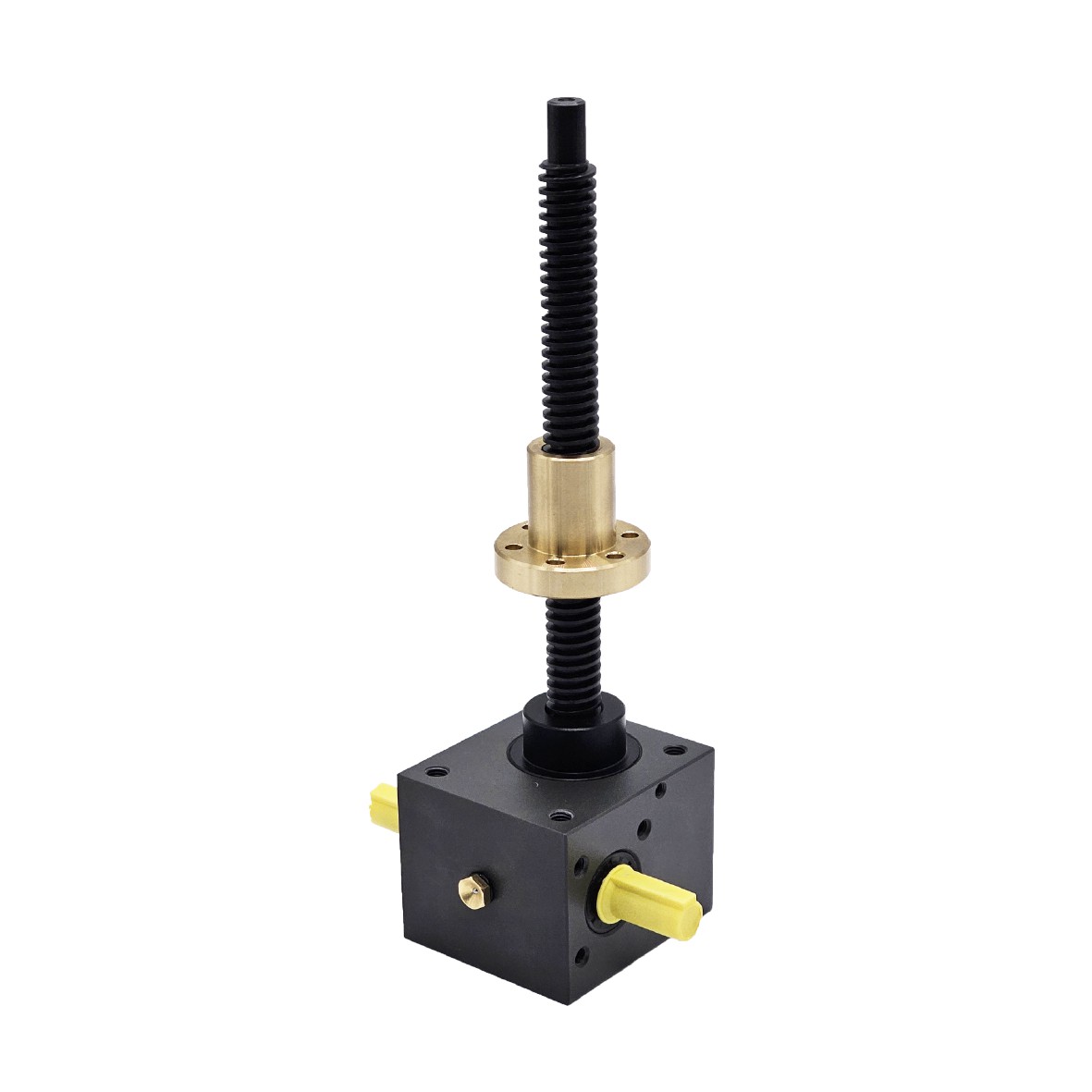
Screw jacks are core transmission components widely used in industrial applications, converting rotational motion into linear motion. Inside the mechanism, the bronze nut works in direct contact with the steel screw, bearing the critical responsibilities of transmitting power, supporting loads, and enabling self-locking. The material quality of the bronze nut directly determines the overall performance of the entire jack. The impact of material quality is comprehensive and far-reaching, and this article analyzes each aspect in detail.
Impact on Wear Resistance and Service Life
The bronze nut and the steel screw are always in a state of sliding friction, making wear resistance the primary indicator of material quality.
High-quality bronze nuts are typically made from high-performance copper alloys such as tin bronze (e.g., ZCuSn10P1) or aluminum bronze (e.g., ZCuAl10Fe3). These materials have a dense microstructure, moderate hardness, and a Brinell hardness generally ranging from 80 to 120 HB. Under long-term friction conditions, the wear rate is low and the service life is long, with normal operation reaching several thousand hours.
Low-quality bronze nuts are often made from ordinary brass (such as H59 or H62) or even recycled scrap copper. They have low hardness, loose microstructure, and frequently contain internal porosity and sand holes. Under continuous operation, these nuts wear extremely fast. The inner diameter enlarges quickly, the fit clearance expands rapidly, and in severe cases the nut can be worn completely through in a short time. The consequence is frequent shutdowns for replacement, with maintenance costs and production losses increasing dramatically.
Impact on Load-Carrying Capacity
The material strength of the bronze nut directly determines how much axial load it can bear.
High-quality copper alloy nuts have high tensile and compressive strength. Under heavy-load conditions, the internal threads of the nut do not undergo plastic deformation, and the contact stress between the screw and the nut is distributed evenly, providing stable and reliable load-carrying capacity.
Poor-quality nuts lack sufficient strength. Under large loads, the internal threads are crushed and deformed, reducing the contact area while sharply increasing local stress. This not only reduces the actual load-carrying capacity but also accelerates wear on the screw surface in return, creating a vicious cycle that ultimately leads to premature failure of the entire transmission system.
Impact on Self-Locking Performance
Self-locking is one of the core advantages of screw jacks over hydraulic cylinders and pneumatic cylinders. It means that when the drive stops, the load will not slide down under its own weight. Self-locking is achieved when the lead angle of the screw is smaller than the friction angle, and the size of the friction angle is closely related to the material of the bronze nut.
High-quality copper alloy materials have a stable and reasonable friction coefficient, ensuring reliable self-locking at the designed lead. Poor-quality bronze nuts have a friction coefficient that is too low or unstable, which can cause self-locking to fail. In vertical lifting, aerial work platforms, and stage lifting applications, self-locking failure means the load will descend rapidly under gravity. This can damage equipment at best and cause serious safety accidents at worst.
Impact on Transmission Efficiency
The material of the bronze nut affects the transmission efficiency of the screw jack. Efficiency is inversely related to the friction coefficient — the lower the friction coefficient, the higher the efficiency, but if it is too low, self-locking is compromised. High-quality copper alloy materials achieve the optimal balance between self-locking and efficiency, with transmission efficiency typically reaching 30 to 50 percent.
Poor-quality bronze nuts have uneven material composition, causing the friction coefficient to fluctuate significantly. Transmission efficiency becomes unstable and continues to decline as wear progresses, leading to increased energy consumption, excessive heat generation, and further deterioration of operating conditions.
Impact on Operating Noise and Vibration
High-quality bronze nuts have a dense microstructure and uniform hardness, producing smooth friction with the screw during operation. This results in low noise, minimal vibration, and smooth equipment operation.
Low-quality bronze nuts contain internal defects such as porosity, sand holes, and compositional segregation. During operation, friction is uneven, easily generating abnormal noise and periodic vibration. This vibration not only degrades the working environment but also accelerates fatigue damage to other components such as the screw, bearings, and couplings, significantly reducing the overall reliability of the equipment.
Impact on Transmission Accuracy and Positioning Performance
In applications requiring precise control of lifting height, such as automated production lines and precision positioning platforms, the material uniformity of the bronze nut directly affects positioning accuracy.
High-quality copper alloy nuts have a linear expansion coefficient that closely matches that of the steel screw. When temperature changes, the deformation of both is similar, the fit clearance changes little, and positioning accuracy remains high and stable. Poor-quality nuts have uneven material composition, deforming inconsistently when heated. The fit clearance changes continuously with temperature and wear, causing lifting positioning deviations that can directly lead to product quality problems in precision applications.
Conclusion
Although the bronze nut is only a supporting component inside a screw jack, its material quality has a comprehensive and profound impact on the equipment's service life, efficiency, accuracy, noise, self-locking performance, corrosion resistance, and operational safety. When selecting and purchasing, users should clearly specify the material grade of the bronze nut and prioritize high-quality copper alloys such as tin bronze or aluminum bronze. Low-quality materials of unknown origin must be firmly rejected. While the procurement cost of high-quality bronze nuts is slightly higher than that of inferior ones, the full life-cycle perspective shows a significant reduction in maintenance frequency, downtime, and safety risks. The overall return far exceeds the initial price difference.








Tel:+86-317-7369999
E-mail: demai@demai.org
Mobile:+86-18653450543 (Wechat)
Address:No. 6, Haihe Road, economic development zone, Wuqiao County, Cangzhou City, Hebei Province

点击右上角
分享给朋友吧
Copyright ©2023 All Rights Reserved Hebei Demai Transmission Machinery Co.,Ltd.
Copyright ©2025 All Rights Reserved Hebei Demai Transmission Machinery Co.,Ltd.
