
The Internal Structure of a Screw Jack: A Detailed Exploration
2025-11-19 14:12:02
Click:
“
A screw jack is a mechanical device that converts rotational motion into linear displacement, widely used in industrial machinery, construction equipment, and automation systems for lifting
”
A screw jack is a mechanical device that converts rotational motion into linear displacement, widely used in industrial machinery, construction equipment, and automation systems for lifting, lowering, or positioning heavy loads with precision. Its robust design combines simplicity with high efficiency, making it ideal for applications requiring controlled movement under substantial loads. This article examines the key components and functional mechanisms within a dermail screw jack.
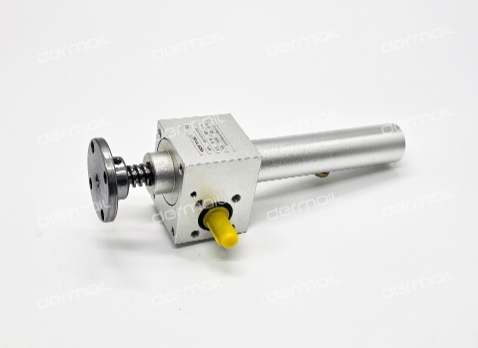
1. Core Transmission Components: Lead Screw and Nut Assembly
The lead screw and nut are the central elements responsible for motion conversion and load transmission.
- Lead Srew (Threaded Shaft)
- Material & Design: Typically forged from high-strength alloy steel (e.g., 40CrMo or stainless steel), the lead screw undergoes precision machining and heat treatment to achieve hardness and durability. Its thread profile may be trapezoidal (for self-locking capabilities in static applications) or ball-type (for high-efficiency, low-friction operation).
- Function: The rotating lead screw transfers torque from the input mechanism to the nut, converting rotational force into linear motion. The thread pitch determines the speed and force output—a larger pitch enables faster movement but lower force, while a smaller pitch increases lifting capacity.
- Nut Assembly
- Material & Structure: The nut is usually made of wear-resistant bronze, polymer composites, or steel, with a helical groove matching the lead screw’s thread. In ball screw jacks, recirculating ball bearings are housed within the nut to minimize friction and wear, achieving transmission efficiencies of up to 95%.
- Function: The nut engages with the lead screw to translate rotational motion into linear thrust while supporting axial loads. Its design directly impacts the screw jack’s load capacity, precision, and operational lifespan.
2. Power Input and Torque Amplification: Motor and Gearbox
The motor and gearbox work together to provide controlled rotational force and mechanical advantage.
- Motor
- Types: Common choices include electric motors (AC/DC, servo, or stepper) for precise speed and position control, or manual hand cranks for low-cost, non-powered applications.
- Function: The motor supplies rotational energy, which is regulated via controllers or gear ratios to achieve desired lifting speeds and forces.
- Gearbox (Reducer)
- Types: Worm gear reducers are widely used for their self-locking properties and compact design, while planetary gear or bevel gear reducers offer higher efficiency and smoother operation.
- Function: The gearbox reduces the motor’s high-speed rotation to a lower output speed while increasing torque, enabling the screw jack to handle heavy loads. For example, a worm gear reducer with a 50:1 ratio can multiply the input torque by 50 times.
3. Load Support and Motion Guidance: Bearings and Guide Mechanisms
Bearings and guide systems ensure stable, friction-optimized operation.
- Bearings
- Types: Thrust bearings support axial loads, while radial bearings or angular contact bearings handle radial forces and misalignment.
- Function: Bearings reduce friction between moving parts, prevent lead screw deflection, and maintain alignment for precise linear motion.
- Guide Mechanisms
- Structure: Guide rods, linear rails, or telescopic sleeves are often integrated to restrict lateral movement of the lifting platform.
- Function: These components ensure the load moves vertically without wobbling, critical for applications like automotive lifts or stage platforms where stability is paramount.
4. Safety and Protection: Limit Switches and Sealing
Additional features enhance operational safety and environmental resistance.
- Limit Switches
- Function: Mechanical or electronic limit switches automatically stop the motor when the lifting platform reaches its upper or lower travel limits, preventing overextension and damage.
- Sealing and Protection
- Design: Dust covers, rubber seals, or IP-rated housings shield internal components from contaminants like dust, moisture, or chemicals, extending the screw jack’s service life in harsh environments.
- Design: Dust covers, rubber seals, or IP-rated housings shield internal components from contaminants like dust, moisture, or chemicals, extending the screw jack’s service life in harsh environments.
Conclusion
The internal structure of a screw jack integrates precision-engineered components—from the lead screw and nut assembly to the motor-gearbox system and guide mechanisms—to deliver reliable, high-force linear motion. Its modular design allows customization for diverse applications, ranging from lightweight industrial automation to heavy-duty construction projects. By understanding these core elements, engineers can optimize screw Jack system performance for specific load, speed, and environmental requirements.








Tel:+86-317-7369999
E-mail: demai@demai.org
Mobile:+86-18653450543 (Wechat)
Address:No. 6, Haihe Road, economic development zone, Wuqiao County, Cangzhou City, Hebei Province

点击右上角
分享给朋友吧
Copyright ©2023 All Rights Reserved Hebei Demai Transmission Machinery Co.,Ltd.
Copyright ©2025 All Rights Reserved Hebei Demai Transmission Machinery Co.,Ltd.
