
Multi-Unit Bevel Gear Screw Jack Linkage: Key Applications
2025-09-10 08:42:19
Click:
“
Bevel gear screw jacks, renowned for their compact structure, high load capacity, and precise positioning, are widely utilized in industrial automation, heavy machinery, and infrastructure projects.
”
Bevel gear screw jacks, renowned for their compact structure, high load capacity, and precise positioning, are widely utilized in industrial automation, heavy machinery, and infrastructure projects. When integrated into multi-unit linked systems, these devices unlock enhanced capabilities for synchronized motion control, enabling applications that demand heavy-duty lifting, high-precision alignment, and large-scale spatial adjustment. This article explores key scenarios where multi-unit bevel gear screw jack systems excel, highlighting their technical advantages and real-world value.
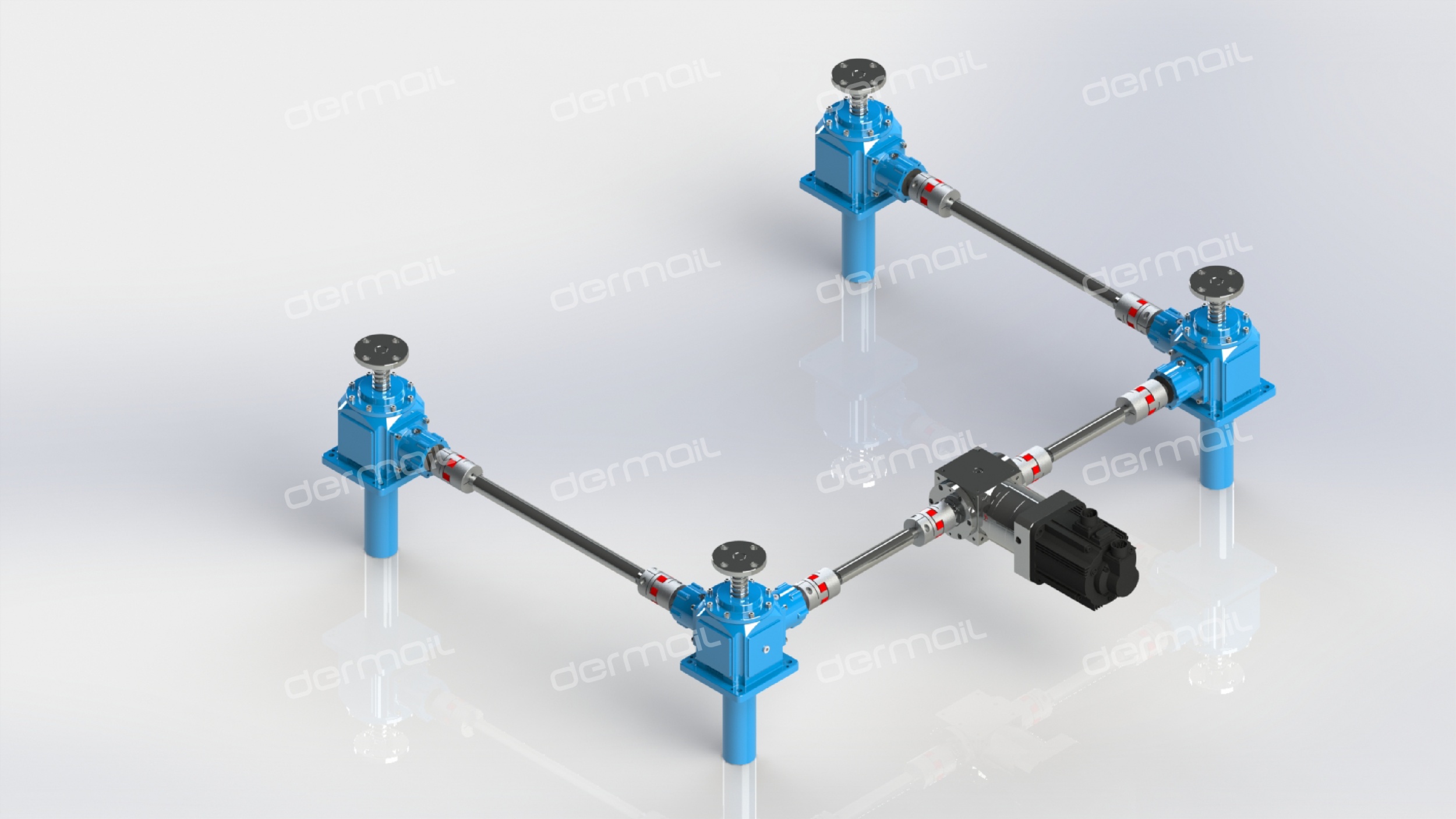
1. Heavy-Duty Lifting in Metallurgy and Mining
In industries like steel manufacturing and mining, large-scale equipment such as blast furnace tops, electric arc furnaces, and ore crushing machinery require frequent maintenance or replacement of components weighing tens of tons. Single screw jacks often lack the capacity to handle such loads safely.
Multi-unit linkage solution:
- Load distribution: Multiple screw jacks share the total load, preventing overload risks and structural deformation.
- Synchronized control: Electrical synchronization systems (e.g., PLC + servo motors) ensure all units move at identical speeds, avoiding tilting or jamming during lifting.
- High-precision positioning: Combined with laser sensors or encoders, the system achieves sub-millimeter accuracy, critical for aligning furnace components during installation.
Case example:
A steel plant used four bevel gear screw jacks to lift a 120-ton blast furnace top. By linking the jacks via a centralized PLC, the operation achieved ±0.1mm vertical alignment, reducing installation time by 40% compared to manual crane adjustments.
2. Dynamic Stage and Entertainment Systems
Theaters, concert venues, and film studios demand versatile, silent, and safe motion control for stages, lighting rigs, and camera platforms. Multi-unit screw jack systems enable complex movements like tilting, rotating, or multi-layer lifting, enhancing visual storytelling.
Key benefits:
- Multi-axis motion: By arranging screw jacks at different angles, stages can perform synchronized 3D transformations (e.g., rising while tilting).
- Low-noise operation: Bevel gear designs minimize mechanical vibration, meeting acoustic requirements for live performances.
- Redundant safety: Interlocked control systems halt all units if one fails, preventing accidents during high-profile events.
Case example:
A Broadway theater deployed eight screw jacks to control a 20m² stage platform. The system enabled seamless transitions between 12 preset positions, including a sudden 'disappearing act' achieved by rapid synchronized descent.
3. Automated Production Lines and Logistics
In automotive, electronics, and warehousing, efficient material handling relies on precise, high-speed lifting of workpieces, pallets, or storage racks. Multi-unit screw jacks optimize these processes through:
- Flexible load handling: Adjustable jack configurations accommodate varying workpiece sizes without redesigning the entire system.
- High-throughput synchronization: Screw jacks driven by servo motors achieve cycle times under 5 seconds, matching robotic assembly line speeds.
- Space efficiency: Vertical lifting reduces factory floor footprint compared to horizontal conveyors.
Case example:
An automotive plant used six screw jacks to lift car bodies during welding. The system synchronized with robotic arms, achieving ±0.2mm positional accuracy and cutting cycle time by 25%.
4. Large-Scale Infrastructure Construction and Maintenance
Bridges, dams, and high-rise buildings require stable, wind-resistant lifting platforms for construction or inspection. Multi-unit screw jacks offer:
- Anti-tilt design: Mechanical or hydraulic compensation systems counteract wind loads, keeping platforms level.
- Long-stroke capability: Stacked screw jacks enable lifting heights exceeding 20 meters for bridge maintenance cranes.
- Remote monitoring: IoT-enabled jacks transmit real-time data on load, temperature, and vibration to control centers.
Case example:
A bridge inspection project used ten screw jacks to raise a 50-ton mobile platform. The system maintained <0.5° tilt even in 15 m/s winds, ensuring technician safety.
5. Renewable Energy Equipment Installation
Wind turbine blades and solar panel arrays demand precise alignment during assembly to maximize energy efficiency. Multi-unit screw jacks provide:
- Micro-adjustment control: Fine-tuning of blade pitch or panel angle via synchronized jack movement.
- Corrosion resistance: Stainless steel or epoxy-coated jacks withstand harsh outdoor environments.
- Explosion-proof options: For offshore wind farms, ATEX-certified jacks ensure safe operation in flammable atmospheres.
Case example:
A 6MW wind turbine installation used four screw jacks to lift and rotate a 90-meter blade. The system achieved ±0.1° angular precision, reducing aerodynamic losses by 3%.
Technical Considerations for Multi-Unit Linkage
- Synchronization method: Electrical (servo/PLC) for high precision; mechanical (gears/chains) for cost-sensitive applications.
- Safety mechanisms: Overload clutches, emergency brakes, and redundant sensors prevent accidents.
- Maintenance: Centralized lubrication systems and modular designs simplify upkeep of large jack networks.
Conclusion
From lifting nuclear reactor components to orchestrating Broadway spectacles, multi-unit bevel gear screw jack systems demonstrate unparalleled versatility in handling heavy, complex, or safety-critical motion tasks. By leveraging synchronized control and robust engineering, these solutions continue to push the boundaries of industrial automation and infrastructure development. As industries demand ever-greater precision and efficiency, the role of linked screw jack systems will only expand into new frontiers.








Tel:+86-317-7369999
E-mail: demai@demai.org
Mobile:+86-18653450543 (Wechat)
Address:No. 6, Haihe Road, economic development zone, Wuqiao County, Cangzhou City, Hebei Province

点击右上角
分享给朋友吧
Copyright ©2023 All Rights Reserved Hebei Demai Transmission Machinery Co.,Ltd.
Copyright ©2025 All Rights Reserved Hebei Demai Transmission Machinery Co.,Ltd.
