
Key Factors Influencing the Lifespan of Ball Screw Jacks
2025-06-30 16:34:33
Click:
“
Ball screw jacks are critical components in precision machinery, robotics, and a
”
Ball screw jacks are critical components in precision machinery, robotics, and automated systems, valued for their high efficiency, accuracy, and load-bearing capacity. However, their operational lifespan is subject to multiple interacting factors. Understanding these elements is essential for optimizing design, maintenance, and performance. This article explores the core influences on ball screw jack longevity.
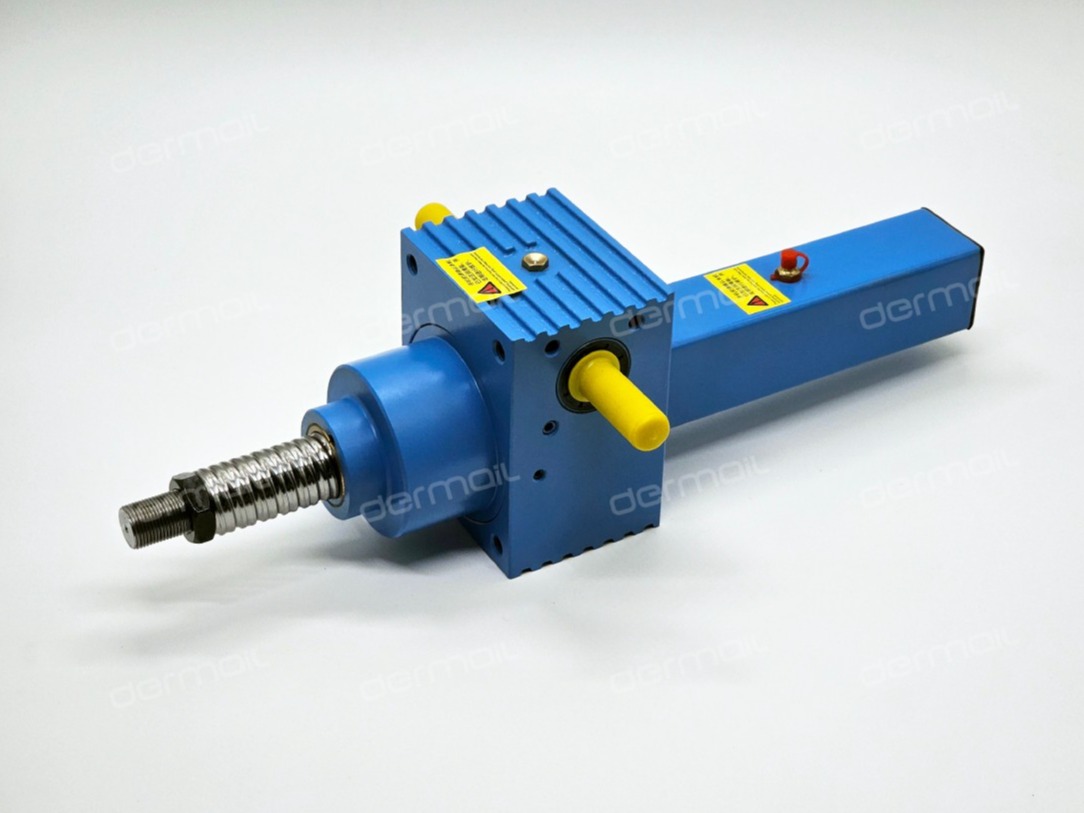
1. Material Selection and Heat Treatment
The durability of ball screw jacks hinges on the mechanical properties of their core components—typically high-grade alloy steels (e.g., 40CrMoV, GCr15).
- Hardness and Wear Resistance:
The screw shaft and nut must undergo precise heat treatment to achieve a surface hardness of HRC 58–62, ensuring resistance to pitting, spalling, and abrasive wear. Insufficient hardness accelerates degradation under heavy loads or high-speed operation. - Fatigue Strength:
Materials with high fatigue limits (e.g., through carburizing or nitriding) reduce the risk of crack propagation under cyclic loading, a common failure mode in industrial automation applications.
2. Lubrication Regime and Contamination Control
Lubrication is the lifeblood of ball screw jacks, directly impacting friction, heat generation, and wear rates.
- Lubricant Type:
- Grease: Preferred for low-to-medium speed applications (≤1,000 RPM), offering long-term retention and corrosion resistance.
- Oil: Used in high-speed or high-temperature environments, providing better cooling but requiring frequent replenishment.
- Contamination Risks:
Particulate ingress (dust, metal chips) or chemical exposure (coolants, humidity) degrades lubricant effectiveness. Sealed designs (e.g., labyrinth seals, bellows) and IP65-rated housings mitigate contamination, extending service life by up to 300%.
3. Load Conditions and Duty Cycle
The lifespan of a ball screw jack is inversely proportional to the stress it endures.
- Dynamic Load Capacity (Cₐ):
Exceeding the manufacturer’s rated Cₐ (calculated based on ISO 3408-3) leads to premature ball bearing fatigue. For example, a jack rated for 10 kN dynamic load may fail within 5,000 cycles if subjected to 15 kN. - Duty Cycle:
Continuous operation (24/7) generates higher heat and wear compared to intermittent use. Thermal management systems (e.g., forced cooling) are critical for high-duty applications like CNC machining centers.
4. Thermal Management and Environmental Factors
Heat is a silent killer of ball screw jacks, causing thermal expansion, lubricant breakdown, and material softening.
- Operating Temperature:
Ideal temperatures range from -20°C to +80°C. Beyond this, thermal expansion coefficients (α ≈ 12×10⁻⁶/°C for steel) induce axial play, reducing positioning accuracy. - Ambient Conditions:
Corrosive environments (e.g., marine, chemical plants) necessitate stainless steel components or protective coatings (e.g., nickel plating). In high-vibration settings, anti-backlash nuts and preloaded ball sets minimize impact damage.
5. Installation and Maintenance Practices
Even the highest-quality ball screw jacks can fail prematurely if improperly installed or neglected.
- Alignment and Parallelism:
Misalignment >0.05 mm/m induces side loads, accelerating wear on ball bearings and raceways. Laser alignment tools are recommended during installation. - Preventive Maintenance:
Regular inspections (every 500–1,000 hours) for lubricant degradation, seal integrity, and backlash changes can double lifespan. Predictive maintenance (e.g., vibration analysis) further optimizes uptime.
Case Study: Automotive Assembly Line
A ball screw jack used in robotic welding cells typically lasts 8–10 years under controlled conditions (8-hour shifts, 50% duty cycle, temperature-regulated environment). In contrast, the same unit operating 24/7 in a foundry with high particulate levels may fail within 2–3 years due to accelerated wear and thermal stress.
Conclusion
The lifespan of dermail transmission ball screw jacks is determined by a synergy of material science, lubrication engineering, load management, thermal control, and operational discipline. By addressing these factors holistically—through robust design, proactive maintenance, and environmental safeguards—manufacturers can achieve 50,000–100,000 hours of reliable service, even in demanding industrial settings.
Keywords: Ball screw jack, lifespan, material fatigue, lubrication, dynamic load, thermal expansion, preventive maintenance.








Tel:+86-317-7369999
E-mail: demai@demai.org
Mobile:+86-18653450543 (Wechat)
Address:No. 6, Haihe Road, economic development zone, Wuqiao County, Cangzhou City, Hebei Province

点击右上角
分享给朋友吧
Copyright ©2023 All Rights Reserved Hebei Demai Transmission Machinery Co.,Ltd.
Copyright ©2025 All Rights Reserved Hebei Demai Transmission Machinery Co.,Ltd.
